
My Two Best Planes
It's really a superb thing, simplicity. It's not the same as nor is it anything like minimalism. Valuing simplicity is to dwell and thrive in the humility of being a maker. Politics and social standing dissolve at the workbench and I do it using ordinary tools I bought in poverty and made do until my skills were so established using them I could never let them go both because I valued them in what they gave to my worklife and then too because, well, nothing bettered them.
The two planes below are the most ordinary of all metal-cast planes. Not only that though. They are the two very best planes I have and have ever owned––no others come even close. I use them every day for decades. I've replaced the cutting irons many times but never as a retrofit for thicker or harder versions. That's always seemed to me at least to be such a silly thing to do. I think sometimes, often, people just want to spend money. Totally unneccesary, really. No, I simply wore the blades down many times over the decades, down to the nub even though I rarely if ever ground them on any mechanical grinder. I think I may have gone through ten cutting irons between my Stanleys. I'm fastidious about sharpening. That's not the same as obsessive compulsive, you know. It's just the diligence of living and working as a craftsperson fully engaged in the work and striving always for excellence.
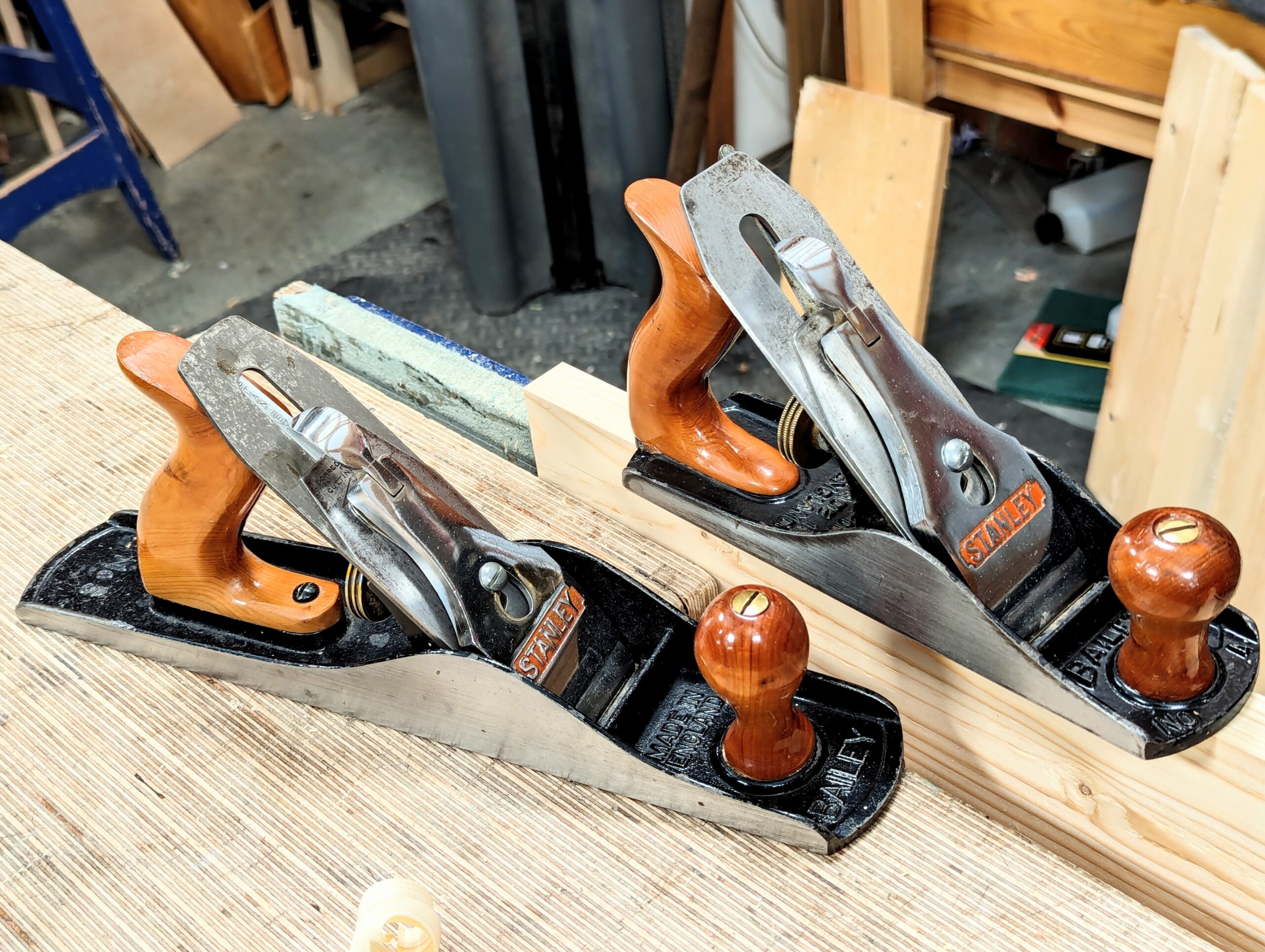
I know now that there is no plane to match these two as far as superb functionality goes. Its inventor and developer usually gets little or no mention anywhere from those modern-day knock-off makers which I feel is quite disingenuous. As this is the case, I generally make a point to do this in memory of and respect for his brilliance. Leonard Bailey is the man who develeoped and perfected all the Bailey-pattern bench planes along with the Bedrock versions to. Hi is the man.
For certain it is doubtful that many makers today could have invented the plane that we have. Of course, therre were many other planes developed and invented ranging fron Scottish panel planes to Spiers, Norris and a dozen or two others but the genious of Leonard Bailey and his series of bench planes and others really knows no equal, even after 125 years further on.
I do think too that it is worth mentioning something here that attests further to the lasting qualities of the inventions I speak of. Few users today have or could ever match the number of hours and days of use these two planes have had through the last six decades of my everyday using them. Week in, week out, year in, year out since 1963 I have used a Stanley #4 and #5 bench plane. Imagine using a plane hour-on-hour and daily six days a week through sixty years. Believe it or not, in my worklife, that means I have picked them both up at least 144,000 times each and it's likely to be many more times that. What's more, these two planes still have zero flaws as far as functionality goes too. Nothing is worn away and whatever I have gained from my daily escapades using them just seems to get better. Shoes, cars, electric drills and drill-drivers, power routers and skillsaws ultimatley wear out as do all things, but I wonder how many can pick up and use a bench plane 480,000 times (and that is very conservative estimate on my part) because I pick either one or both up 20 times an hour most days.
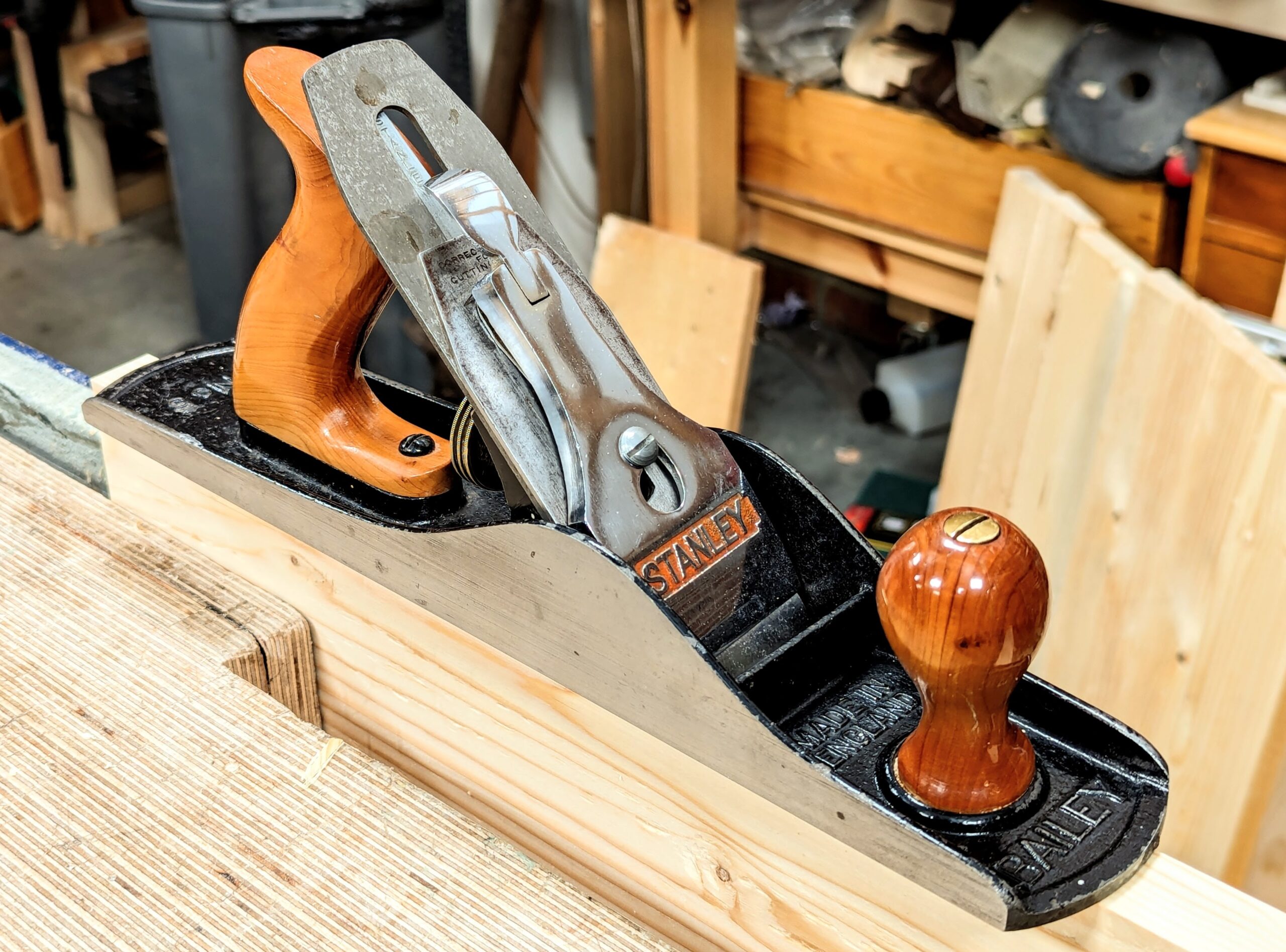
I changed the handles for no good reason but to teach you and others how to make both handles without resorting to using or needing a lathe. I am glad I did it. These handles are made from yew and the wood came from a friend in North Wales where I lived and worked at that time. The hour-and-a-half video has had half a million views and the video is an hour and a quarter long. Not having a lathe simplified everything but it also worked instructionally to show not only how to do it but to do it well.
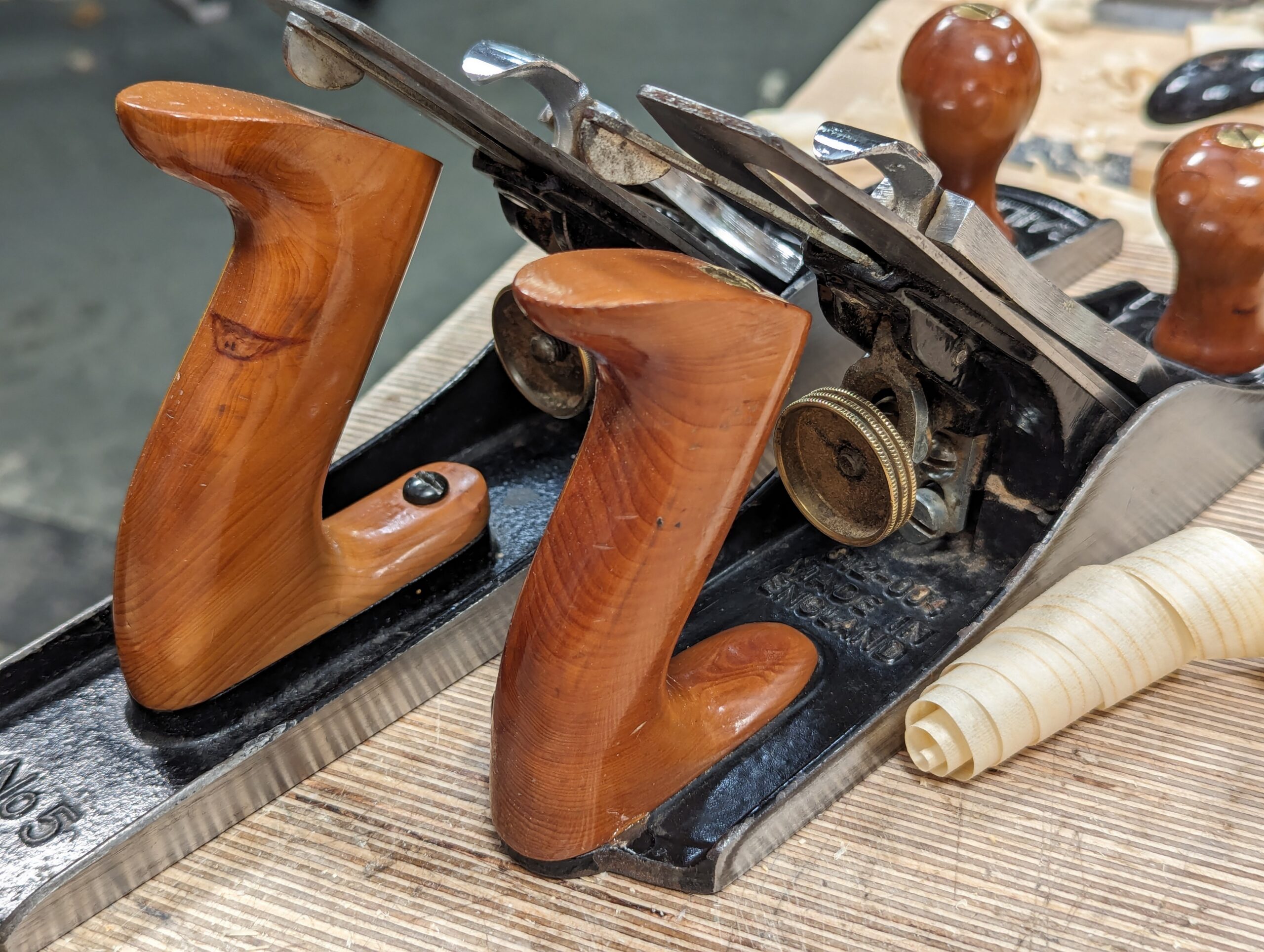
The handles I made are custom fitted to my own hands and yet they are slightly different to one another. Yew is a good wood for this work. I am glad I picked it. Simplicity creeps into my workplace through tasks that have no monetary value or gain. These are not sold things. I have many such tools that have become 'owned' through use and the years of using. The wonderful dimension is the primary motive of making your things. You know, the unsold, never-to-be-sold things you made for your use. It's so different than making to sell. There was a time when men making had no choice but to sell everything they made, especially working men and women. Surviving depended on selling, growing and making just about everything. But every so often you come across creatives who took themselves off the conveyor belt and grew, cooked and made truly and not as some kind of cultic following. I have seen cultic works in my life. Zones of controlled involvement where acceptance depended on doing everything the same as others. You buy and wear certain clothes, buy and use tools and equipment to show others that you follow and belong in the same zones. It has the apperance of belonging but the truth of it is usually quite artifical. In my world and seeing those who have followed the same or similar path I have seen remarkable people make remarkable changes to recover what might have otherwise been lost to them and the next generations. You have validated my work, you makers, striving for excellence whenever you can and wherever you can. You amaze me!

You can learn to rehandle your working planes here and here. The experience of doing this changes both you and the planes. The deepness of the things I speak of cannot be had using anything but hand tools. Tasks of this nature, doing out-of-the-ordinary things, have translatory properties and influences on your mind as well as your body. These are self-challenging and cannot be had any other way.
So there you have it. You can still buy a well worn but cared for Stanley (or Record) for around £20 and then less if you are prepared to wait, shop around and such. Currently there are a dozen listed that will sell for less than £20-25 on eBay UK right now and that is not much for a lifetime plane. My week's wage when I bought mine back in 1965 was £3.50, the cost of the plane. Simplicy and fixing up planes is the best way to master the skills needed along with gaining the working knowledge and physics of the plane.
Comments ()