
Tolerances In Wood
I'm working, planing and thinking or is it the other way around? Attention in two tasks is always an alternating process and never truly bipartisan in that usually the ability to concentrate on two or more high-demand tasks soon obviates deferment one to other in measured exchanges according to priority. I switch between three planes and my thoughts are on the beech wood I am planing. I noticed that where the wood had been exposed to the atmosphere surrounding it for the last few years the surface was harder to plane because the wood had greater resilience. Ripping the 5 1/2" wide 1 1/4" thick section into two 9/16" thick pieces and planing these inner faces I found less resistance as I worked. This 'inner' work is telling. And it's because of this and these types of encounters that I say hand-tool woodworking is nothing like the same engagement with the material as machining wood.
So why does this matter? Different strokes for different folks, eh?
Well, I learned something in making this project that I would and could never have learned by passing it into or over the revolving cutterhead of a power planer. You see, it's a much deeper level of knowledge and by this, I understand the 'this one' wood might be used over another or that this work will take longer than using some other wood.
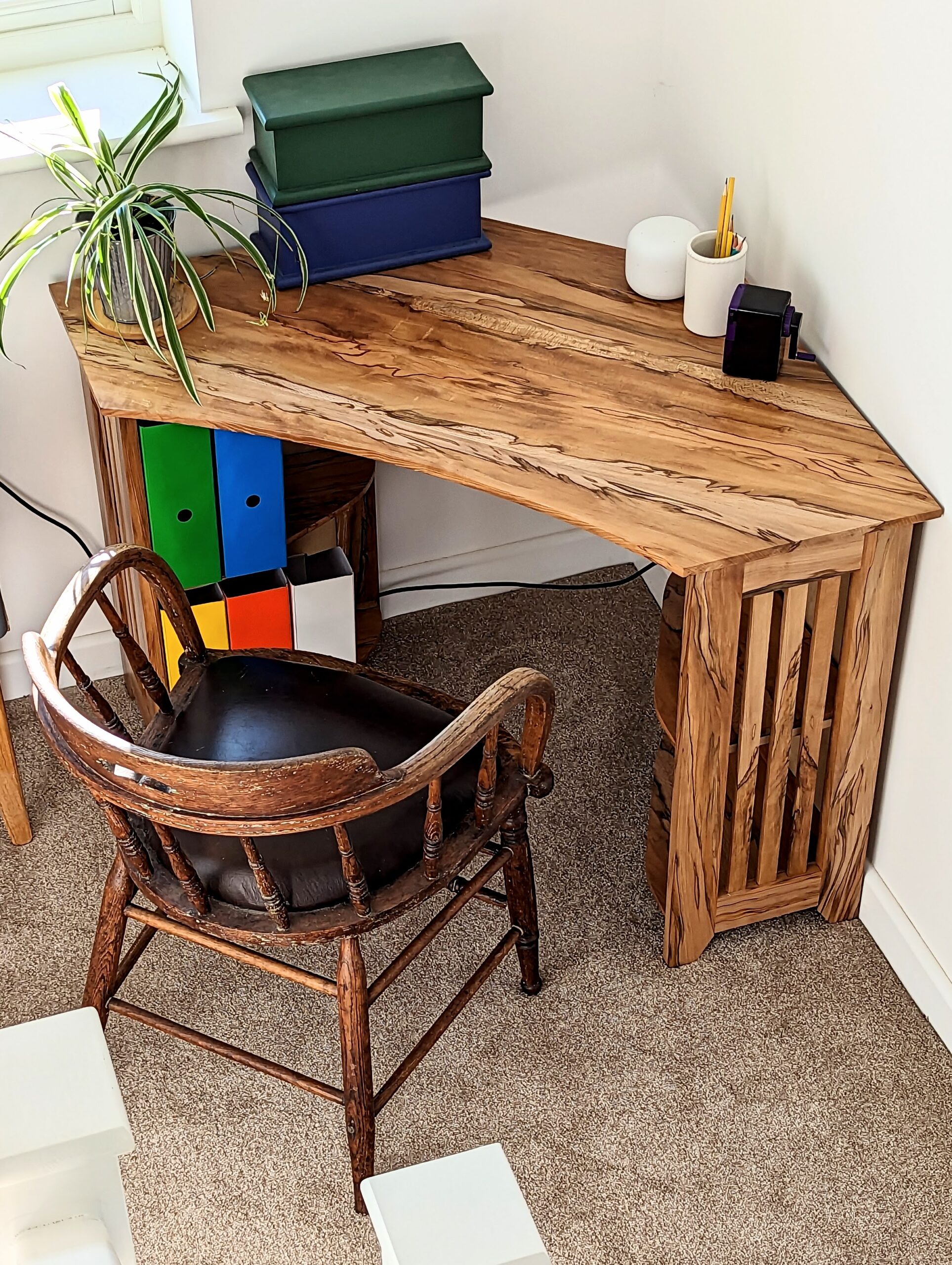
A questioner asked me why I switch between using a knife for some delineations and then a pencil for others. Well, it's usually, mostly, because of this insider knowledge I've gradually and slowly accumulated over my six decades in the saddle and never by something read because the something read is unwritten and then too often unspoken too. That's why I am writing it here and am willing to explain it more fully whenever we video my projects. This is what is different about my platforms and channels. I have a lot to compare things with over those sixty years of daily making. The spalted beech is radically different in the working of it to the newly cut five-year-old stuff kiln dried and prestressed by the process. The air-dried spalted material is much more stable as is all wood that is air-dried but no one will tell you that anymore. Especially those who sell wood bought and sold commercially.
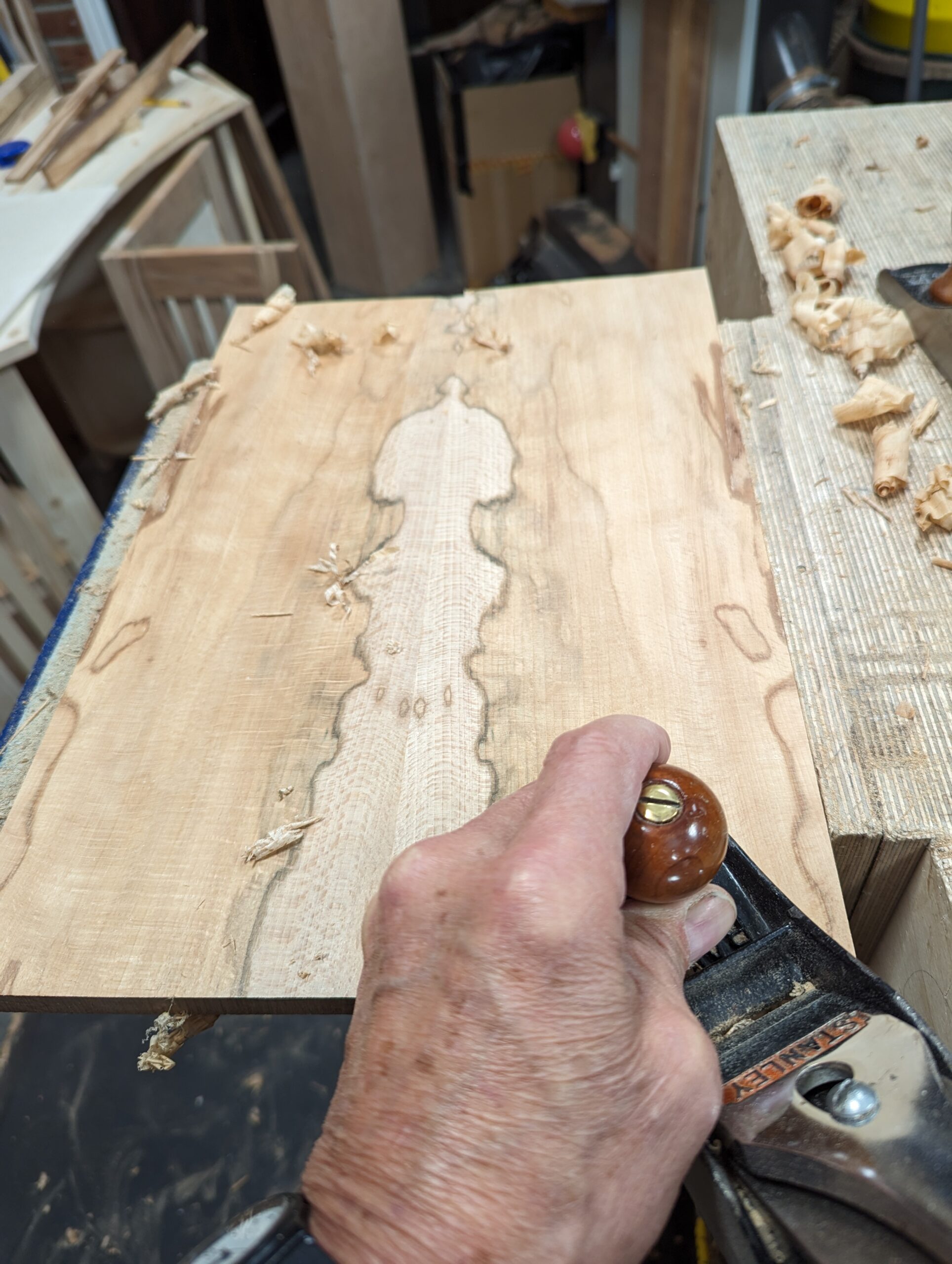
Knowing how density in wood affects the tools and the joinery can only be had in the doing of woodworking and by that, I mean only (with emphasis) by using hand tool methods. By this, alone wood always gives feedback in different measure and in different ways according to our sensitivity, constantly. As soon as the plane surfaces the board we have a mass of information to work with about that very specific wood, that particular area on the side of the workpiece and in that section that will be different than the wood a foot away. The more handwork you give to your woodworking the more conversant you become and the greater your knowledge the greater your success will be. It's this intimacy that sets us apart as makers. Whereas machinists often, often, and for no good reason, get offended by my advocacy for handwork, I hold to my belief that this level of working wood seems to draw a different and more full picture and understanding of our work, our wood that just deepens our knowledge. Ideally, everyone should try both ways of working wood, the hand methods and the machine methods. The problem is that using any of the woodworking machines takes only a few minutes to expedite the cuts but using hand tools with a good level of proficiency might take many many hours, days, weeks and more to gain the kind of working knowledge I speak of. Our kind of learning through the senses is a never-ending experience that gives us the depth of knowledge as well as a sense of anticipation telling us that there really is too much to learn beyond the mere machining wood but it cannot happen any other way.
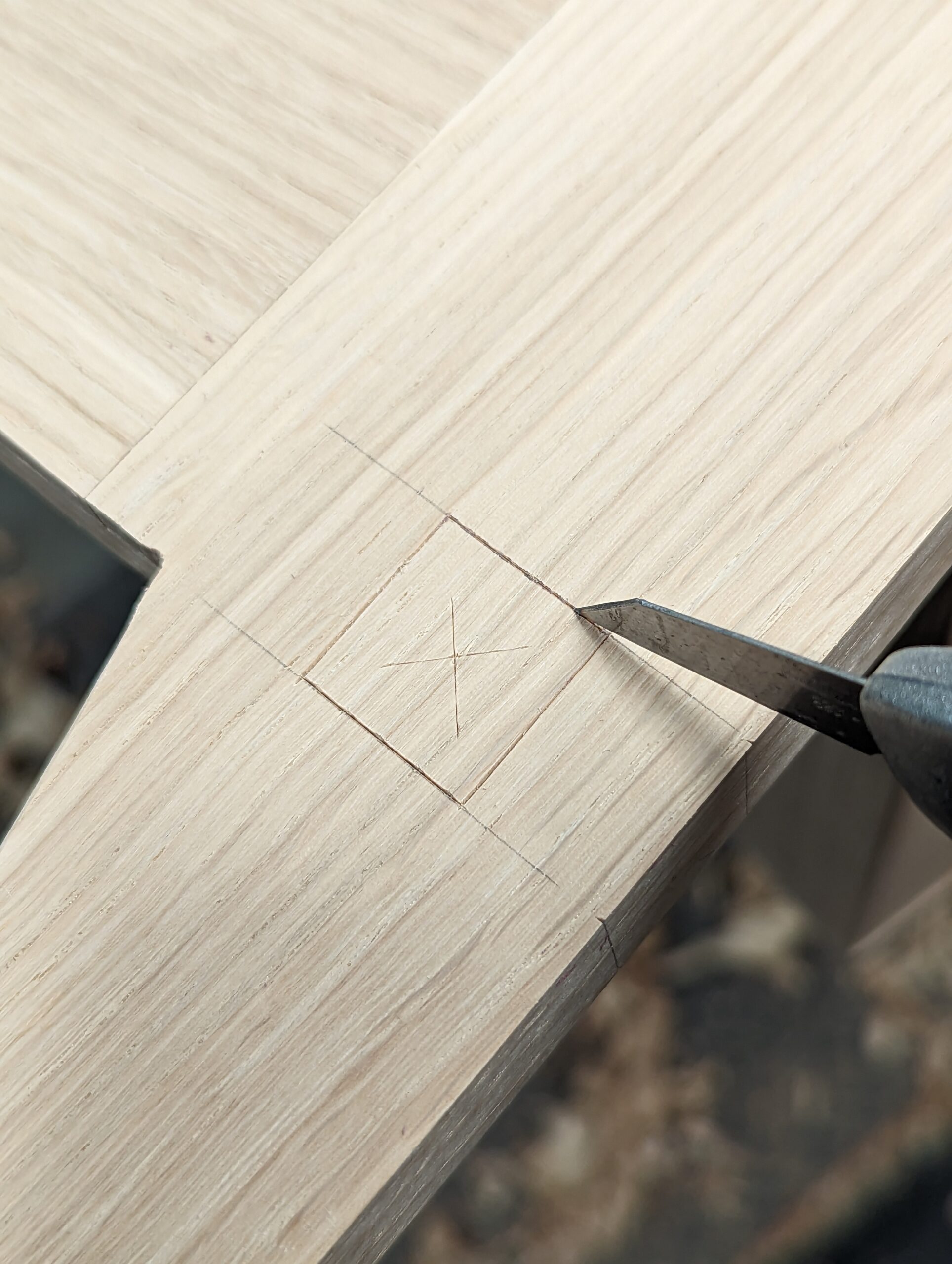
The knife versus the pencil can really only be understood by direct comparison and in no way just once but by many repeats in many wood types and as often as you have time for. Every stick and stem of wood reacts differently to hand tools and you get to a point where you can indeed look at a piece of wood and pretty well know what reaction you will get. Of course, too, every stroke you make with the saw, plane or knife and chisel is dulling the cutting edge you are working with. This makes every cut different at the most micro of indiscernible levels but taking the difference from the beginning first cut and comparing it to a hundred cuts later also gives better understanding of how things shift.
Working in the beech this past few weeks, planing the surfaces, inner wood and outer wood, sawing with and across the grain with various saws ranging from modelling saw to rip-cut handsaw and all in between gave me a wide range of different feelings and these were not at all experimental but real work. The number of knifewalls came to over a hundred and then the chop cuts from the chisels used came in the hundreds too. I gained tremendous insight to beech but that was because I was interested but not just interested. No, more than that. I was being governed by my obvious feelings, the sharpness of my tools, the distance in cuts from my delineation lines in pencil and by knife.
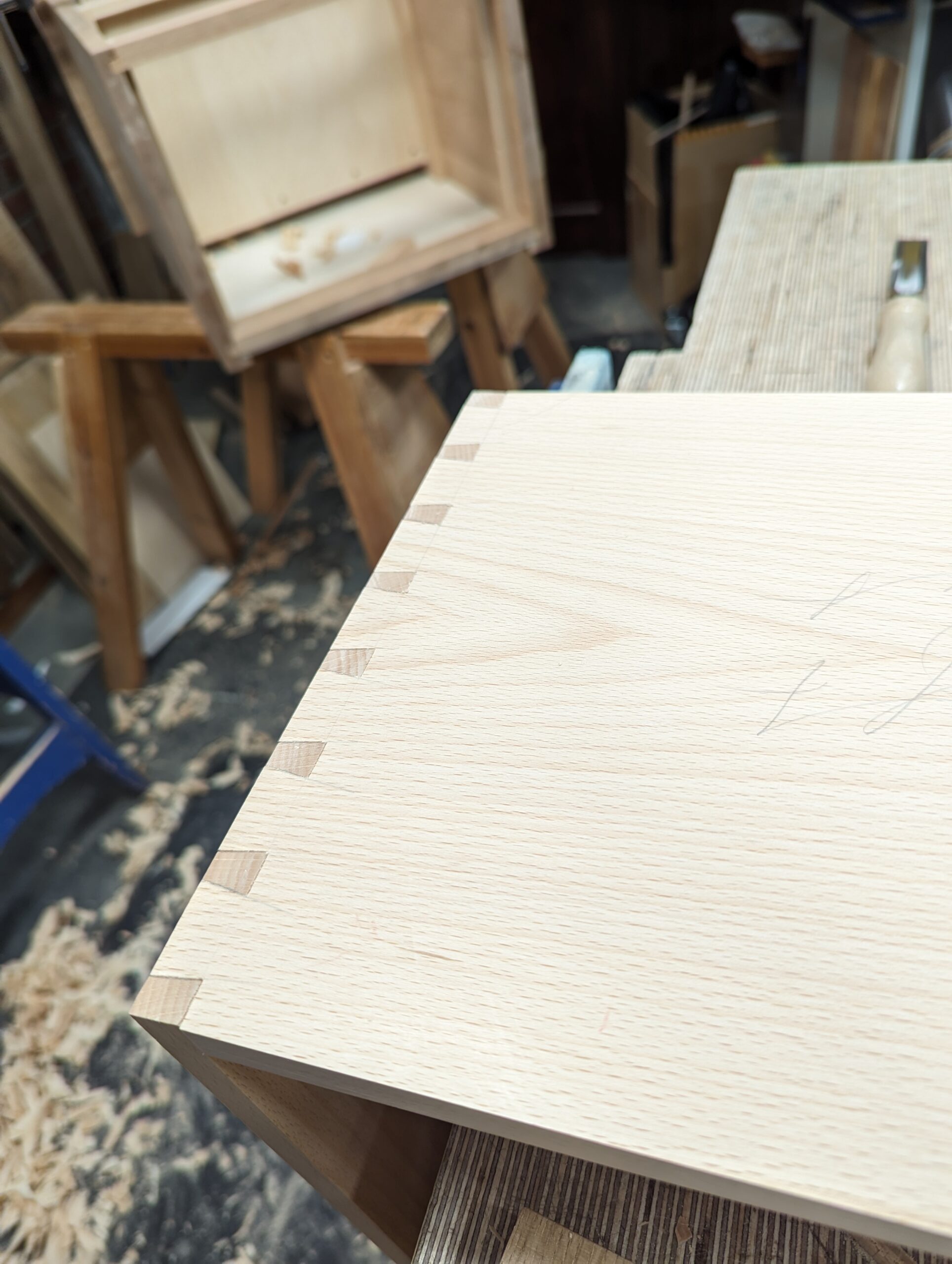
Using the pencil proved more accurate and tolerant than the knife and it is this I want to talk about. Knifewalls around dovetails is establishing the highest extreme of intolerance. Cut to the knifewalls and the dovetail will not go together without serious hammer blows and the wood is more likely to give somewhere. Some will disagree with this but no matter. Experience tells me that knifewall tracing to accommodate a counterpart results in ultra-high levels of friction with glue added at the level ensuring that the joint will never go together as is. What we really need is not a knife-splitting hair but a judgement following clear pencil lines. If I ever had to choose between only using a pencil line or a knife line I would most likely choose the HB (#2 USA) pencil. I sharpen this repeatedly as needed until the layout is done. The pencil is more versatile, often clearer and super-sharpenable. So what more is there about the pencil?
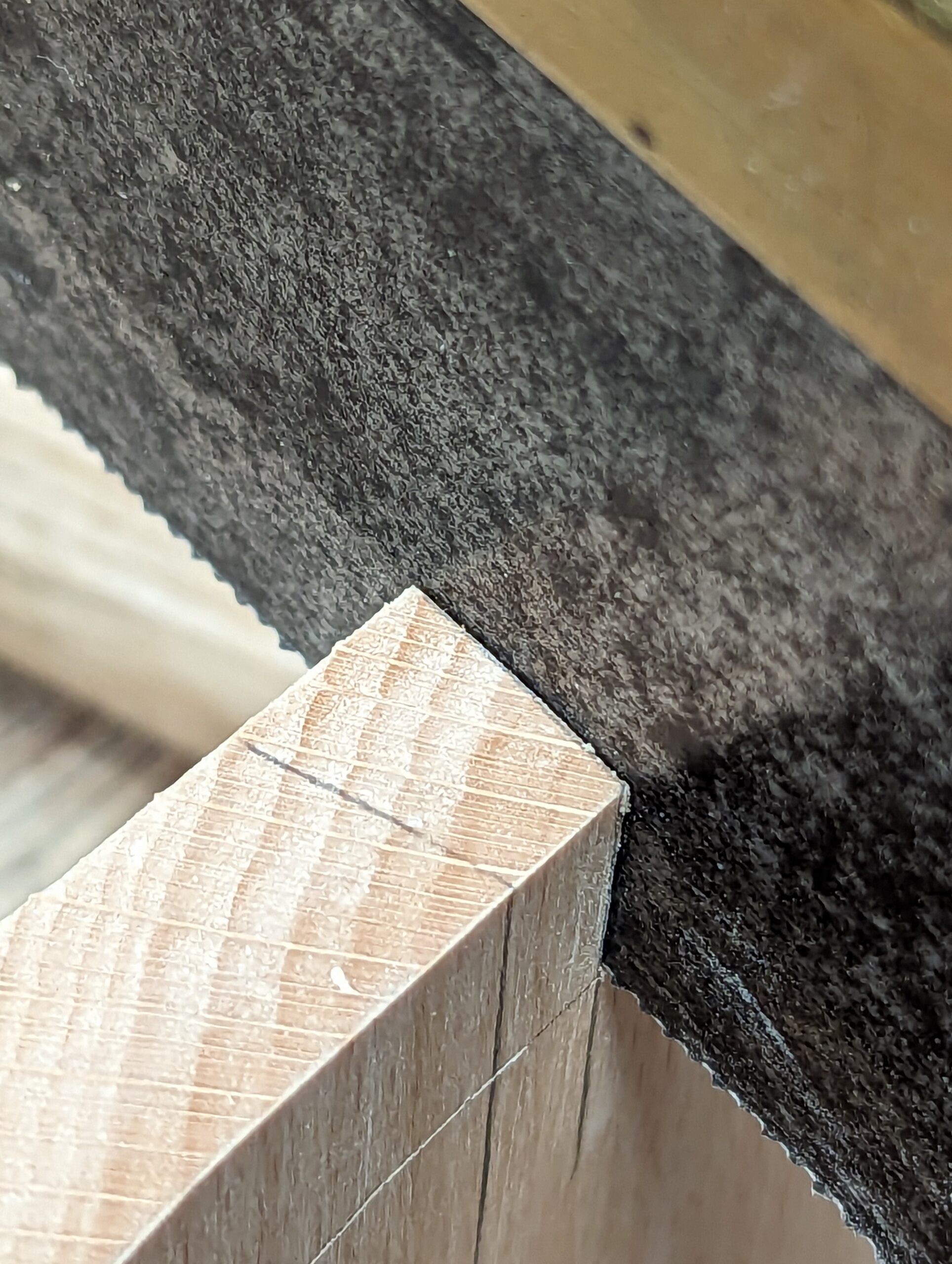
Some woods are spongily compressible. I can name a dozen of commonly used ones right off. For some wood types, it's to do with fibre softness and the best way to consider this would be to start thinking differently in the same way we might consider other materials if indeed you understand other materials. Stack up a ream of photocopy paper to 5cm deep and clamp the stack in the vise and it will perhaps then measure only 1mm less at 49mm. Do the same with corrugated cardboard and it will go down to 6mm. Both are paper products made from tree pulp fibres. materials of different types have some measure of compressibility. Did you know that glass is considered a liquid but that's not the case at all. Glass is an amorphous solid existing somewhere between between the two states of liquid and sold. Consider it more a highly resilient elastic solid, meaning it is completely stable. I consider wood to be more like straws with capillaries and then strands of wool both of which make it compressible in different measure. No two woods are the same but can often be comparable even though the variance is massive even within each species. The growth of wood varies according to the weather conditions and the environments in which that wood grows. This is as unpredictable as the weather itself is today. The output of growth creates a natural unpredictability. This in turn presents those who work their wood with hand tools the one thing that is absolutely predictable. Wood is mostly unpredictable. Once you accept this, the more successful you will become.
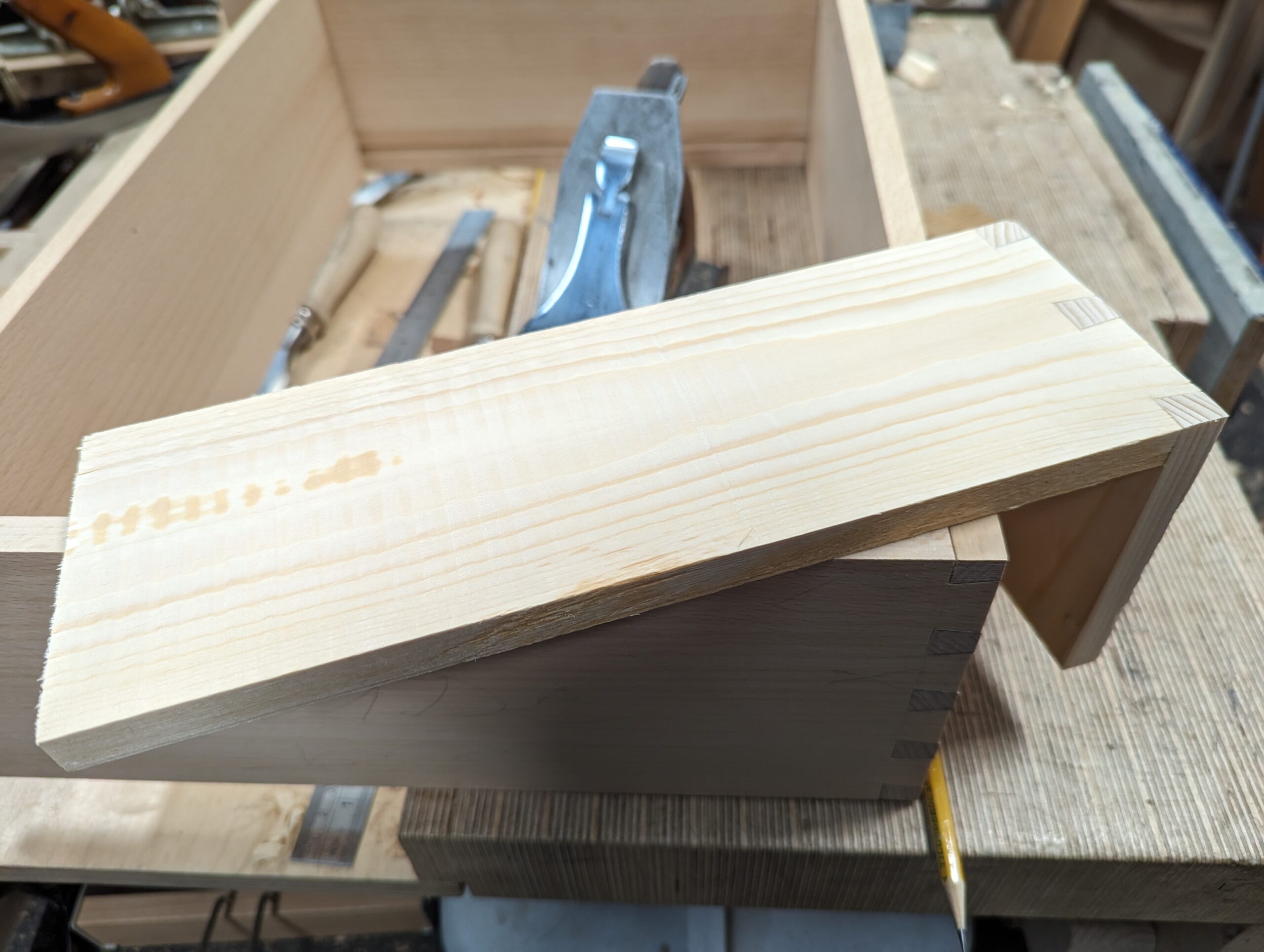
Fitting dovetails into their respective recesses causes an interlocking of surface fibres if the meeting faces come from the saw and not the chisel. I believe that these fibrous surfaces give the best adhesion inside the joints we create. When the wood is pare-cut with a chisel, as some advocate, we lose this 'toothing'. Some woods, beech as a good instance, have less absorbency and benefit from the toothing a sawn surface provides. These facts, and they are facts, are not written but they should be passed on hence my labouring these points here and now so that perhaps the 50,000 woodworkers who will read this will keep it, use it and also explain it to others and pass it on in the years to come. DovetailS in a slightly tighter counterpart enter a gradual compression in themselves and then also the pins on either side which in turn creates its inevitable domino effect into the adjacent dovetails and pins. One oversight one in the middle or elsewhere will increase pressure on the others. This knock-on effect can advantage us and disadvantage us. We need to know what these tensions and pressures are in our working no matter how long in the tooth we are and no matter how long we know this wood type or that one.
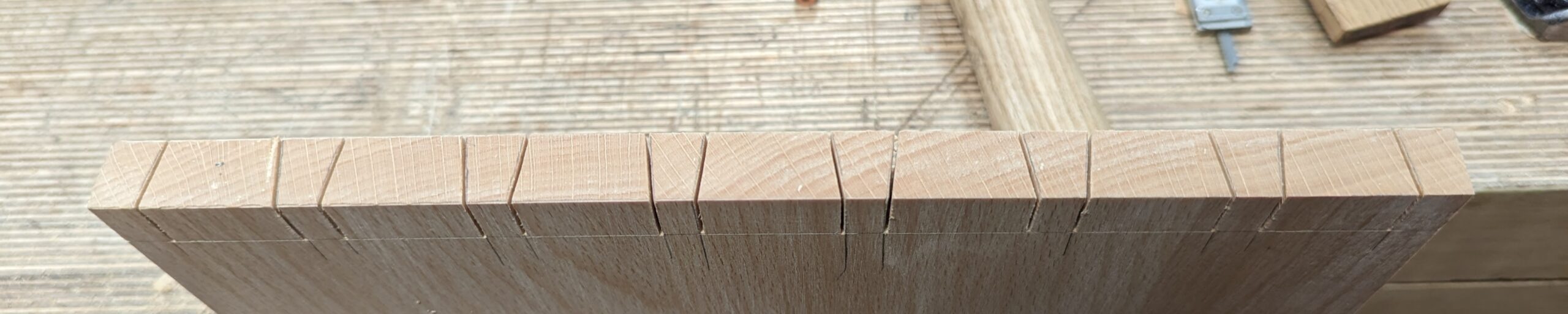
Understanding the toothing of meeting surfaces to joints, of course, means that we need to saw accurately in our cutting tight up to lines and keeping to any angles used in the joinery so that those surfaces do indeed compress evenly and the fibrous surfaces mate well. This strikes apprehension in this new to working wood because they find this requirement more challenging but are quite confident about creeping up on the final levels. Indeed, some advocates eschew off-the-saw advocacy but not for any of the valid reason I give here because, well, they just never thought of it. Of course, 99% of the woods we access will saw and give excellent toothing so why not just go ahead and use whichever we prefer between the pencil and the knife? As I said, the knife is intolerant. We tend to cut right up to this knifewall but then find the recesses are actually too tight for some really dense-grained hardwoods like ebony, rosewood and several others. These woods are not comprising, not absorbing, inflexible and stubbornly resilient. These are the hard woods to work with to get gap-free joinery with. The knife tracing around the dovetail to establish pin positioning results in absolute cut lines. The problem most often is the tightness of the joinery and especially is this so when you have many dovetails to form a corner. The pencil lines seem more tolerant, more absorbing, more flexible and so on. That does not mean we should never use one and not the other but that we make our decisions based on out intimate knowledge.
Comments ()