
Gems That Go Unnoticed
There are not many craft and woodworking shows I visit that surprise me with gifted makers. By that, I don't mean gimmicky presenters with a gift for quickspeak but more the ordinary artisans who actually capably make with skilled hands and deft fingers in different crafts. At the Henley Country Craft Show at Stonor last weekend I found only a few people crafting that produced impressive work. Signs dotted around the tent walls said "Meet the Makers" but in some cases, jewellery for instance, and some leatherworkers, the signs might better have read Meet the Assembly Workers or more still Meet the Importers. But there were potters galore, and a basket weaver making baskets of different types from willow he grew himself for harvesting and making into dyed baskets. Spoons are a repeat performance for spoon carving with axes and profiled knives from soft and green hardwoods and sometimes you will see someone really gifted but not so much on this visit. No, there were many kit sellers selling gear like marbling kits, wood block stamps laser cut for you to stamp your own fabrics with their designs and such. These were machine made cookie cutter type stuff and not much to do with hand making and craft. Actually, most of that side of things replaced the need of craft skills more than anything.
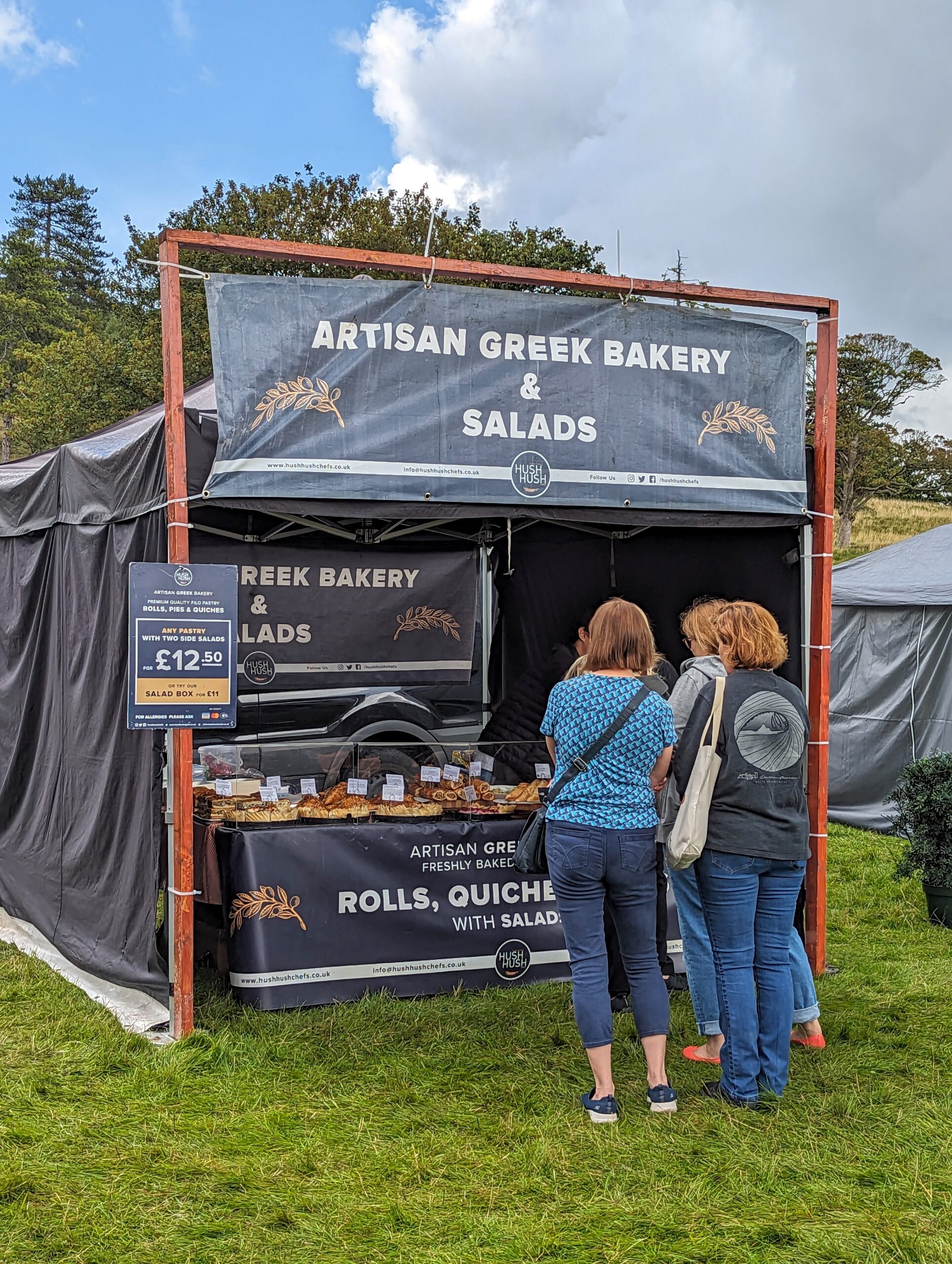
Going this time made me aware of some of the dynamics making shows happen. Half of the booth or stall holders were selling food, which was good, needed and of course, expected. Some of the foods they made and sold themselves and some looked bought in. It was mostly about there and then cooking on a hot plate. The delicious gourmet food booth sold ordinary burgers which stretched the description of the food title to be much longer than the booth sign and then some. I bought some delicious homemade Greek food that came from a small bakery in London owned by two Greeks. The price was good and well worth my lunch allowance––I was working. Looking for artisan artists these days is mostly the needle-in-the-haystack search. I found three that met my criteria in the 100 or so exhibitors. But there was an entertainment value in the others and this leads me to say what the dynamics are that make a craft show work.
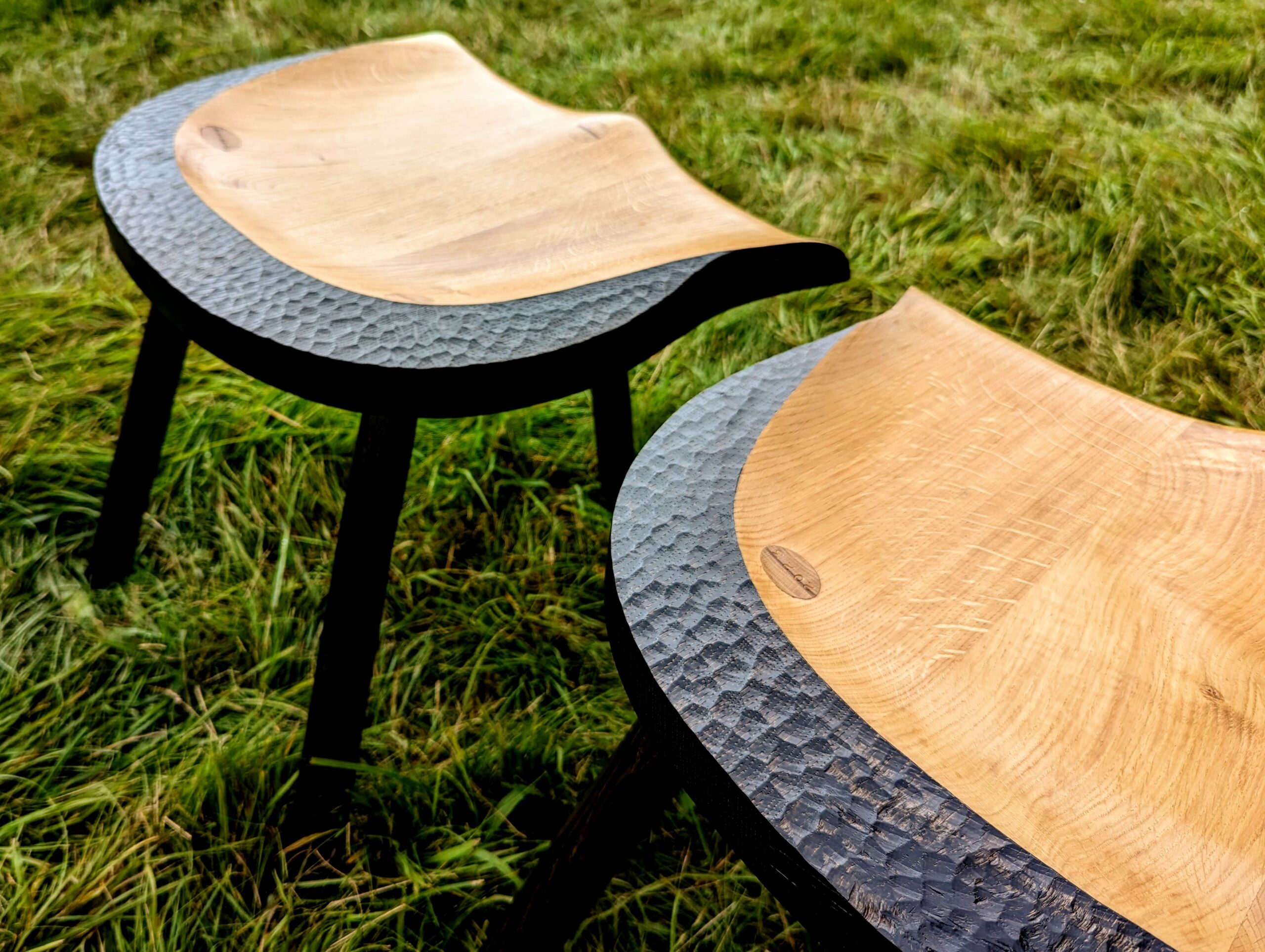
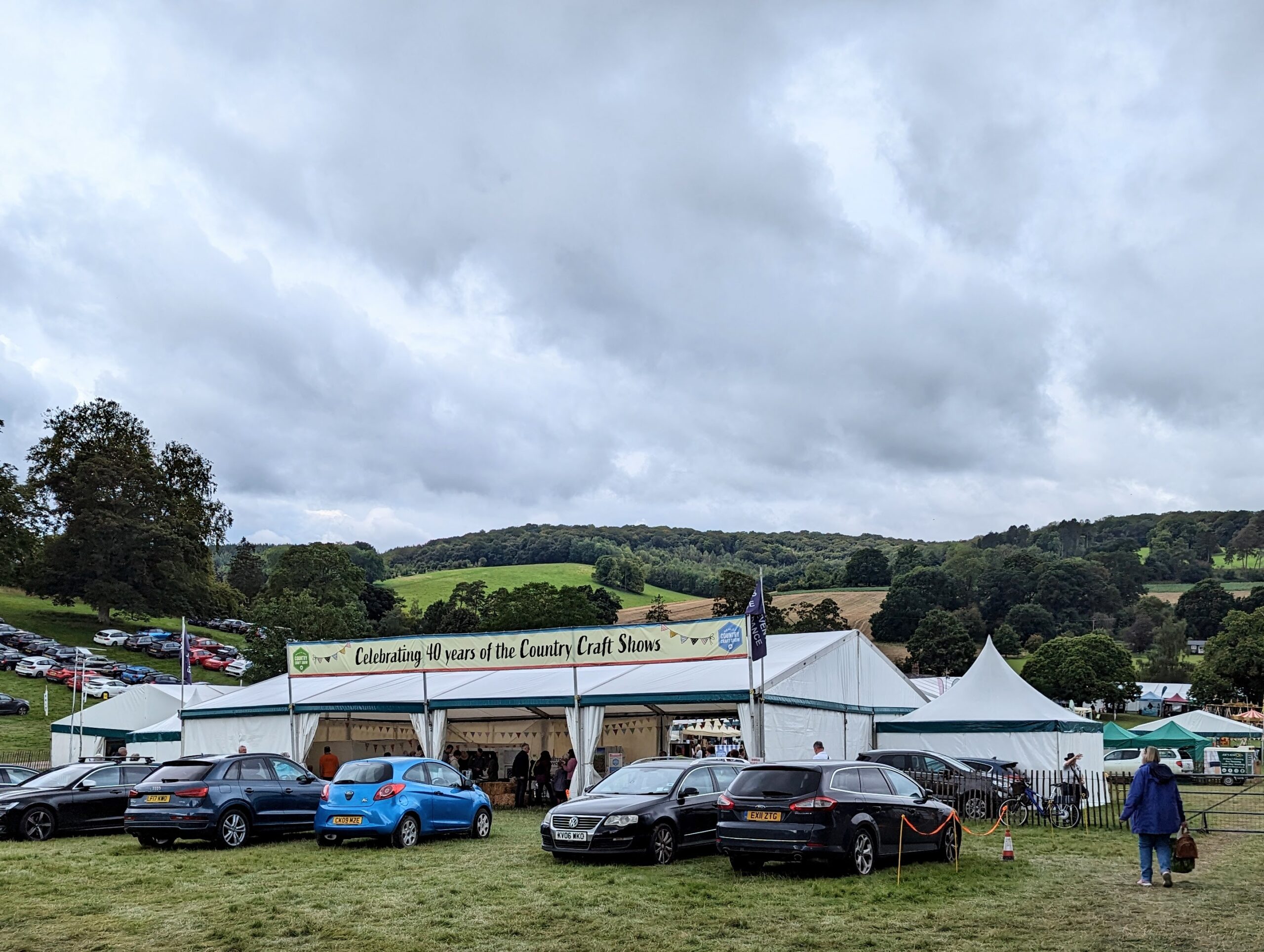
The venues for craft shows of any size are often country homes; former mansions owned by the rich and privileged. Fields holding sheep the week before suddenly have parking lanes and tent pitches hosting overnighters and daytime visitors to the show. This July and August have been clouded by more enjoyable cool weather with a goodly amount of rain and zero hosepipe bans. Not like other parts of the globe with horrendous weather conditions, fires and more. Having lived in Texas for two decades I am now more leery of traveling anywhere where heat and sun are the draw. In this case, the Mansion home of the Lord and Lady of the house is a pleasant place to be. Nestled in the traditionally quiet rolling hills, the tents enjoy levels of pastureland that allow for the booths to be neatly situated for a pleasant two-hour walking tour. Surprisingly, I did not really find any truly wowing factors beyond Neil Taylor making his chairs and stools. More on that in a minute.
Here is what I want to say: Craft shows offer different dynamics surrounding mostly entertainment. Booth holders hope to make sales but their goods offer interesting things to look at as well as gifts for different seasons. Though the shows have become entertain-me venues they are also meeting centres for young families to get together and share some open space. With several sources of income possible, there is always a degree of commerce taking place somewhere, mostly surrounding children's play areas and always around food. Let's look at the main venue provider first. Whether they own or rent the space from an owner, there are several sources of income available to them. One, they rent the booth spaces from the vendors selling their goods. Let's say the booths sell for £100 and there are, as in this case, 200 booths. That brings in £20,000. Then there are campsite fees for tents, touring vans and such. It's cheaper than a hotel or Airbnb, usually. Then there are the entry fees to the show. This can go to the venue owner or the renter of the venue space as in the show promoter renting the field, etc. At £10 per person, the entry fee is reasonable and the facilities are good too. Who knows how many visitors there will be over the four-day event? Let's guess at 20,000 and it's likely to be more so there's another £200,000. What the overheads to be deducted from the £220,000 are remains unknown but tents and decent portable bathrooms, power rigs for electricity, etc don't come cheap. Of course, there is a year-round overhead for the property owners or managers. These weekends might bring in a good pot of gold but if the weather fails them they may well take a loss too. It's swings and roundabouts and I would not wnt the headache of it. I was involved in a craft venture and venue for two decades in Central Texas once a year and had many a sleepless night for weeks beforehand.
The entertainers are mainly the booths and booth holders hoping to make a sale somewhere in the day and of course, these guys pay for their venue so they are generally low demand, low cost, low maintenance and self-policing so not too much of an overhead for the venue holder.
The venues within are places of low-cost entertainment for families on a holiday weekend. This weekend is one of our usual eight UK Bank Holidays. I'm still not sure why they are called that and not just like, well, break days or holidays. We also have one or two other days such as Royal celebrations and so on. But anyway, I was entertained watching caterers cater food and drink to families and drinkers who took ten seats with four occupied and the remainder reserved for children who disappeared to the children's entertainment areas whilst lunch eaters stood on the periphery of the tent dodging the rain dripping off the marquees onto their tofu burgers and salad and trying to slice impossibly with a wooden knife with saw teeth 3mm wide.
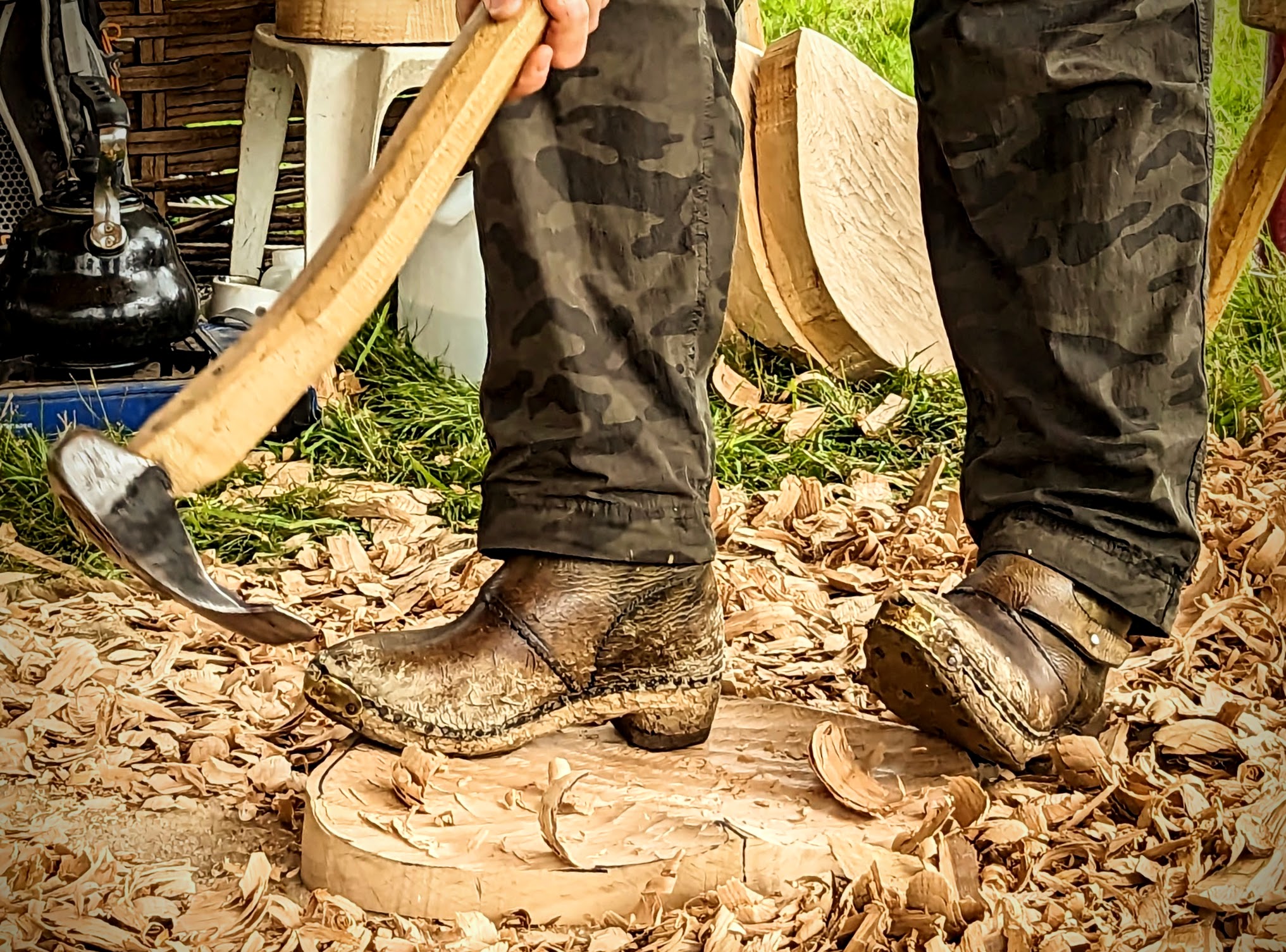
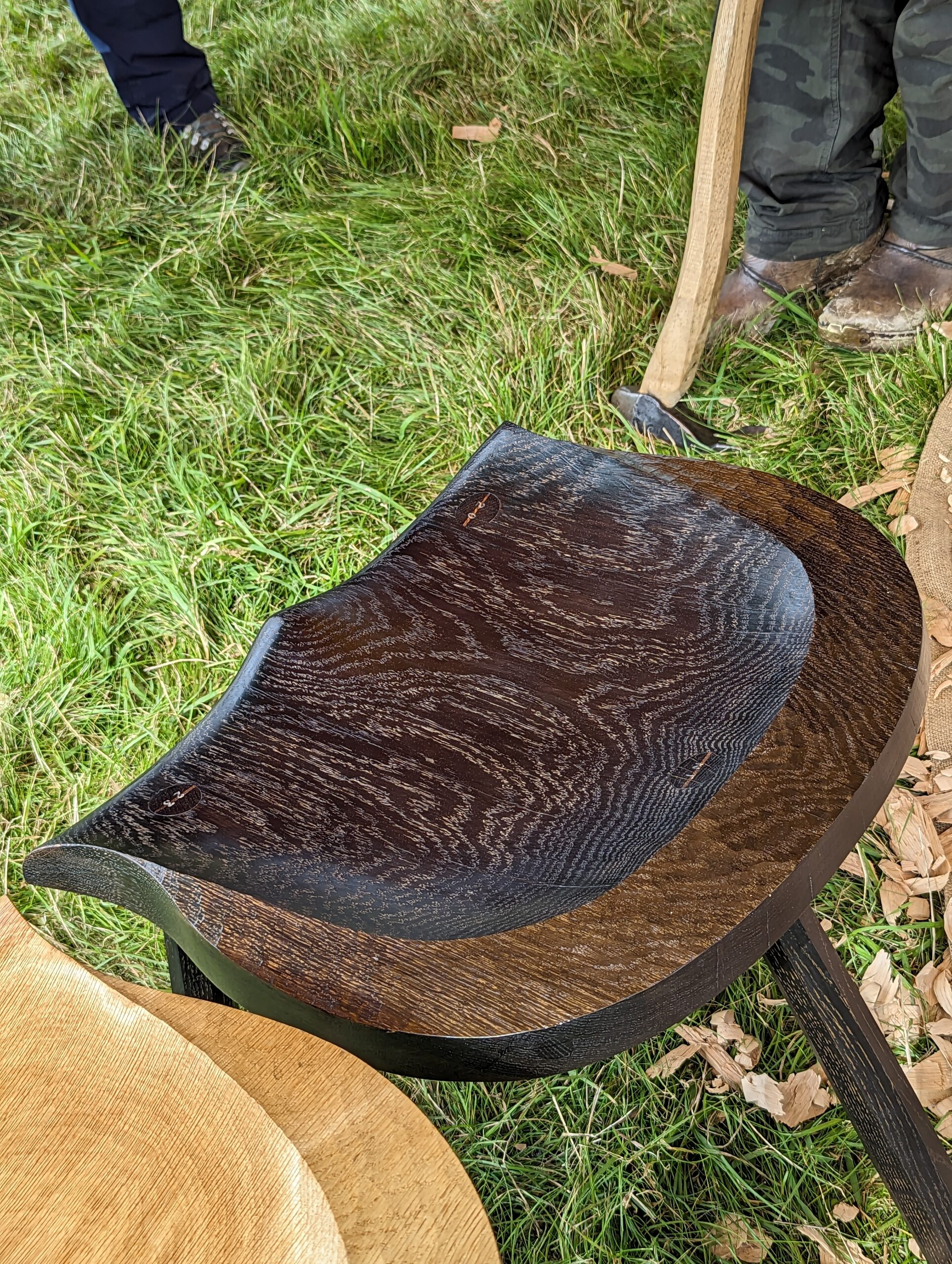
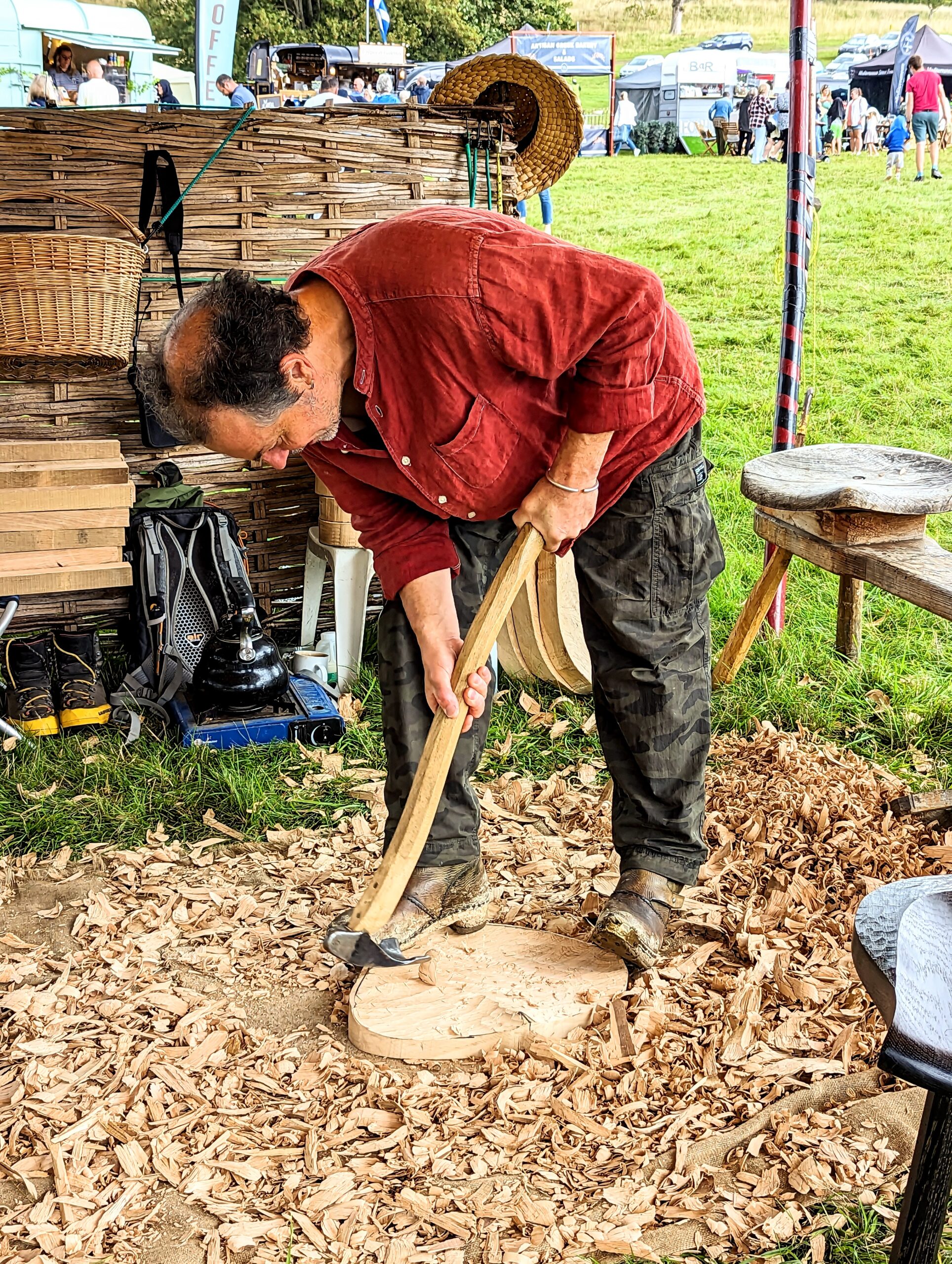
But when I saw Neil standing adzing his next stool seat my sanity was saved. What a breath of fresh air. He's a like-minded lifestyle woodworker going against the industrial tides as much as he is able. We first met ten years ago at a wood festival where we both exhibited and felt a kindred spirit. Ten year's ago that show had dozens of crafting artisans striving to live an alternative lifestyle. Many makers there to share space and time with. It's nice to meet like this. I didn't know he would be there but I hoped he would be. It's not too easy having an intelligent conversation with people trying out chairs for fit but we exchanged a few sentences with each other. Few people can hack it making and selling from rough wood to a finished sale at venues like this these days. Possible buyers jockey with the idea without quite realising that £1,200 is not really a lot to pay for something so hand-hewn as a large chair with bent backs, adzed seats and drawknifed legs and spindles finished off unturned with a spokeshave. One day I will buy one of his chairs. Better do it soon.
Neil is married and has two newly adult sons entering the world of work. They have not followed in Neils's steps and with good reason. Like most children of artisans, they saw how hard it was to work making and then invest all you have in a few weekend shows knowing the weather and people can be fickle. Being gone at weekends for a few seasons is fine but soon they develop their own passages into adult beings.
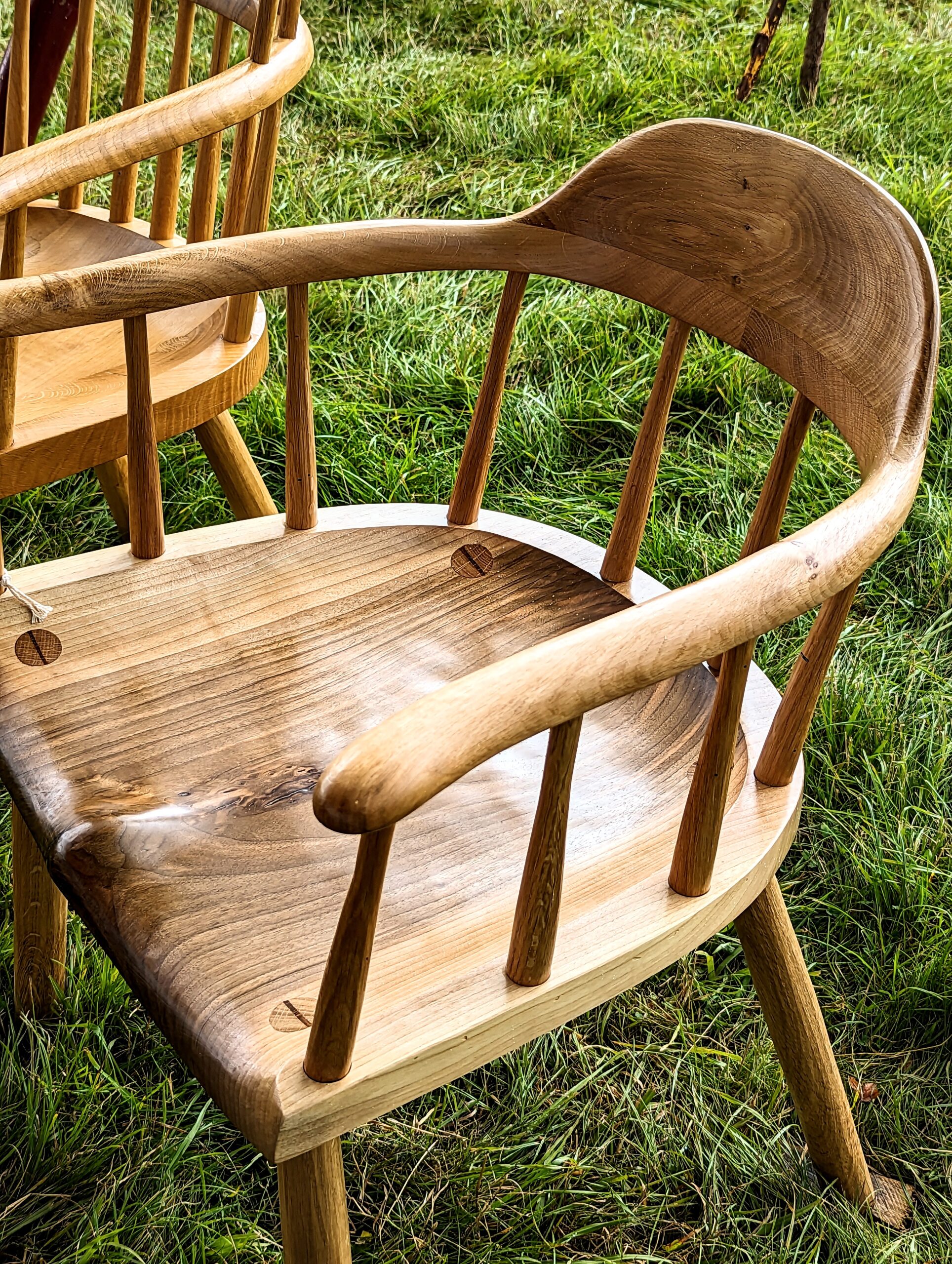
Watching Neil from the wings, him quietly and methodically chipping away at an oak seat with an adze, made me wonder why a hundred people weren't standing there watching and admiring him too. He's not just skilled but remarkably so. How often can anyone walk anywhere and see a man carve a seat with an adze or strip the excess from a stave to make and shape legs and rails? People walked past eating food and drinking coffee or prosecco as if he didn't even exist. Not quite everyone but almost. How is such a thing possible? Of course, it's not as impacting as the buzz of chainsaws and men in chaps and hi-viz gladiator gear. I get that. But the steady progress and the swing of an adze are not slow at all and there are skills in both camps. Still, adze work is not like the man with the chainsaw taking off chunks in seconds to rough out a bear or an owl from a wooden stump. He had it roughed down in ten minutes and everyone clapped even though it still had a way to go. Neil's heirloom pieces will be around in 300 years' time, I have no doubt. The bear? Well, it is quite novel and entertaining but passing.
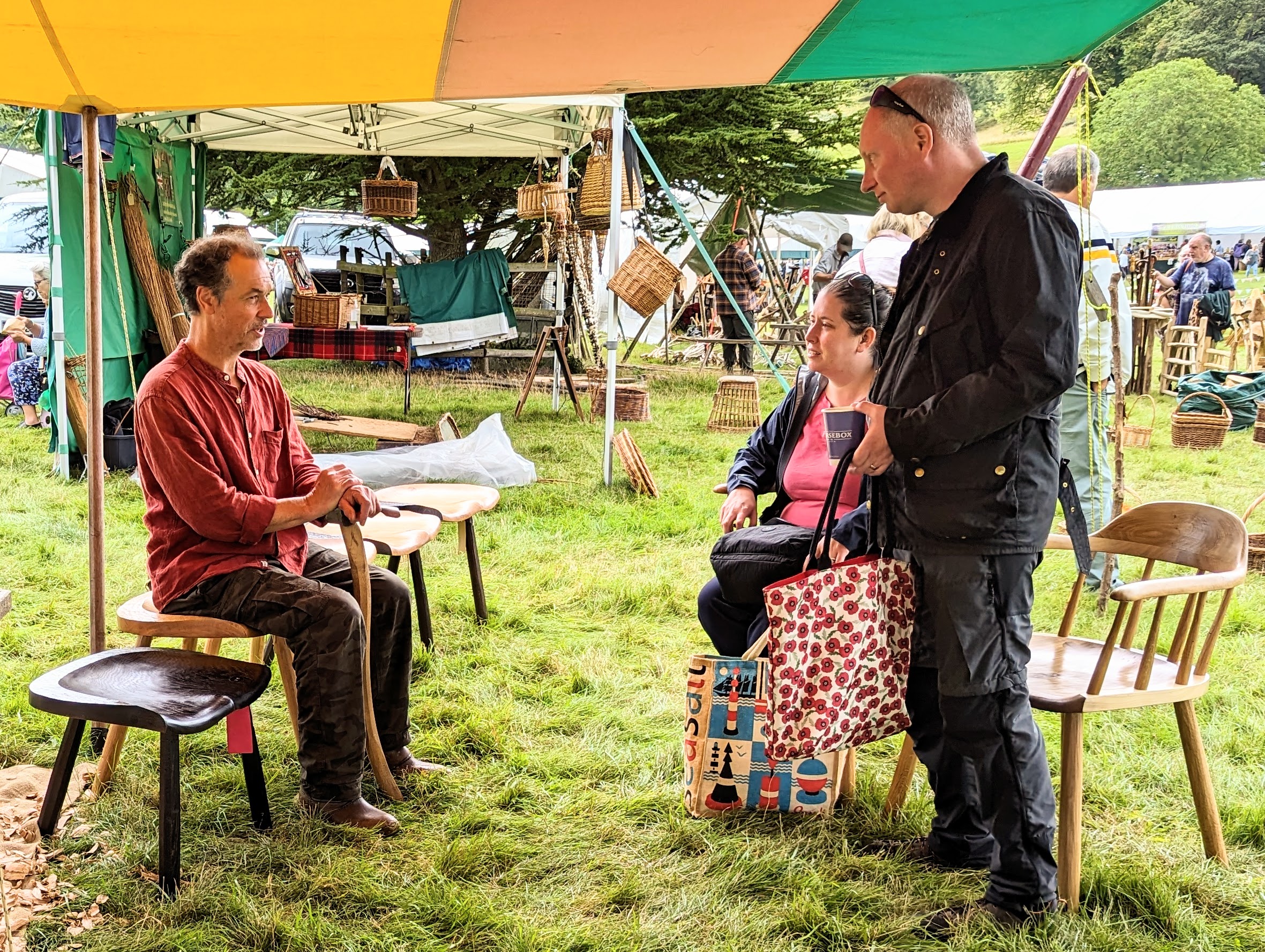
There is always a certain distinctiveness with Neil––I think I would best describe it as the humility of a man who discovered his calling and then had the humility to follow it decidedly, with certainty and a sense of having found himself. Few people in our day would regard the man as having what they might call 'a real job' though, of course, very real is because what he might describe as his passion I would more actively and even provocatively describe it as his calling because I believe in callings be they vocational or whatever. There is no diminished accountability for naming it so. We all have one. We usually fail to follow it because, well, we have too many distracting influences not the least of which could be the highest bidder offering us a job or an unhearing parent who cannot believe their children can indeed decide for themselves. The certainty I feel being in the same space with Neil is what I feel when I am making but one I rarely feel with others selling at craft shows. There is a certain confidence in the man that sits squarely alongside his inner calm. Most men in his shoes would likely never survive the unknowing future of being a crafting artisan maker that comes with the territory. You only get it when you've lived it, relied on it, understood the reason for it. Getting off of the expectational conveyor belt most are carried along by is not so easy. others expect that one day you will see the light and get a real job somewhere in industry doing something like fitting and hanging doors using some power equipment or maybe working in a big box store, such like that. But, well, not everyone is meant to do that and neither do I see Neil in some reenactment museum being mused over by people dressed in the garb for entertainment. Don't get me wrong, some will enjoy that and it's entertaining. But for Neil, it's more the meekness of his controlled inner strength that carries him along in his vibrant lifestyle. You seldom see this at craft shows. people cannot see the realness of the man or the woman who takes themselves off of the conveyor belt to live an alternative reality as best they can. Neil isn't looking to be admired. No, admiration is not his thing at all. he just found peace in being him as a maker. The few who took time to sit with him, who sought him out, well, they got it.
The Neil gems in this world are rare discoveries. You don't find them often at all. Humility and skill have no gimmicks and there is nothing sensational about them even though their work merits our total attention for however long we can give it. I hope one day to interview more such artisans before they finally disappear. And don't anyone dare try to tell me they won't eventually disappear. They will.
Comments ()