
A Good Blade
In building our latest project in the Sellers' Home bedroom series I relied on my bandsaw for many of the long and often heavy rip cuts. I expect many of those building the same projects might well decide to do the same. Mostly, this was to do with the type of different and often random widths I decided on for the panel strips and framing superstructure. The alternative is either a lot of hand sawing or machine milling in some other way. I am constrained by a single machine in my workshop,. This lone bandsaw handles everything for me perfectly. And the outcome of the final design made my use of it well worth it. Mostly the tedium was my choice throughout the different settings of narrow strips to develop texture and laminations in each of the pieces I designed. In the wardrobe I just completed there are over 200 pieces in its building and, of course, many following here do own a machine or two set up in their garages and so some may well do the part of or the whole project by machine. I always go through the hand methods I use in any project thoroughly for those who want to further develop their skills, gain the true benefits of the added exercise hand tools give and then too the high-brain demand handwork challenges us with, it's all there. Hand tools remain current technology for woodworkers today but the loss of skilled long-term teachers from an artisan maker background lessened with each decade. This does not mean the methods are old fashioned and outdated, just that they were never intended for mass producing repetitive cuts as were machines.
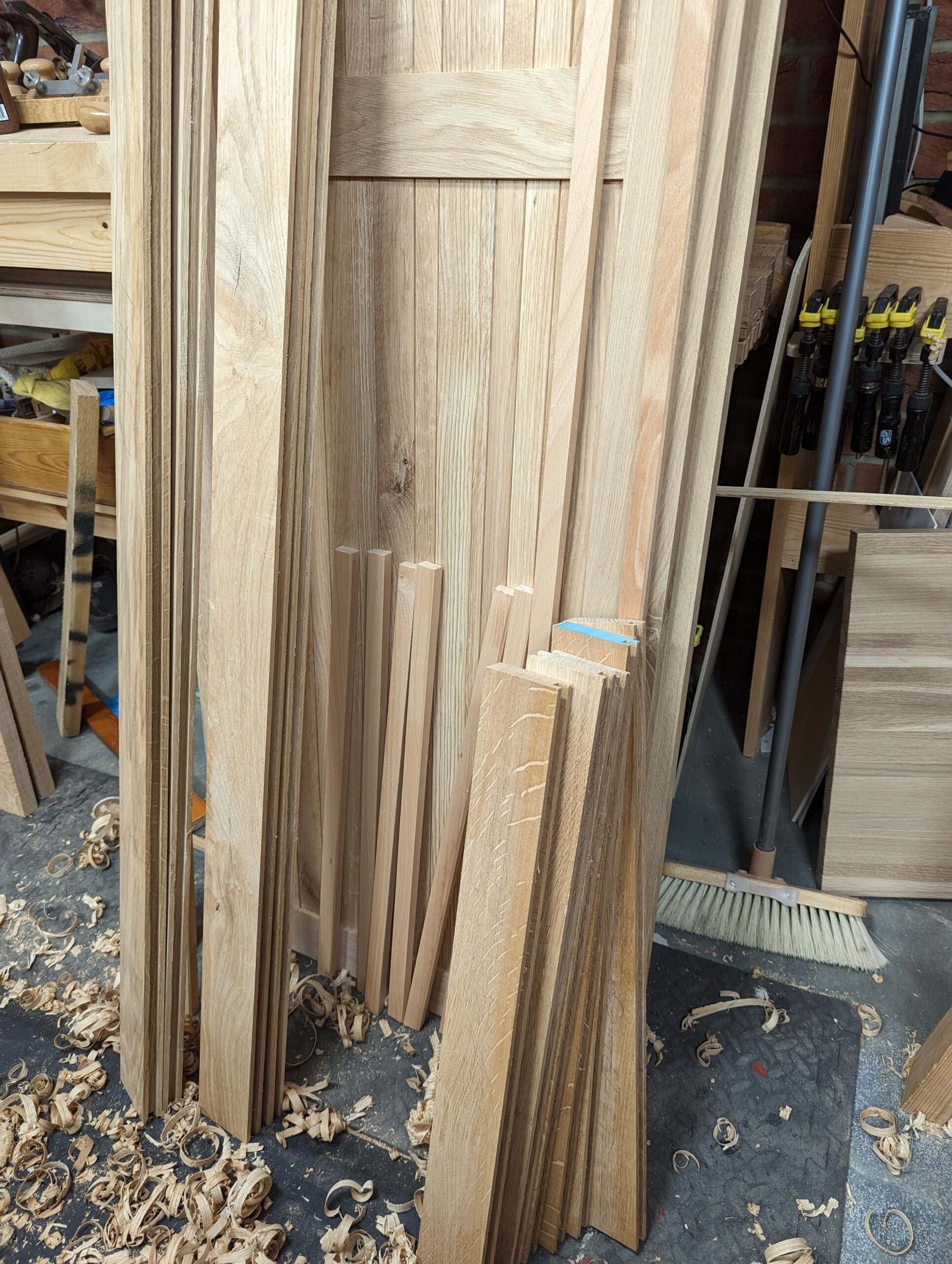
My point here then is that if you are bandsawing your material it's worth using the best blade you can, one that's hopefully in the affordable range and one that gives a decent clean cut when the two parts separate. Ripcutting and resawing are one and the same mostly. In our benchwork, we are not usually slabbing tree trunks but down-sizing thicker and wider sections to reduce cost and labour. The bandsaw removes the smallest kerf, tackles cuts twice and three times deeper than most tablesaws and when set up correctly needs only a few light passes with a bench plane to prepare the wood for 250-grit sanding smooth if wanted. About the downside to bandsaws is that they are restricted when it comes to crosscutting anything longer than the diameter of the bandsaw wheels minus about a half inch. Does that mean buy a chopsaw? I certainly wouldn't. I have two options. I either use my handsaw or, if I have a lot to do, I will use a jigsaw. Would I use a Skilsaw? No, not usually. The only time I might use a skilsaw is on sheet goods but even then that would be a big ask of me. I doubt I have used mine in the last two years or more. Too, too messy and invasive for me and totally unnecessary. A decent jigsaw is certainly good enough for my initial rough cut and the ends can be trimmed later when I get to the actual joinery or whatever. My strategy is to crosscut by hand or with a jigsaw, resaw, true up and size by hand plane and then use the table sled on my bandsaw to trim to final length and square. But in equal measure, I will also use purely hand methods, crosscutting with a handsaw and end-grain planing with or without a shooting board or my planing stop system.
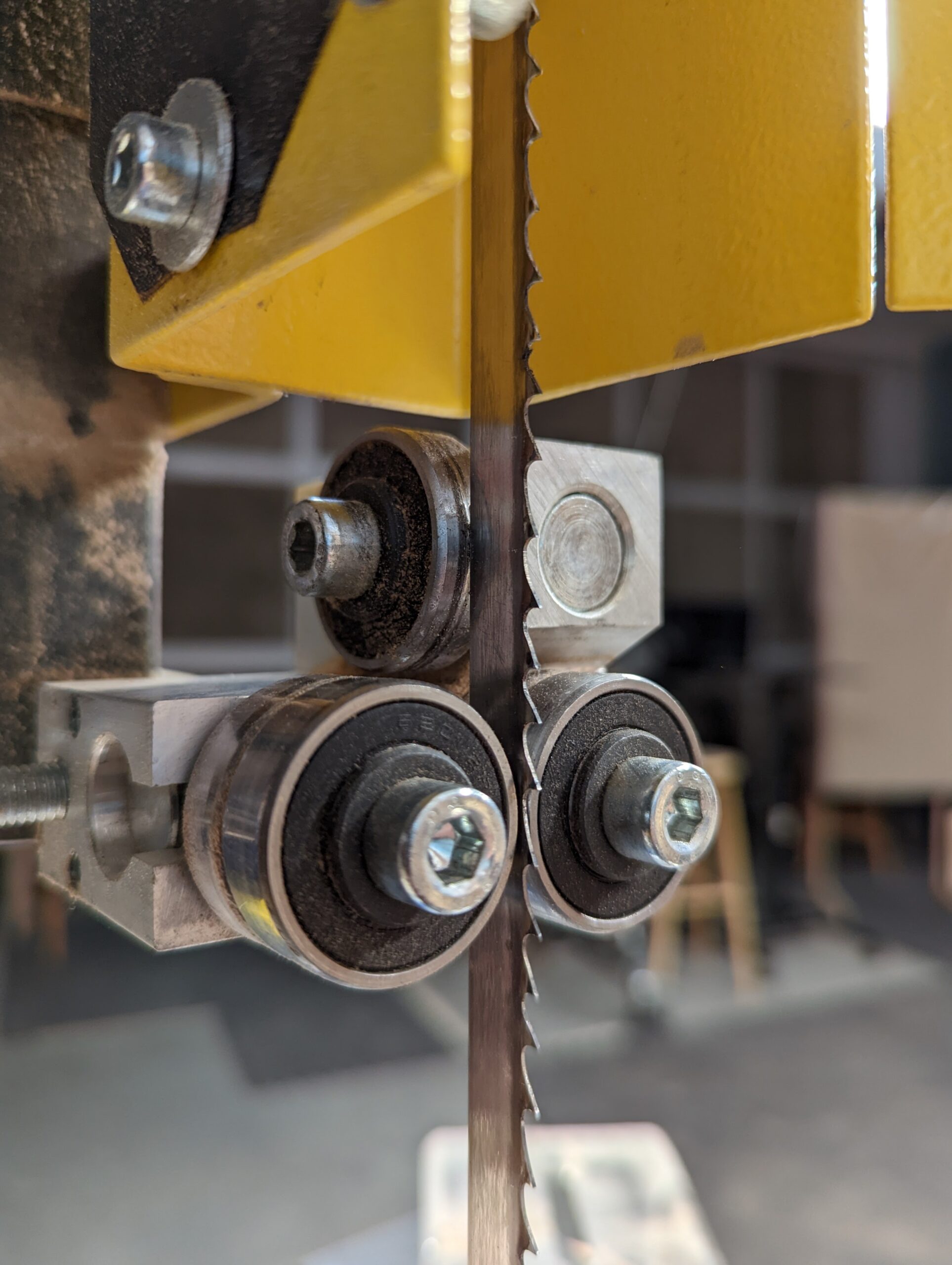
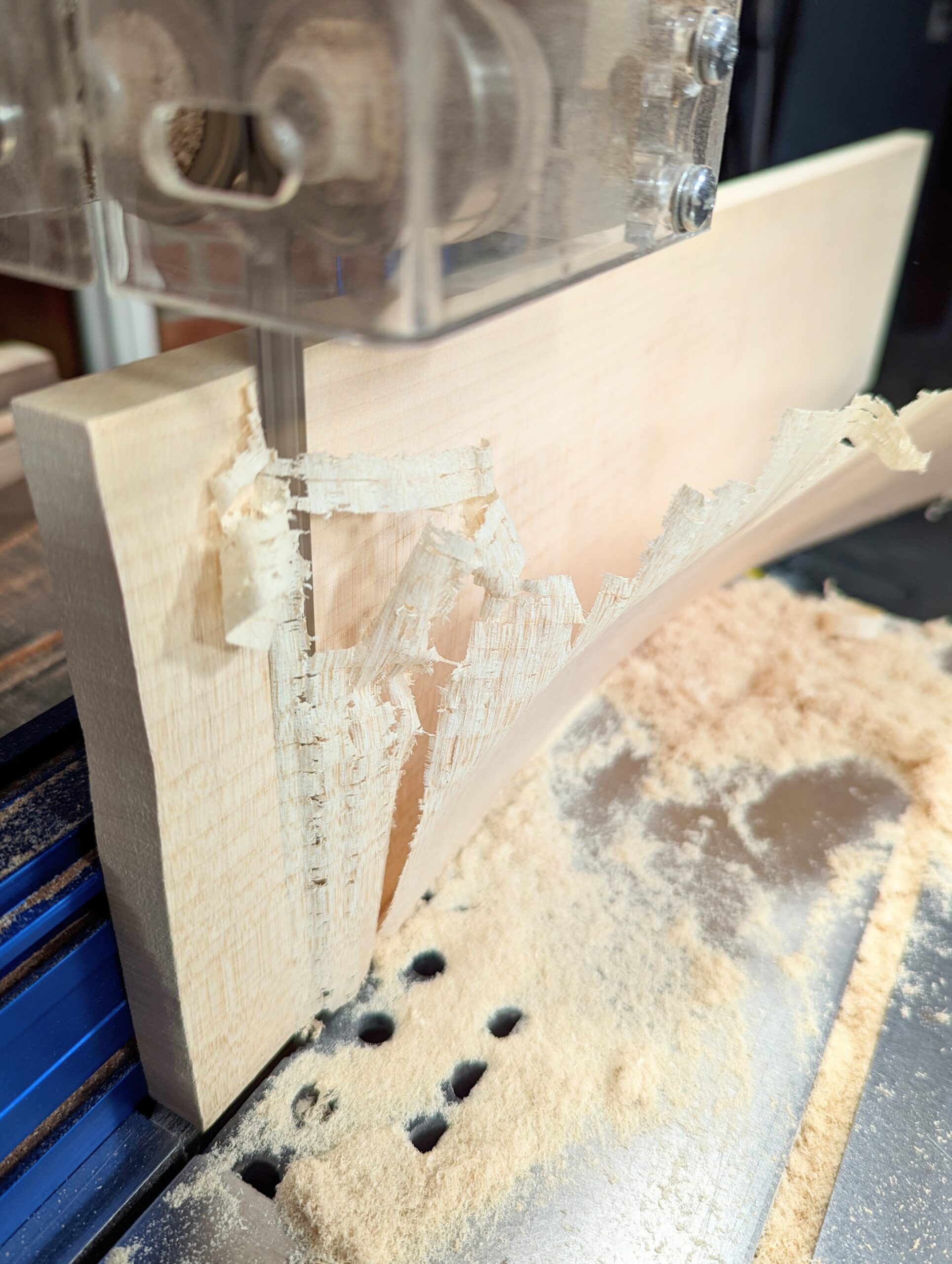
I installed a new blade into my bandsaw well over a month ago. I generally rely on a premium 1/2" x 3–4 TPI (tooth per inch) vari-tooth blade for a couple of good reasons but the main ones are the strength the weld gets in a 1/2" long weld and then of equal value the beam strength/resistance this affords the blade against thrust pressures. Beam strength is extremely important for heavy and deep rip cuts and of course, this is all relative. Take a commercial machine with tungsten carbide teeth on a steel band 4" wide. Driven by a multi-horse-powered diesel engine, not much will stop and each revolution of the blade can take travel run of 3". Compare this to my 1/2" blade ripping 8-10" deep wood at a feed rate as low as it gets to one delivering slabbed boards 24" wide at a metre every few seconds and you'll better understand what I am saying. The beam strength resists blade-twist in the face of your push-power into the teeth of the blade. If the blade is not taut enough then it will tend to flex sideways one way or the other and follow the easiest or weakest path the grain in the wood offers. Any grain opposition such as knots, the wood surrounding knots, crotch-grain, growth ring hardness and density variation will divert the blade from your straight and intentional line. The more taut the blade the less deviation, generally speaking. The difference in tensionability between a 1/2" blade and a 3/8" one is, well, 25%. In the face of diverse grain patterning, any shift in direction can flex the blade and no matter how minimally, this can set a different course pulling the wood according the the softer grain and a path of less resistance. This happens and the more we can do to minimise it the better the outcome in finished cuts. The 1/2" blade resists side flexing by the allowed extra tension we can apply to the blade when we stretch it between the two wheels. Offering a good and broad weld along the joint lines to create the band means that the blade is less likely to snap through the tension applied and then too blade fatigue at this critical weld point. The weld on blades is often the weak point in the circle and after the blade has been used for a while this will be the point where the blade usually snaps if it is going to snap at all. The strength of the weld is important because the strength of the weld allows the application of adequate tension to keep the blade taut between the two bandsaw wheels. Remember too that 'stretching' that blade is not simply a question of applying as much tension to the blade as you can through the tensioning wheel or lever. Finding the balance as we tighten the blade to the two wheels takes precision and our sensitivity is important. Too much tension can be as adverse as not enough. You can watch my video here on how to establish a good balance in setting up your bandsaw which includes setting the blade tension.
I cannot say exactly how many rip- and cross-cuts I made in cutting the 200 pieces for the wardrobe from the original commercially cut and rough-sawn boards before hand planing but I can offer a guestimate minimum of at least a thousand long-grain cuts ranging from 1/2" to 8" deep. Choosing the best blade can be confusing so my best choice of blade might help. It's a blade I have sued for a long time and one that meets all of my criteria day to day. I look for the gold standard as I do not want to always be changing the bearing positions to accommodate different blade widths and types. Thinner and narrower blades have their place in different work. If you make bandsaw boxes with super tight curves into corners then a blade wider than 1/4" will be pretty useless to you as anything above 1/4" is best for straight or gradient curves as in long rip cuts with no tight turns. The narrower the blade, the tighter the radius that can be cut. 1/8” to 3/16” blades tend to be used for cutting extremely tight radiuses with 1/4" blades being the most common width for general radius cutting. Whichever blade you choose, adjustments to the side alignment guides will be inevitable to ensure the guides maximise alignment in relation to the beam width of the blade. My bandsaw has twin, side-by-side bearings of 10mm each so about 3/4" of blade can be fully supported if ever I need it but I like the tensionability a half-inch blade gives me in my usual work.
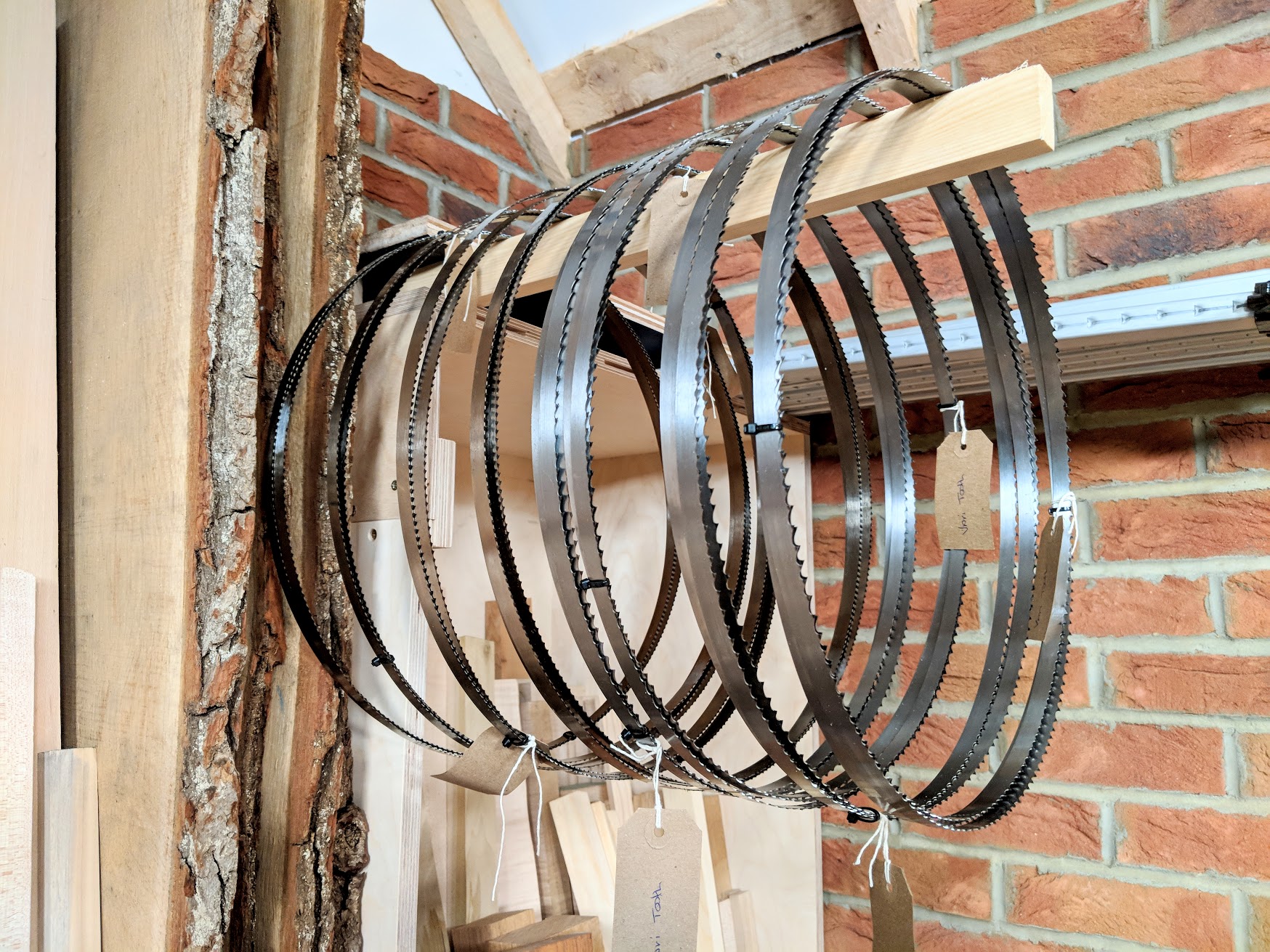
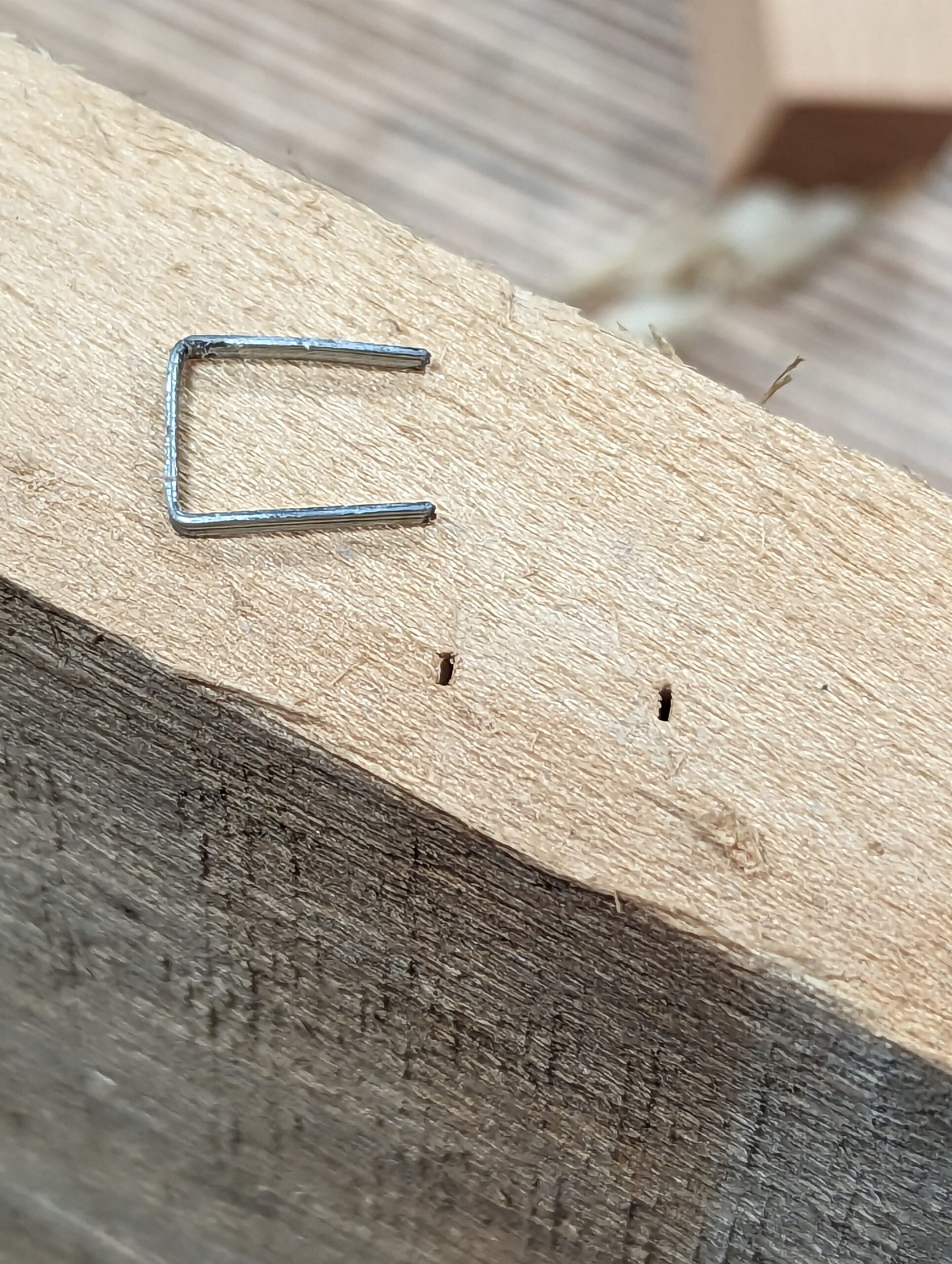
I'm always careful with my bandsaw and the blades in place. No pallet cutting unless the blade is near done with and for good reason. It's not just the obvious nails and staples but the broken-off ones and the pebbles in the underside slats that embed themselves in the wood. Stones and staples are the worst things for even the hardest teeth as they are fully hardened throughout. I just picked up some walnut at a cost of £240 for just two wide boards seven feet long with a band of staples all the way along one edge.
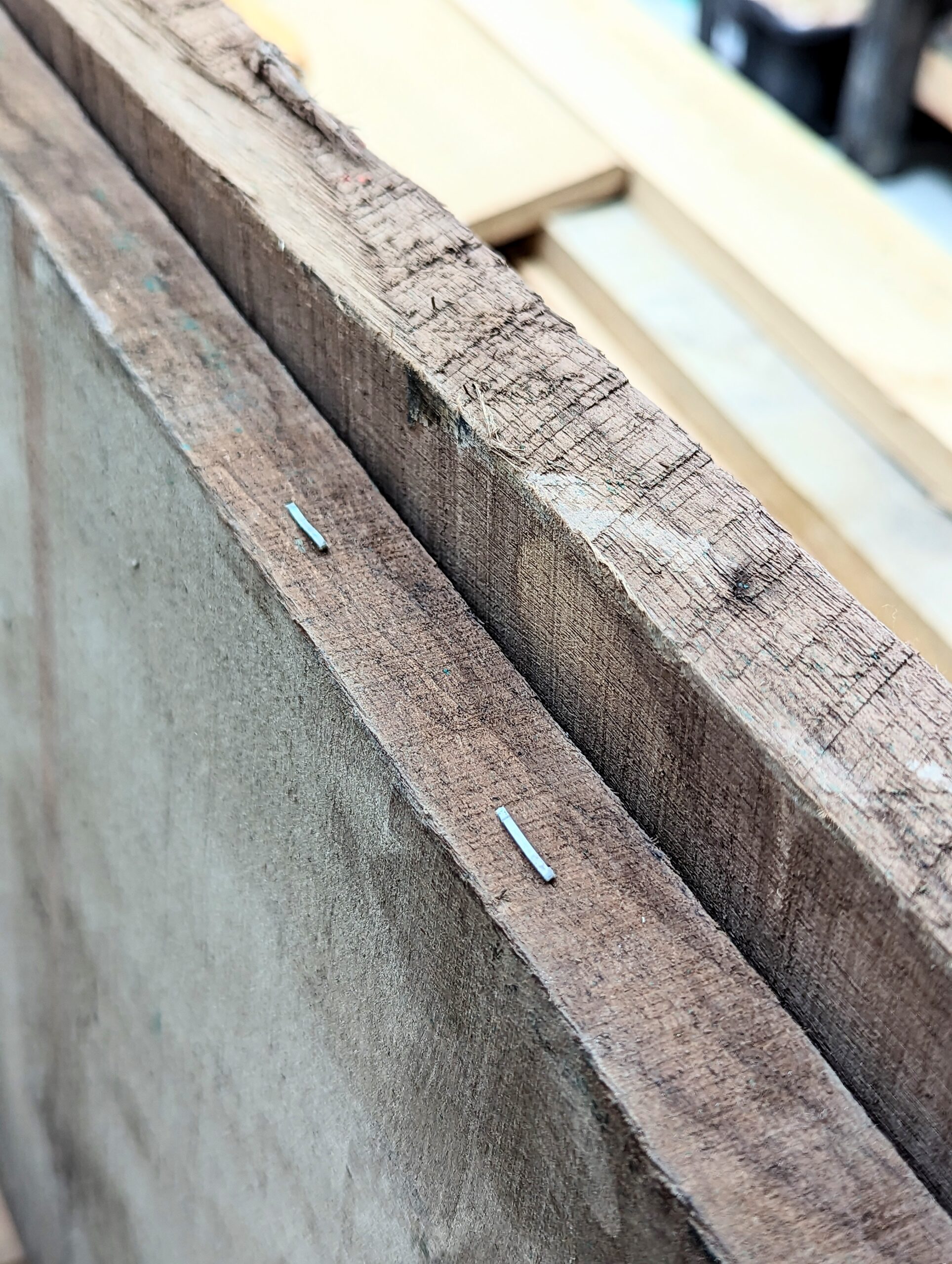
Yes, I can pull the staples, but there are no guarantees that they will always pull cleanly or indeed someone else less connected didn't leave a staple point in there when they pulled the tarp. I will look for any telltale holes.
My favourite blade for the type of work I generally do which is predominantly ripcutting wood but also crosscutting too is the Tuffsaws 1/2" vari-tooth. The 'vari' part is both the size of the teeth, determined by the distance between the teeth points and the various depths of the individual gullets. The 3-4 means the number of teeth can vary between 3 and 4 to the inch run of saw blade.
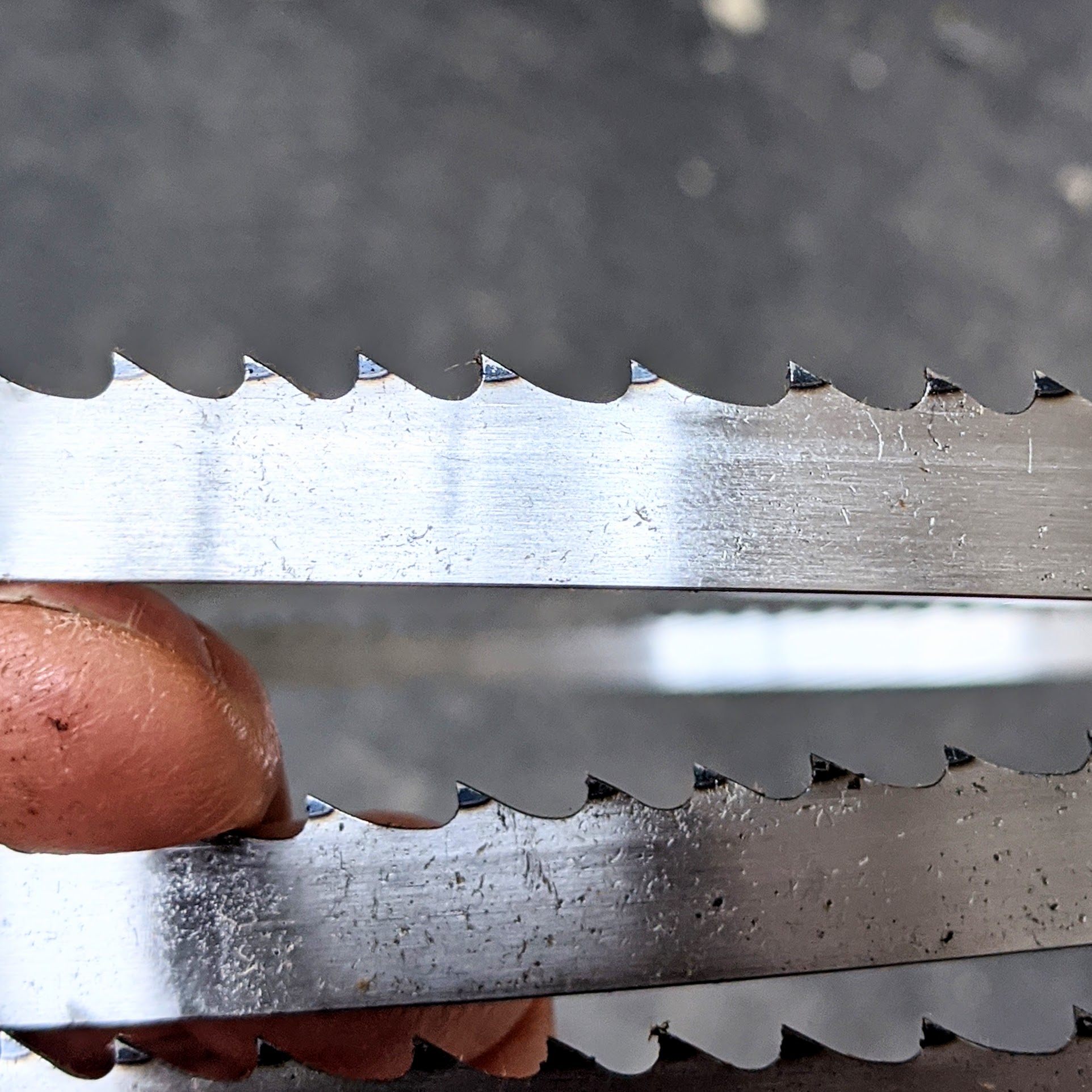
As the tooth points are all aligned to the tooth line and the teeth are different sizes, the gullets dip and dive to different depths. You might think that this variability would cause irregularity in the smoothness of the cut and then to a noticeable difference in the feed as you push the wood into the blade but that's not the case at all. This variation gives a smooth and even cut, minimises any vibration and results in uniformity. Any variability in needed pressure by the user will be directly because of variations in the grain and there are many complexities to this. Also, variabilities occur through the mechanics of the machine itself caused by blade guides, tensions to the blade, pullied drives and belts used, tyres to the bandsaw wheels and more. It sounds complicated but you will get used to your particular bandsaw and earn what makes a difference as you make standard adjustments. As an example, a pattern for me is to run a new blade for 20 minutes of use and then go back in and check the blade tension, bearing alignments and such like that. I should point out here that using a deeper beam (more than my suggested 1/2") does not necessarily mean a better cut or indeed the ability for applying greater tension. It can be exactly the opposite and this will depend on your bandsaw. Some bandsaws do not have the capacity to apply the greater tension demanded by wider blades and can indeed compromise the bearings, guide components and the bandsaw frame itself. Applying too much tension will indeed relate to the bandsaw frame type and engineering quality and, as most bandsaws are now steel box construction rather than the cast iron older versions, some box construction types can be more prone to flex according to the applied tensions and other pressures in use. Remember vibration can result in harmonics throughout the box construction which can cause unwanted undulation in the passage of the blade into and through the cut. It takes sensitivity not to over-tension or alternatively under-tension a frame which causes temporary distortion between the wheels top and bottom. The variation of outcome between different tensions can be most remarkable and too much to talk about tensioning here.
My blades cost me around £13 a pop for my 16" bandsaw. This seems to mean that with a general lifespan of a blade, as a full-time maker, being about six weeks is about 9 blades a year so a yearly expense of £113 per year or a mere £2 a week. Hard to beat.
Comments ()