
Simpler Thoughts for Simpler Making
Making small and simple woodworking projects can sometimes take as much time to make as something big. In my workshop, the designs are never designed and thereby governed by whether it can be geared up for being made using machines, handheld or freestanding, both, I never think in those realms anymore although at one time, a lifetime ago, I did. In my early days as a maker, most designs became a production run of this or that. I had several lines and made them in batches. Gradually I ended up spewing stuff out to bring the price down to compete with companies whose sole business was a form of mass-making or another. This is a danger for us all. When we see life as a five-day-week, nine-to-five and end up on a six-day- and seven-day-week, six-to-way-past-dark something is taking over you. The shop gets crammed with machines and dust extraction systems and before you know it you somehow lost the thing that prompted your early start to your working in wood.
The greatest decision I ever made was never to work for money again. Scaling back to make a piece at a time and sell it didn't come overnight. I had bread-and-butter work I quite enjoyed but it left me unfulfilled. It took a paradigm shift for me to reprogram my life and disengage from the plugged-in workshop where everything relied on powered cuts from machines of every size. The one thing that stood me in good stead was my fully-orbed and developed hand skills. All of my furniture has always been handmade. To live in an age when all dovetails, in general, come from a power router and a jig guide and say I have never cut a dovetail that wasn't cut with a dovetail saw and chisel chopped, I mean 58 years of doing so, is quite something for a professional furniture maker.
I think that that is what has made life as a maker so very unique and different for me. Not trying to fit tasks to multiple machines and hand-held machines like power routers, jigsaws, skilsaws has given me such freedom when others thought it would only hamstring me and would lose me the freedoms I'd gained. In my hand-making world, I found a life of unlimited freedoms and new possibilities came together around every corner. I discovered the excitement I hadn't realised that I had lost, excitement in my work. new health and strength I thought to be lost. Did I ever tell you of the man who went through days of anxiety because he faced the task of recessing a hinge by hand because he couldn't get the power router in to do it for him? It was in an existing cabinet, finished apart from this one small task. He owned the very best and most expensive hand tools, pristinely sharpened by him as a student in a UK college of furniture making but left unused because he'd adopted machine methods of working for the interim years. I hope this helps to illustrate the possible distortion that has taken place through the generations. Thankfully we are reaching an audience that wants what I rediscovered in my world of making. Does this mean we should never use the machine for any of our work? Of course, it doesn't. Just question every cut. Challenge yourself.
Today, and for at least a couple of decades, 98% of my work comes from a hand tool. It's not a boast, just an encouragement. In my opening days as an apprentice, every surface was hand planed and guess whose task that was? It's all too easy to say power equipment is just an alternative way. Most often it's not, especially if you prefer not to use machines in part or for the whole of what you do, but simply choose an alternative way by hand means. To achieve the best results you must train yourself just as you would to become a sporting rock climber, canoeist and so on -- you don't get in your car to train your body for fitness. It's your body and mind that has to be transformed from one conditioned way to another. First thing in the morning I must make a decision whether to use my car or my bike. Some days the bike has less appeal. So it is between the bandsaw and the handsaw. One gives me ease, squareness and perfect parallelity, the other gives me much self high-demand to my body, brain, emotion and so on. My choice. How much more when you have a power planer and a tablesaw, a mortising machine, a chopsaw, power router and so on? I hope that this explains why I am doing what I am doing. For me, it was a new way of looking at the whole of life -- it was organic and vibrant gain, just as it was in my early youth before others and life influenced me differently. Suddenly O woke with a spark for the day, I couldn't wait for the day to start. This enthusiasm extended to those who worked with me. My own children, my apprentices. Doors began to open as others answered their calling too, a calling that took them off the conveyor belt. Please understand this though, of the hundreds of thousands following all or part of this philosophy, the majority are not nor do they intend to become full-time woodworkers. They just want to be truly skilled in their work, find sanity for a few hours a week, train their bodies and minds for a different pace in life and make. If I have achieved this in my later life now, and I have, then I am already a success by this one thing alone. Is my work done? No way. I have much more to do yet!
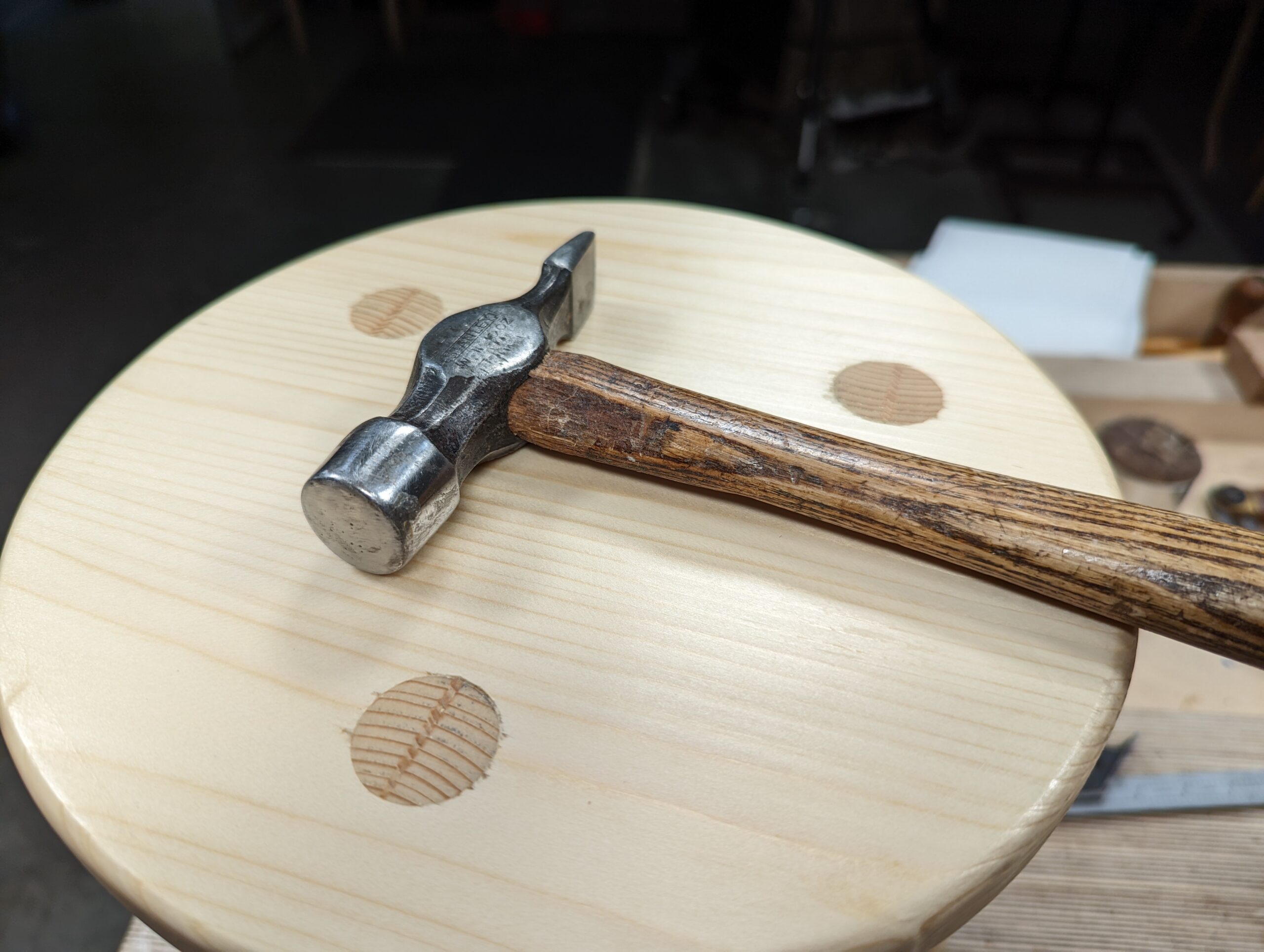
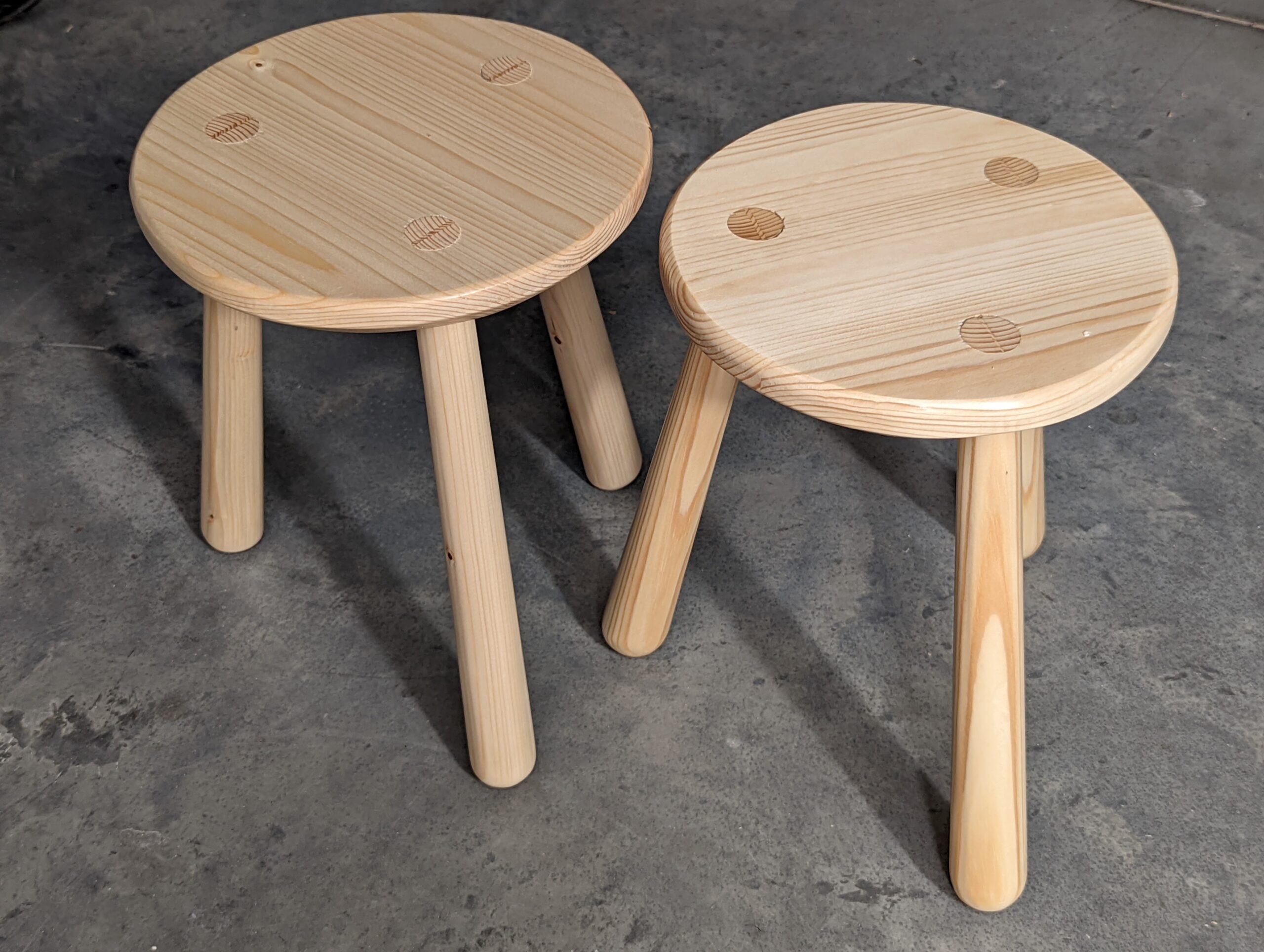
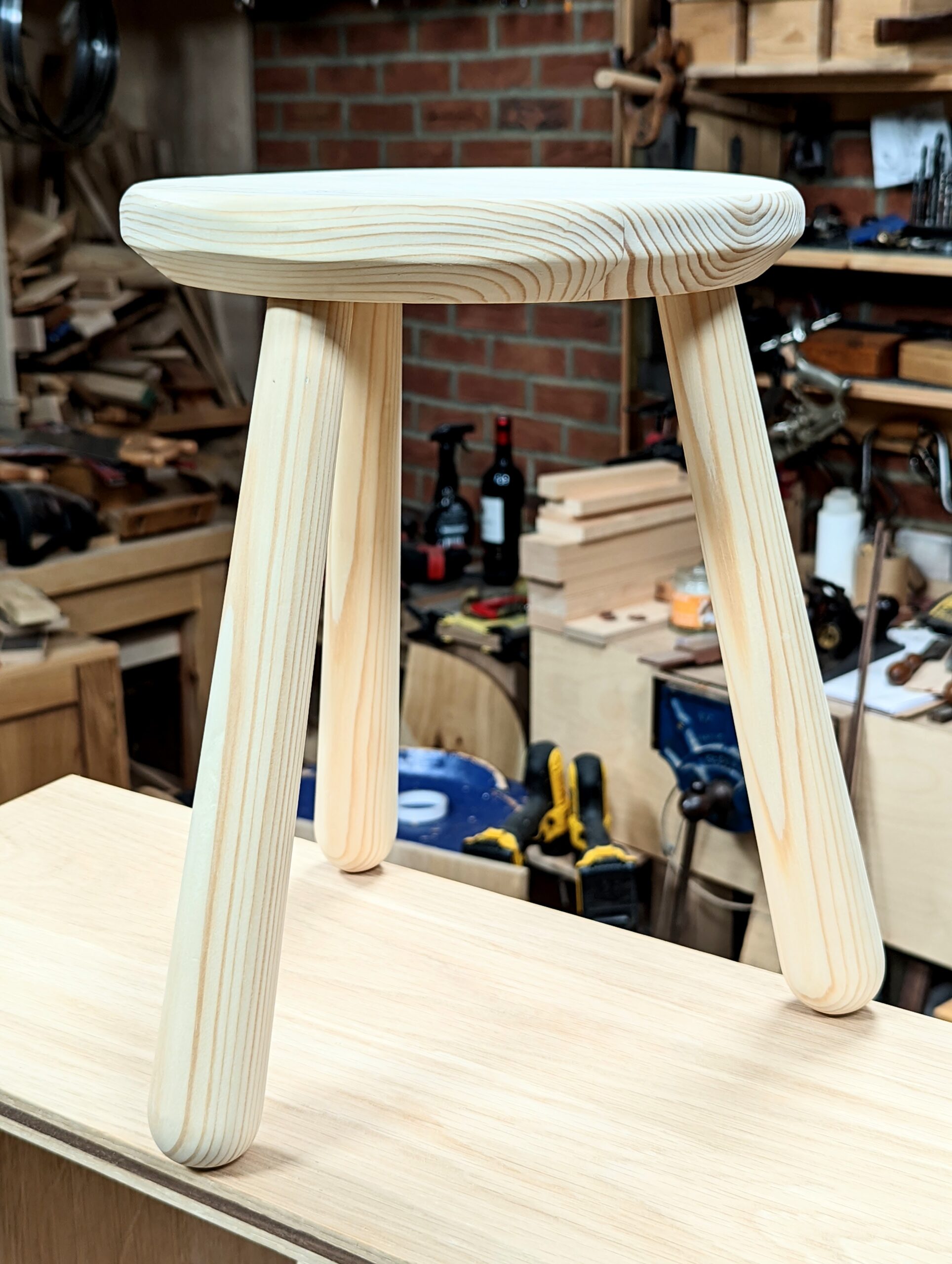
I thought about a small project I worked on this week. I set a timer on the second one because I calculated that the first one took me about an hour and a half to make. So we set the camera rolling and I made. The three legs for my three-legged stool took 35 minutes, that's twice as long as it would take if I turned them on my lathe, but not all woodworkers own a lathe, the turning tools, the power grinder to grind them sharp enough, and then the space to house one. This is where we come into our own. Take away coves and beads, ornamentation conventionally achieved by turning on the lathe, and you bring something tangible home to create a range of rounded projects with nothing more than a foldable workstation or a conventional joiner's workbench. Tapered octagons, square tapers, hollows and cambers can still make simple beauty and elegance happen and even twists, carving can enhance the design you choose if that's what you want. For my three-legged stool, I took the legs from square, pre-cut parallel stock to tapered and then tapered round. It's a systematic process requiring only a hand saw and a #4 Stanley bench plane for the 'doing' work. Certainly not worth turning on the lathe if you factor in the reality that chips fly unpredictably for a couple of metres in every direction, making clean-up a time factor alone. Add in a rasp and a file, a spokeshave and you have the baseball-bat ends and the stool seats square to the floor or the rough ground when done. Simple!
Whereas it's the simplicity I like about my working with my hands, it's much more than that. Even using mallet blows and saw strokes, simplicity translates into a type of inner silence where the tap and rasping sounds, the plane on wood and such, all can translate into greater peace and relaxation, even when the muscles and sinews interrelate in mixed states of association with the tasks. In my world of making, I find myself using very relaxed saw strokes and hammer taps intermittently with more direct forces. It's the interplay I love about my work and working. When teaching classes one on one through the decades, the hardest thing for me was to get intense woodworkers to relax their grip on the life they came from; let the saw do the work and just the weight of their hands direct alone. In almost all cases, woodworkers I worked with applied many times more bruising pressure than they needed. No wonder they were worn out and often sweating by mid-day. It was evident that their whole body was still relating to the world they were conditioned to live in. Such extreme intensity on a continuous level was really quite unnatural, but when I suggested a shift in attitude they were receptive. Why? They mostly believed what I said as I slipped the saw into a cut and it slid down the line without any applied force beyond the weight of my arm and hand. After a day or so they too had it. You could hear the difference in the surrounding atmosphere. there was a peace about their work that seemed almost magical. Instead of being overbearing, over-controlling, they were more contented, less competitive. They found that this was the answer to being in true control.
Mostly it's the know-how that makes handwork different to our expectations. While others might consider it dull, tedious, outdated and old-fashioned, we begin to see things differently. I personally see many things as being fast and efficient. The few hand tools I used to make square sticks tapered round and rounded are highly effective, unfalteringly ready for action. Beyond an occasional sharpening, they need nothing more than working hands, good arms and shoulders. It's never really about muscling and grunt work but mostly simple know-how strategy, body leverage, applying yourself and being responsive to what you feel transmitted through the tools from the wood. The saw takes care of the heavier removal of wood, the plane trues the tapers to the two sides and then creates the tapered octagon stroke on stroke by following straight pencil lines. In the final strokes, you end up with a chiliagon (a thousand-sided polygon) of narrow flats less than a millimetre wide. Already it feels as near as possible to round as you can get from purely flat faces. In hardwood, I would be but a few strokes away from perfected round and that without sanding, but even nearer am I were I to use a more bendable card scraper. This alone takes the arrises down to a perfect round in a matter of a few swift strokes, no more. On soft-grained woods like pine, card scrapers are less predictable because of the hard and soft aspect to the growth rings, but 150-grit abrasive creates a good surface and with only a few strokes too. Hard to imagine, but the round seat with its rounded top and bevelled underside comes with similar speed and the same way except I replaced the #4 plane with a spokeshave, still a plane type though. I added in a rasp and 10" flat mill file as two luxury but not truly essential extra tools.
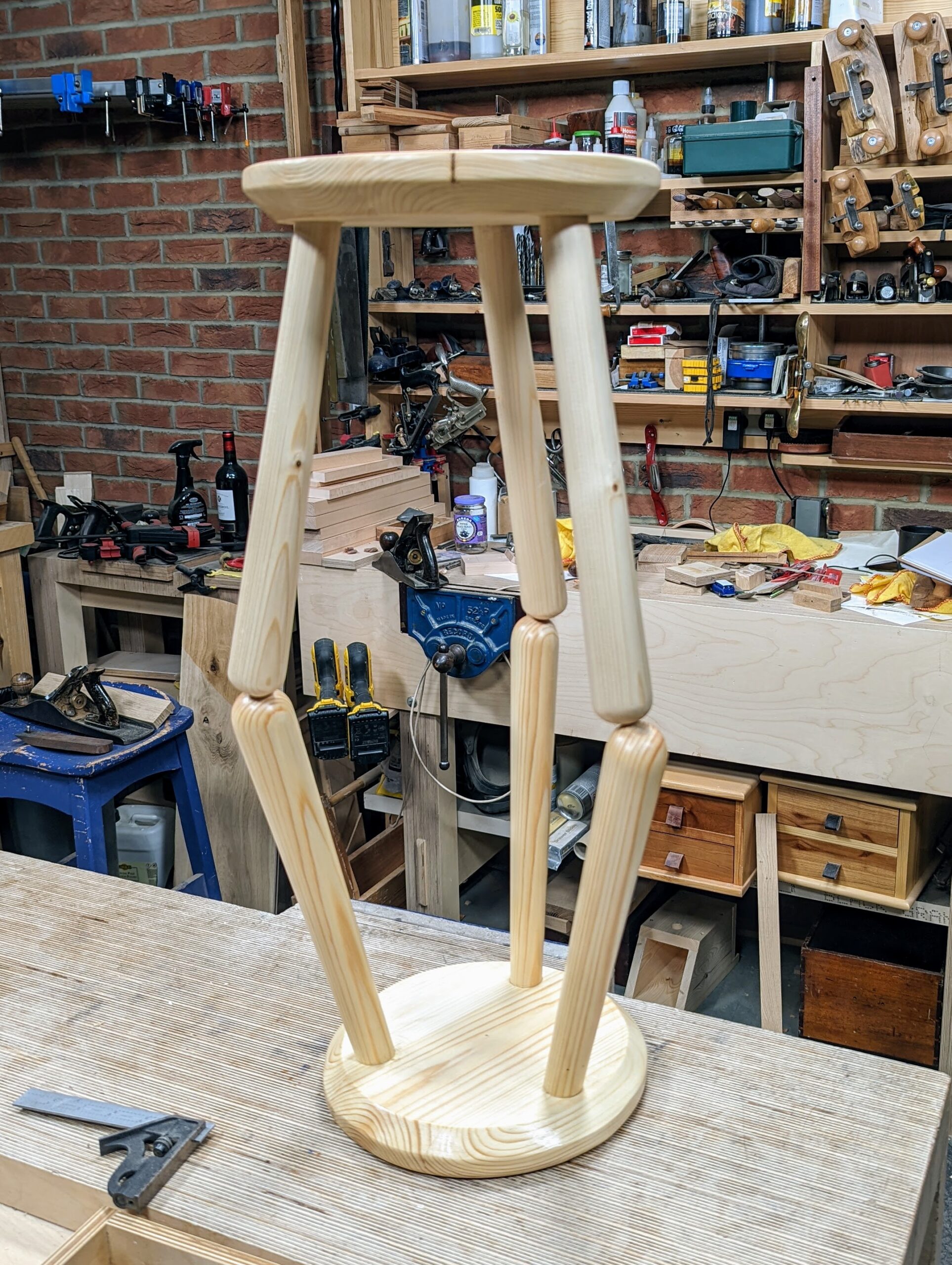
Dividing a circle into thirds is simple and needs nothing more that the pair of compasses you used to make the circle on the wood. To divide a circle into three, simply make the circle and on the circle line use the same radius setting you had for the circle and place the point anywhere you want on the line. Now step off six steps and you will meet at the start point. Draw a line from one of the steps to the centre point. Now, from the first point skip every other one and you will have divided your circle equally into three. The lines from the centre out will be your sight line for the perpendicularity of each leg too. More simplicity.
Having an eye for angles comes by experience and you grow in confidence using some angles regularly in your work. 30-degree bevels for sharpening cutting edges is one for me. On checking, my leghole splays came in at 110º, 107º and 110º but the closeness wasn't muscle memory but the fixed height of my vise, the position of the seat in the vise and a felt-for position on my chest. The rest was eye-balling verticality. Simply put, I placed my wood in the vise with each leg hole positioned uppermost and square to the top of my vise as a check. I eyeballed the first angle until I felt it was what I wanted and mentally acknowledged the angle by the pad of the brace in my chest. The two next holes were felt for by positioning the pad in the same felt-for position. It works.
Whereas the difference between the two stools time-wise as of little consequence, the simplicity of making a complete project in under two hours has a certain appeal simply by virtue of the fact that simple gifts, a few saleable projects, a vehicle to skill-build from creating the cohesion you need to become more confident in making. Think foundation blocks. Huge stones placed in the ground or occurring naturally that support massive buildings of great weight. this is what these sim[ler projects establish in your work-life. Such projects include readiness to sharpen, dexterity and economy of motion, understanding the actual tools and the wood you work on. Yes, I know, you only need one or two stools. So what? Give some away or sell them. The stool is the byproduct of skill-building and knowledge. This, you have for life.
Oh, yes, we videoed the making of these. When ready I will let you know.
Comments ()