
Restoring the Jack . . . Plane Speaking
Should planes arrive sharp and ready to go or are we expecting something that is really of little if any consequence? Well, our expectations have changed a little. It's true, at one time no one expected any woodworking hand tool to arrive with a refined, surgically sharp bevel to the edges. Beyond a coarse grinding at 25-degrees, it was up to the recipient to sharpen it further to the edge they wanted. Today everyone expects it to arrive sharp, otherwise, they're onto their social media making adverse whining comments or the review section of the seller's site giving bad feedback. But a chisel is not like receiving an alarm clock that doesn't work brand new from Amazon. Even if it came sharp ready for paring and chopping, a chisel will usually need sharpening again within an hour or two for the rest of its working life. When did this change in expectations happen and why?
If you order a kitchen knife the knife will arrive sharp and ready to go from the box it came in. Most owners I have known will use any knife until it dulls, which in their book would be after a year or two of daily use. At that point they start considering buying a new knife to replace it and leave the dulled one aside in the same drawer and in the same tray, never to be used again. Whereas I sharpen my kitchen knives once a week or so, or better still as soon as I have to press it firmly to a tomato skin to penetrate. Even if it takes just the lightest of pressure, the knife gets sharpened immediately. Planes, chisels and spokeshaves work on harder stuff than fruit and vegetables. There are occasions when I plane wood that I need to sharpen every 15 minutes. Mostly, that's not the case though. Most hardwoods I use, like cherry, oak, elm, ash and a few more, are easy on the planes and chisels. Because I tend to be high self-demand, I don't care if tools arrive from any source dull. I've spent 56 years sharpening tools several times a day six days a week, I just sharpen them according to need. Now if the kitchen door is sticking and I am not a carpenter I might have a different expectation. I just want something to dig me out of a hole one time. This is the case for many homeowners. It's cheaper than hiring a carpenter if it works. Anyone can ease a door!
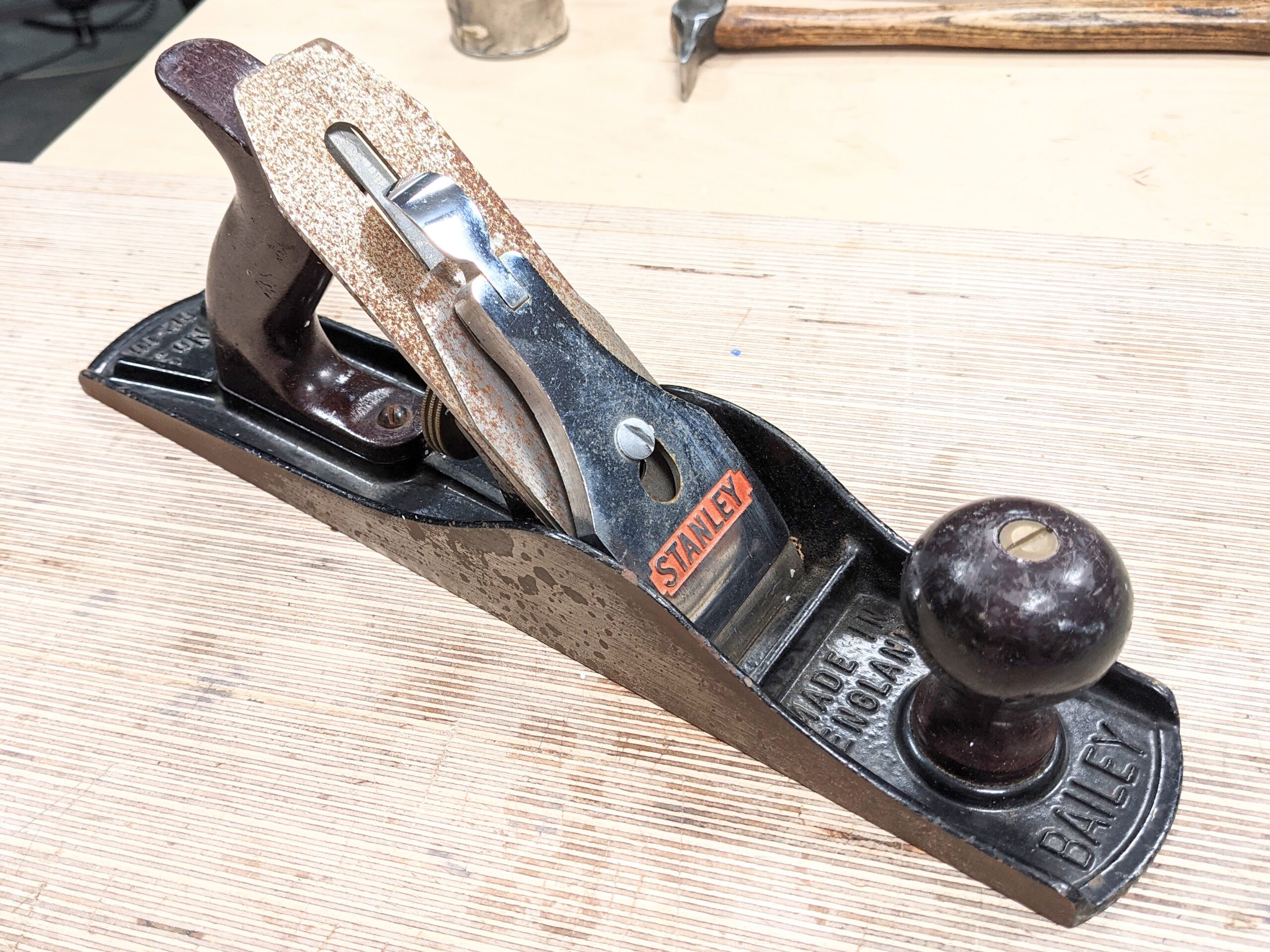
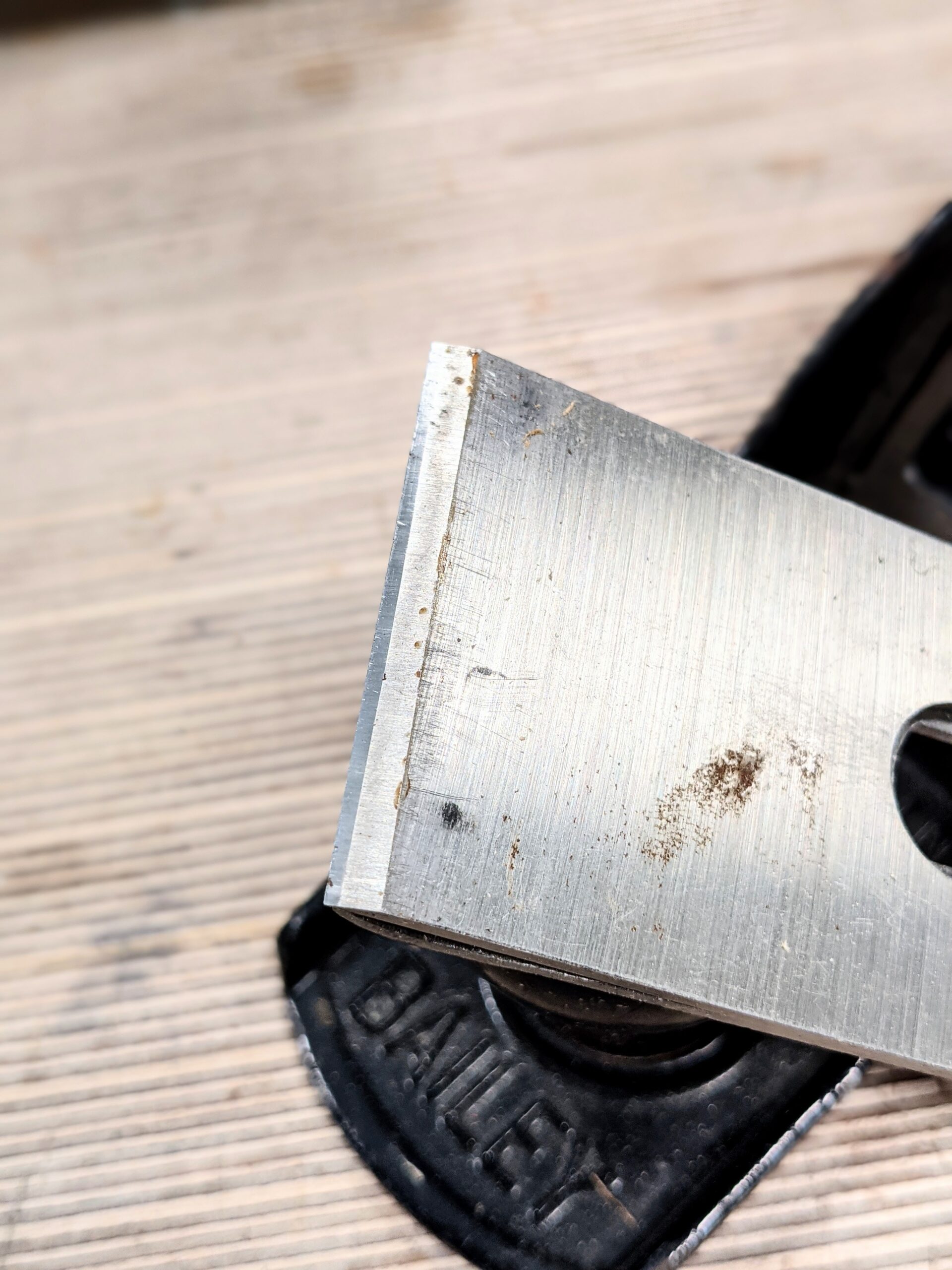
Funnily enough, though this jack plane needs only minor restorative steps, the cutting iron was indeed sharpened with bright shiny macro and secondary bevels as per any textbook and all of which advocate a two-bevel system for no good reason. Why do I say that? These textbooks usually advocate mechanical grinding of the major primary bevel followed by honing the secondary bevel sometimes called the micro-bevel. I advocate a no-nonsense freehand method that starts at roughly 30-degrees and in a continuous sweep with each struck creates an elliptical quadrant that starts at 30-degrees and tapers off to somewhere around 20-degrees. This can be more or less. It's quick to learn and highly effective for free-hand sharpening.
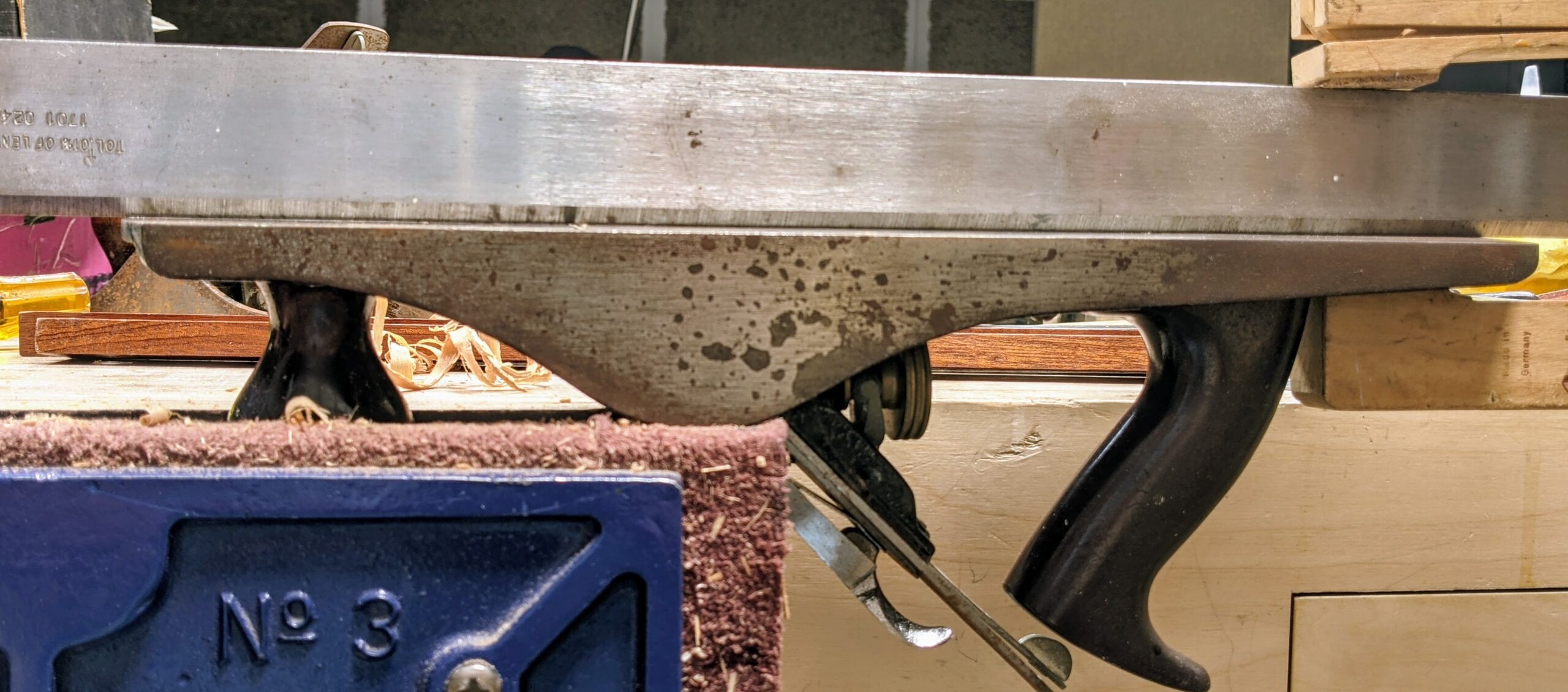
I will first just try the plane without doing anything just to see what I get. The big questions for most eBay and secondhand buyers are manifold. Is the sole flat? Are the sides square to the sole? Is the cutting iron flat, dead flat? Are all the parts there and do they all work? And what about that frog? Is it mated to the sole of the plane well and will it move easily when needed? Things like this race through a person's mind according to how much the modern-day gurus have posted online somewhere. There is always a certain level of legalism tied to those who became teachers by staying one jump ahead of others new to the craft. There is also a legalism tied to those who say of themselves, "Well, I am just a perfectionist." Usually, I find that this is less true of them than their being somewhat more arrogant and it serves as a way of excusing themselves with such statements in the same way people say that they are highly creative and sensitive in their work. That too is often not true too. Mostly they are too precious about themselves.
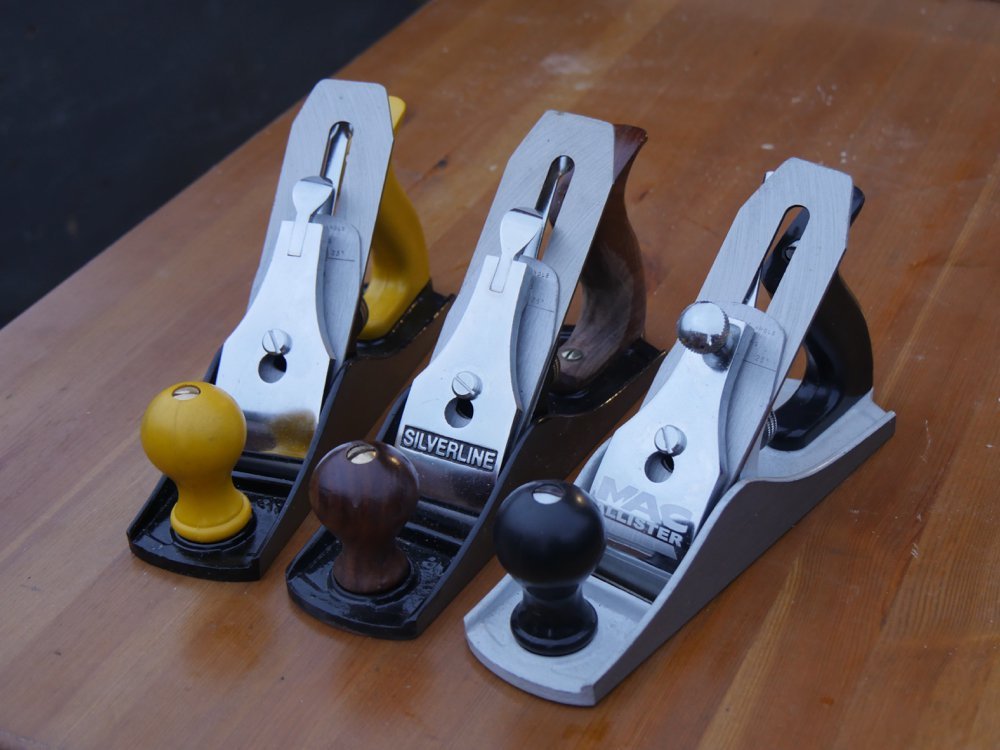
It's funny really because, for so many jobs around the house, the condition of the plane's sole and squareness to the sides, etc can often be of minimal or even no concern. It's when we get to the workbench work that the greater refinements become critical and essential to our work. That's why so many big box stores sell an inexpensive line of planes in their line of products. Planing off three shavings from the edge of a house door to stop it sticking might not need a £250 Clifton plane when a £15 import from Asia will likely do an acceptable job if there is enough muscle and weight behind the thrusts. A few 'tramlines' left in the door's edge by a ragged cutting edge in the edge of the door can be sanded out. Hey Presto! People buying modern-day Stanleys and Records actually have no idea where they are made and packaging is deliberately misleading. I bought two tools from a big-box store here in the UK where it clearly stated that the manufacturers were from the Netherlands and the UK. This statement was at the top of the package. 20 lines down and fairly well lost to obscurity in a long list of inconsequential information, it said, 'Made in China'. I suspect that the whole product line of hundreds of pieces were made in China by a Chinese company purporting to be manufacturers in the different countries. Perhaps owning an office somewhere in Rotterdam or Ealing is enough.
In my quest to encourage woodworkers past and present and then those yet to start their journey into real woodworking using their hands and bodies as the optimum power source has been ongoing since 1990. To do this, I have encouraged everyone to look to hand tools for their woodworking health, safety and wellbeing. It was slow going to pioneer a return to well-proven technologies but, strangely enough, it was new technologies that enabled me to reach those who were searching for the deeper things woodworking. In the beginning, when `i started to encourage others toward hand tools, it was almost impossible. The only open venues for me were shows that promoted the highest presence of machine sales. I felt discouraged at the first show I went to because the booths, all of them, were mostly for carpenters working on job sites. I thought that I didn't stand a chance. That was until I started cutting a hand-cut double dovetail and sharpening a bench plane, both in under two minutes. Suddenly, the seats, passages and aisles were packed. The questions never stopped and at the end of an hour demonstrating the crowd around my bench was ten deep. I suddenly saw where the American woodworker's heart was, and it's the same around the world.
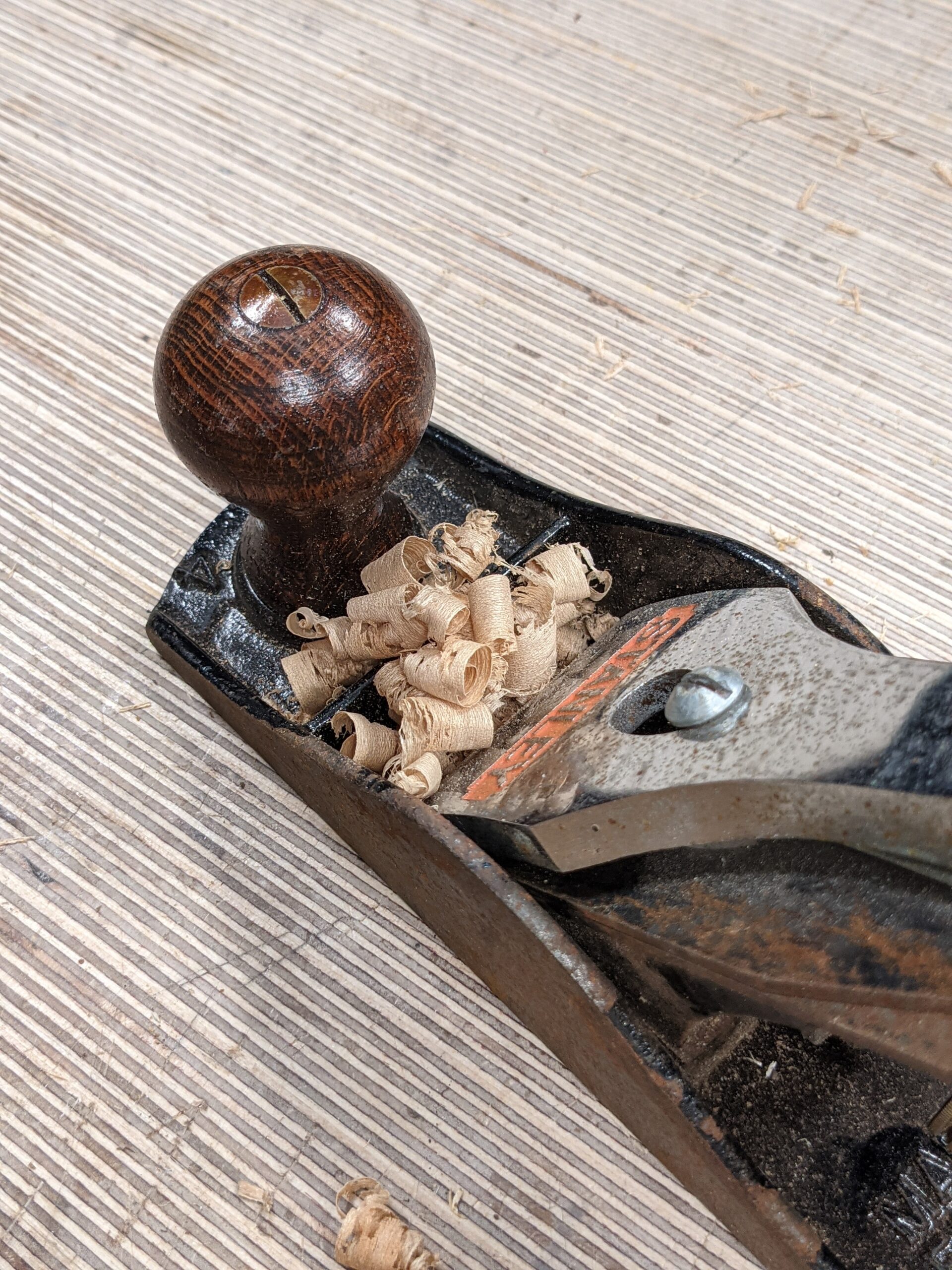
What makes hand tools so doable for woodworkers at all levels is the low cost and availability of secondhand woodworking tools and nowhere in the world is this more apparent than here in the UK. The plethora of secondhand hand tools available via eBay and secondhand sources makes the art of real woodworking possible at much-lowered costs for just about everyone. To replace what I can buy secondhand with new or similar quality quadruples the cost at least. Someone planning their hand tool future will most likely be able to buy all their tools secondhand within a few days or weeks and if they want the lowest prices and are prepared to put in a little sweat equity or say twelve months, searching diligently and with patience, they can likely buy all the tools they will ever need for very little money. Whereas the days of the 99p Stanley #4 on eBay may not come around again, buying smart could result in such a plane for under £10. Don't be surprised if an elderly uncle hears of your newfound craft and offers you his or his father's tools. Neighbours might hear you tap-tapping with a mallet and come over with a saw or a chisel set.
My recently acquired Stanley #5 Jack plane was to prove a point. Surprisingly, it did work straight away from the packing as did the Stanley #4. Both planes were logically packed well and arrived undamaged. The #4 smoothing plane was actually new and most likely unused or if it was used it was for under ten minutes -- the blade was unsharpened.
I will post another blog post to live up to the title of the blog shortly.
Comments ()