
Observations Series Post I
I thought it might help if I posted some life-at-the-bench practicalities for you. Much of the information on hand tools is available in my book, Essential Woodworking Hand Tools, but I can expand on some things a littler more with my reasoning here too. Also, go to commonwoodworking.com if you are new to or relatively new to hand tool woodworking. There is tons of great information there that we have put together for those just starting out.
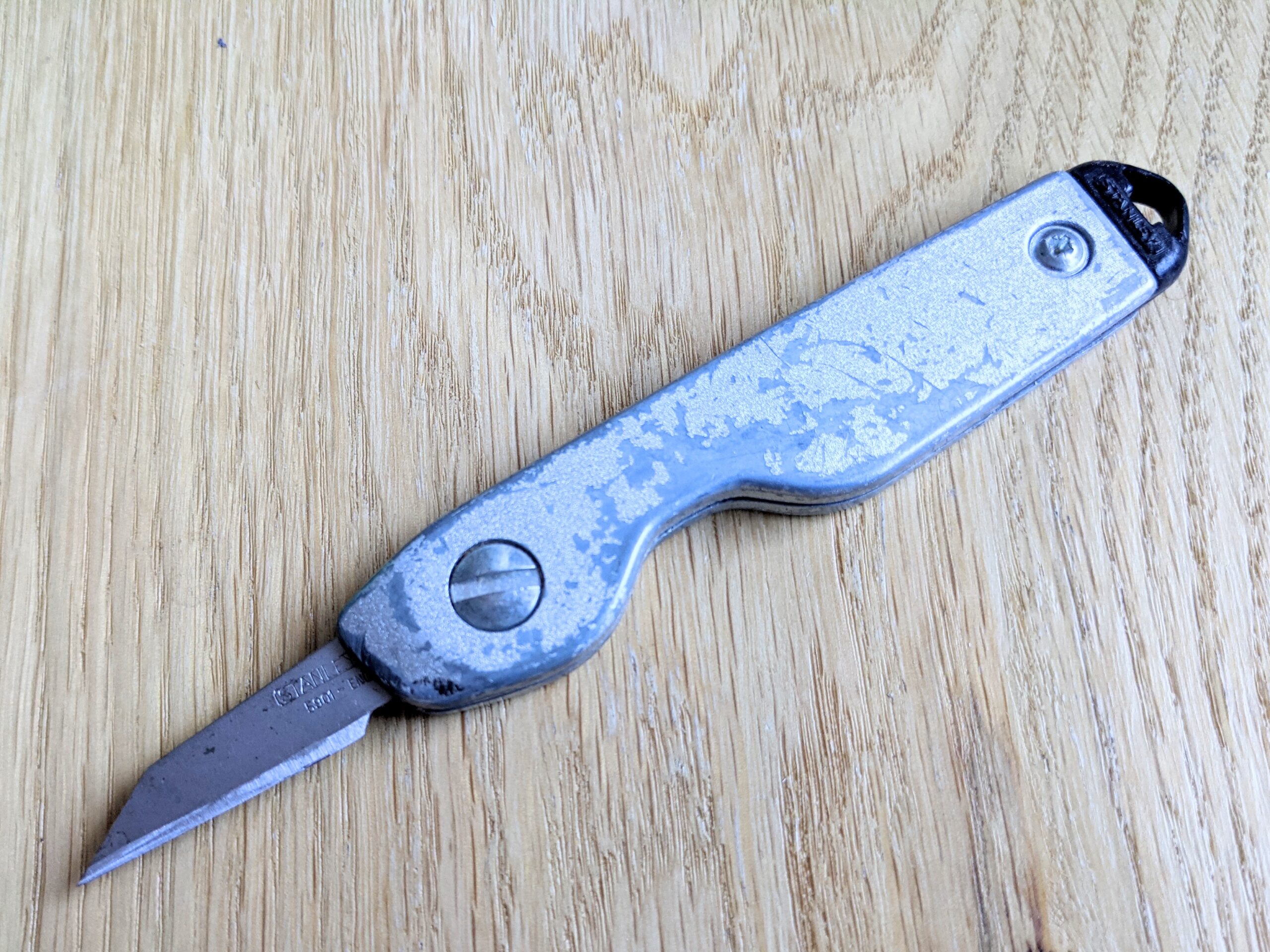
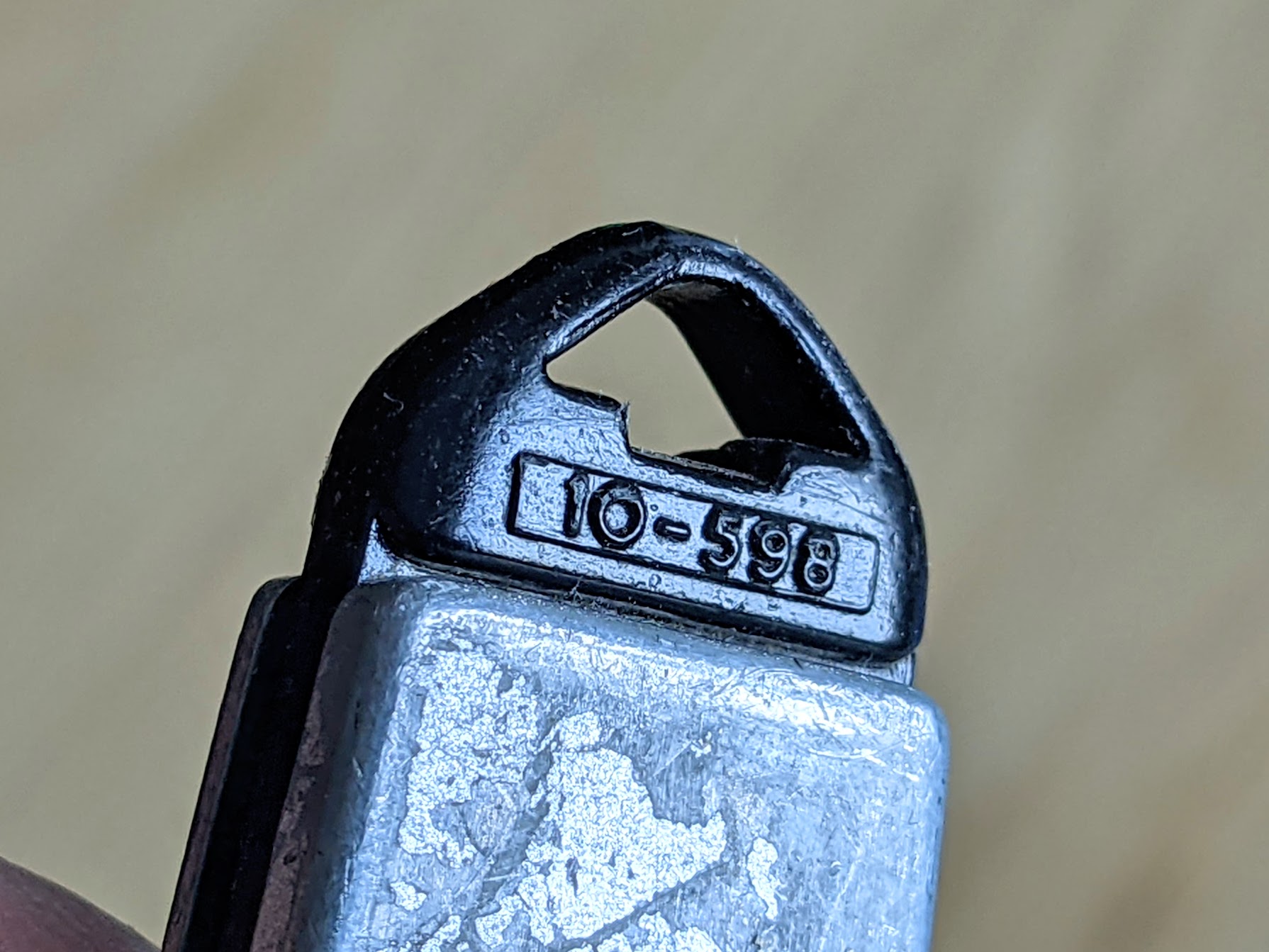
There are many tools that generally pass unnoticed along and around a woodworking workbench. Many get the merest nod, are seldom ever mentioned, and even though they may be picked up a dozen times in an hour or a day, somehow they seem less consequential than they actually are. I too gave many that passing interest even though I relied on them as much as the 'doing' tools like planes and saws. I own many knives for my knifewall work to create cross-grain perfection in the squareness to my shoulder lines. Though I own them, I seldom use them at all these days. Even my many hand-made, homemade versions, lovely examples of workmanship as they are, deliver more an evolutionary process that has led me to where I am today in reaching for my favourite knife, rather than any of the above. Of course, they all work well, but the one knife that delivers every cross-grain cut line for me is my Stanley 10-598. I would never say that it is a pretty knife, but in terms of functionality, I have yet to find the knife that beats it.
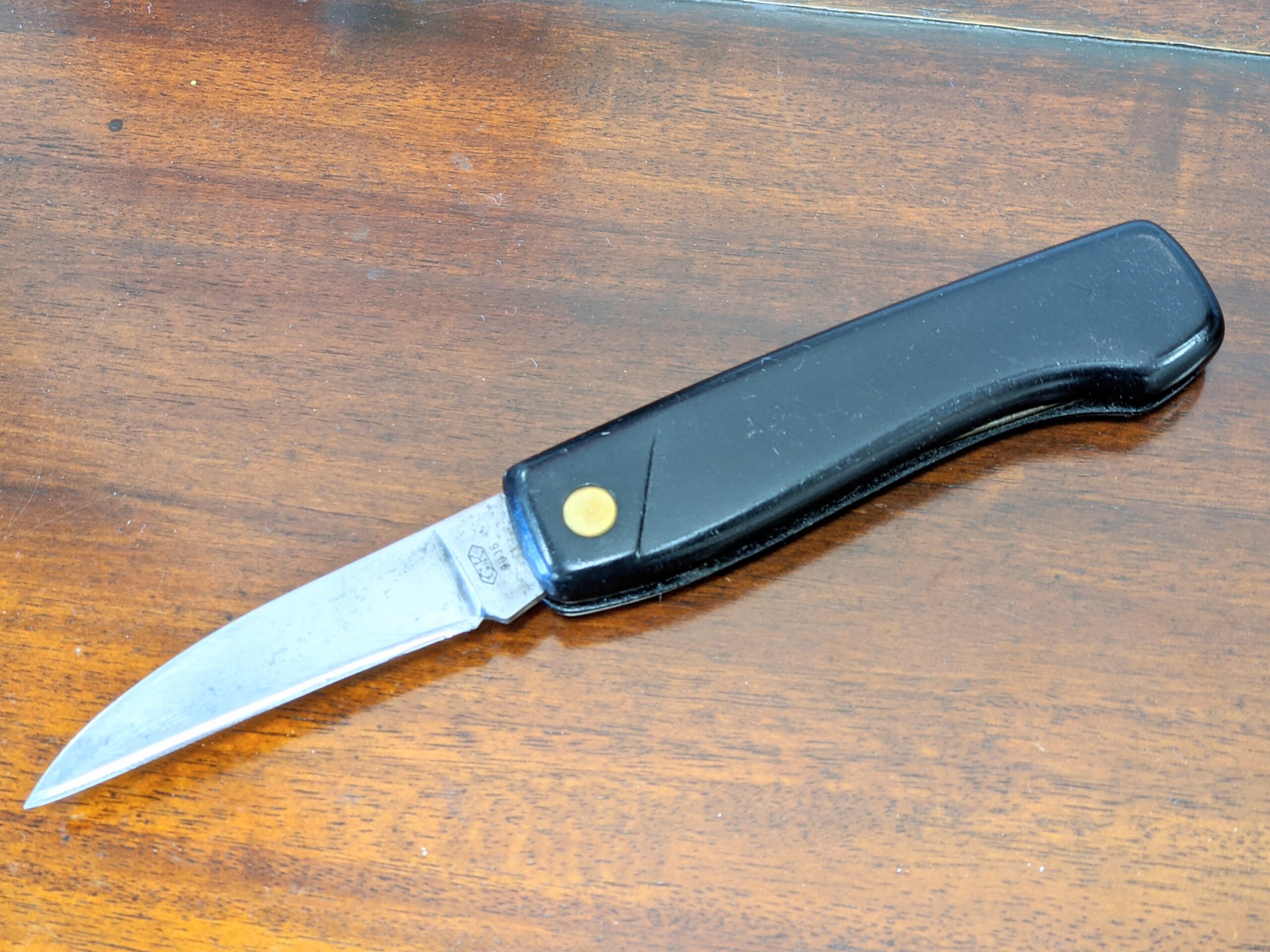
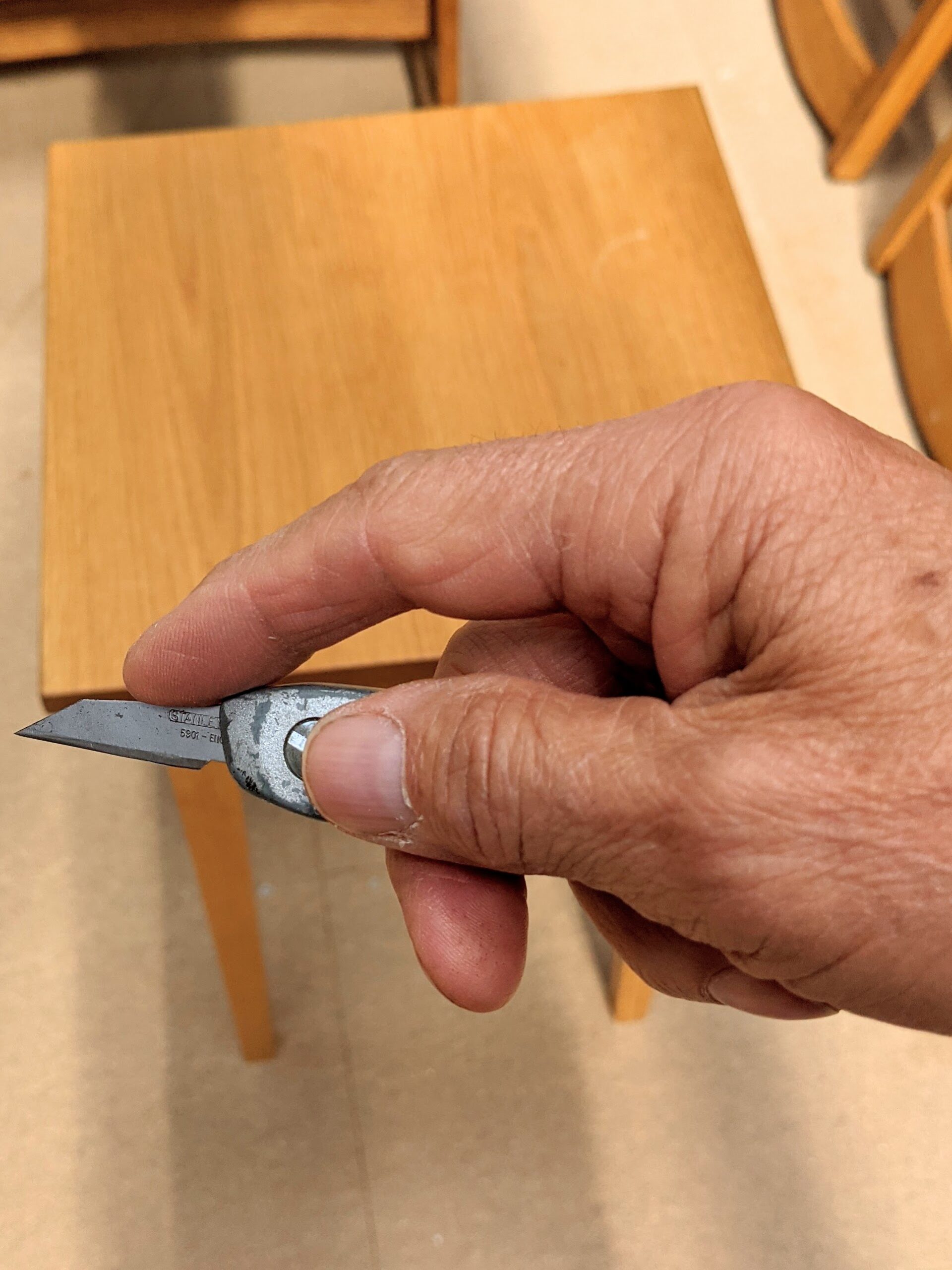
In most lives good pocket knives have gradually been replaced by the ubiquitous utility knife - those ugly versions with razor-sharp throwaway replaceable blades sold in packs of 5, 10 of 50. Over half a century and a score more, such a tool replaced all need for a pocket knife and so too the sharpening of knives. In most cases, the modern-day users could no more sharpen a knife than cut a straight line with a handsaw. That's why the blades are replaced constantly and rarely ever sharpened even though they can be. Knife sharpening skills have indeed been lost to most men for nigh on a century and yet at one time this skill was something all men knew intimately. As a skill lost, I doubt the future holds out much hope or that you'll find anyone on any scale capable of sharpening a knife. In my world, it was a skill mastered in boyhood and kept for life. Not unlike the safety razor that replaced the cutthroat versions, you will find it hard to find any sharp knife in most households, let alone a man's pocket. Below is my pocket knife. I carry it with me everywhere I go and each time a package arrives my granddaughter suggests we open it with the knife in my pocket. I sharpen it once a week, about as regularly as I wind up my 8-day wall clock that is as accurate as fifteen seconds a month and can be adjusted more tightly than that.
It was the spear-point knife that first drew my attention to knives in a different way. I know of many who swear by them and with good theory to back up their opinions. I admit here that I quite dislike their thickish blades and though the weight can be light in the hand, they are often too long and too thick for me. Long handles suggest or even necessitate holding them like a pen which is not the best ergonomic grip for most work.
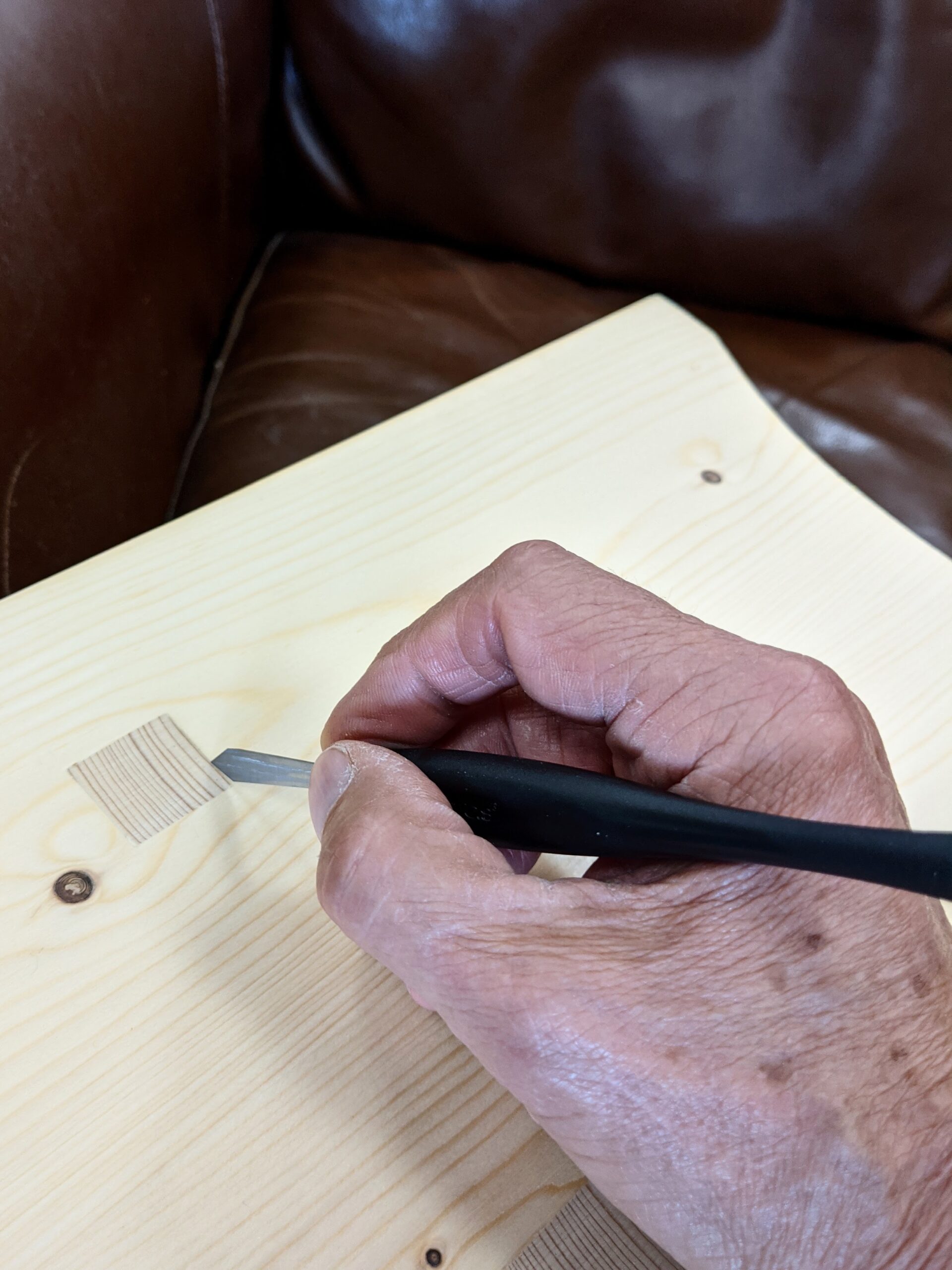
A knife that slips neatly inside the palm seems most perfect to me. There is no posing or poising about it. My fingers fold around it, support it wholly and it's this envelopment that I love the most because of both the comfort in use and the efficacy in creating my knifewall cuts which need more pressure. The supposed theories surrounding spear-points in most cases don't at all pan out with the supposed benefits, but, I agree, you can get used to whatever tool you have.
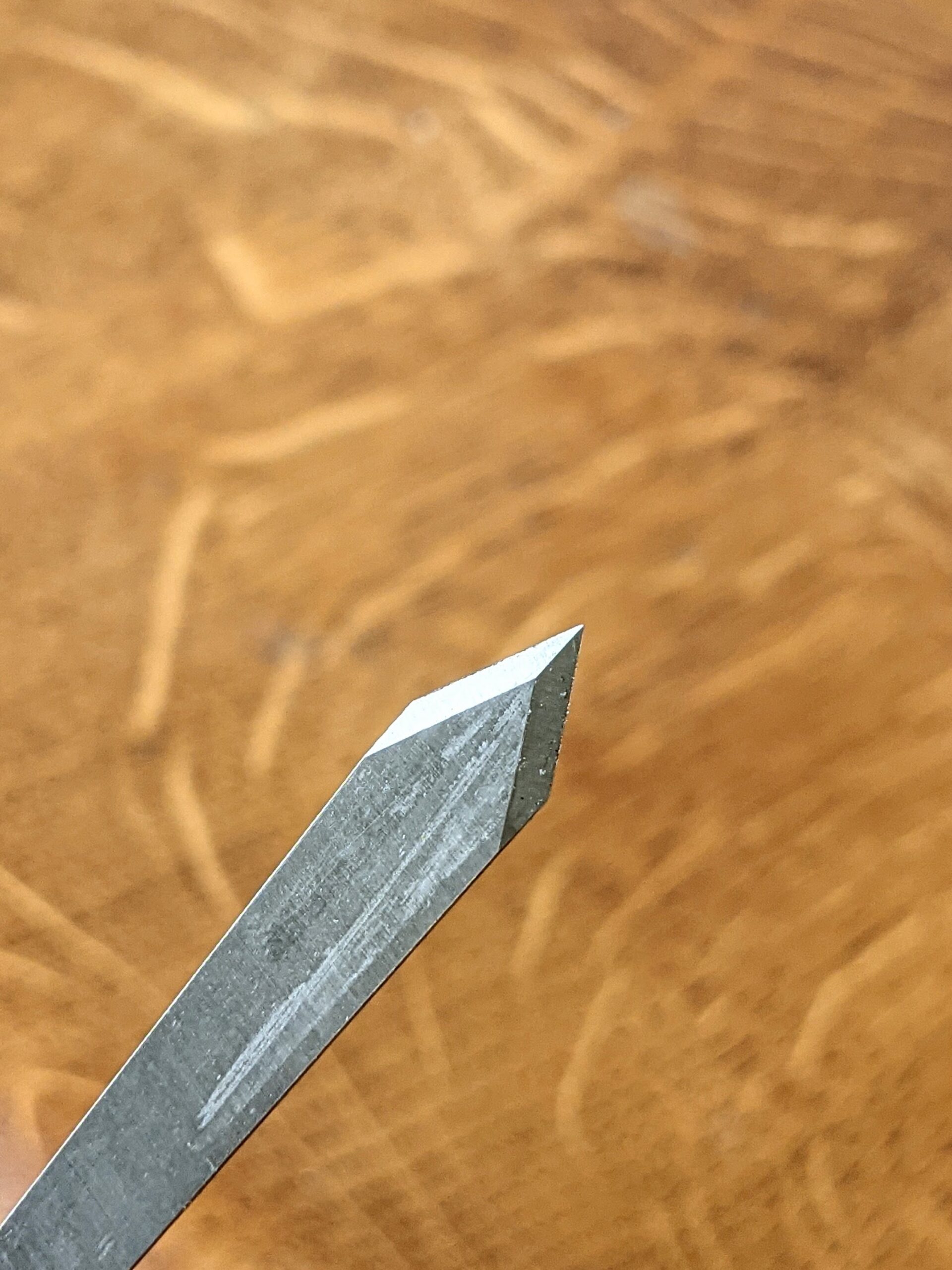
The idea that spear-point knives create a perfect vertical wall when severing fibres is not automatic nor any more a reality than with a standard, bevel-both-sides knife. In my view, it is simply a matter of getting used to whatever you start using. Using a spear-point knife is most likely a personal preference or a point-of-introduction tool (influencing at genesis) rather than the better choice. That being so, it's really of little consequence which knife you choose to get used to in your work. And I'm not looking for argument or trying to incite a riot with spear-point aficionados, just questioning the supposed logic and efficacy behind the theory that spear-points address the certain issues they're professed to, that's all.
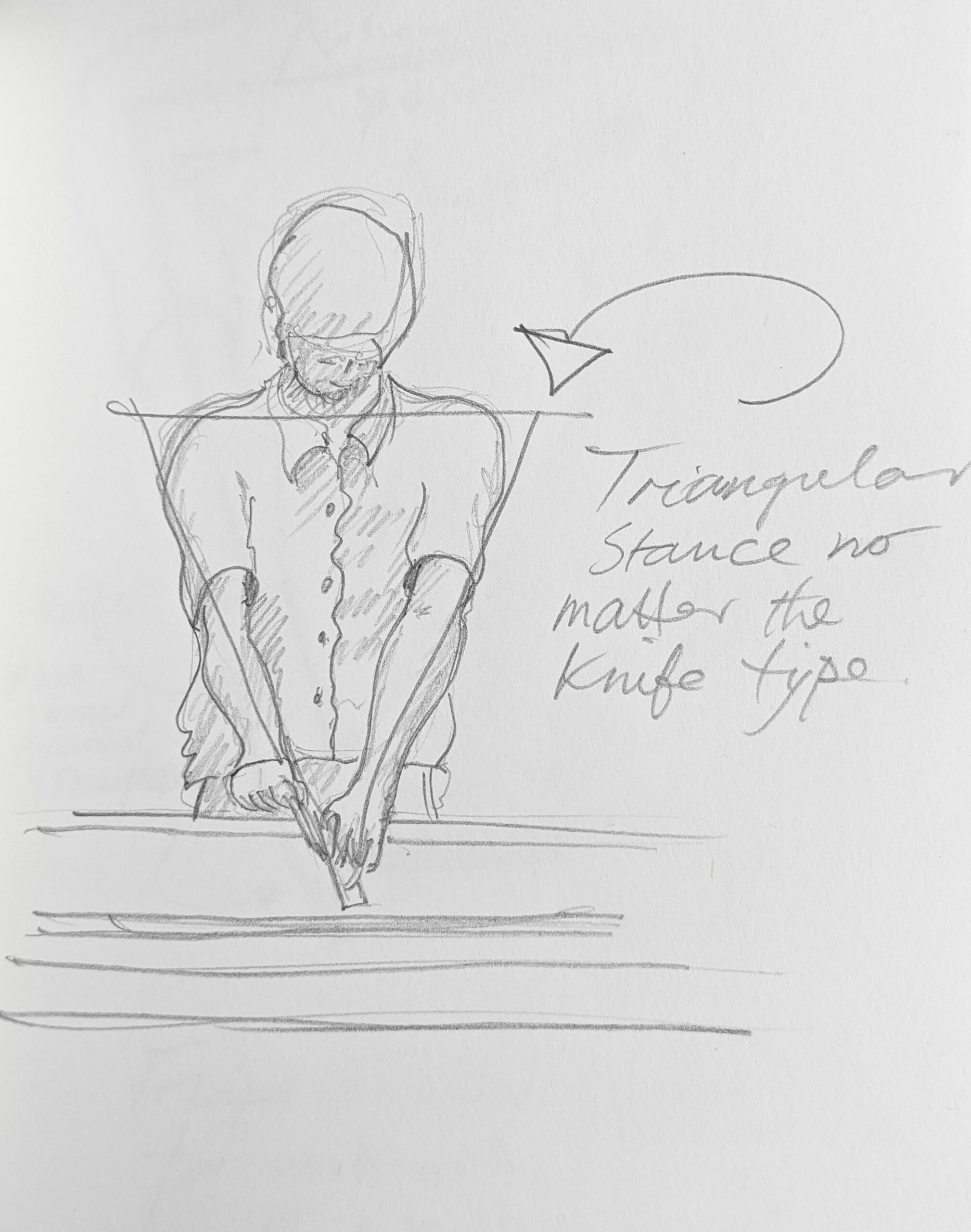
Placing the flat face of such a knife against a straight edge is not of much benefit if any. Why? Well, when you use a knife alongside a straightedge or square, you generally need both hands in near proximity to one another. One hand holds the straightedge and sometimes the wood simultaneously, the other, the knife. The alignment of shoulder to hand functionality creates a triangle between three points of the body - the two wide shoulder-point extremes down to the side-by-side hands. Commensurate to this stance or positioning, the triangular reality the human body assumes when using any knife for a two-handed, two-tool necessity becomes self-evident. To clarify, moving the hands in to any point from two broad shoulder extremes to a pinpoint position to strike a line along a fence is quite less natural in the many applications of creating the knifewalls we need and use to create them. Experience tells me that, whereas verticality may be the intent, rarely do we actually achieve it.
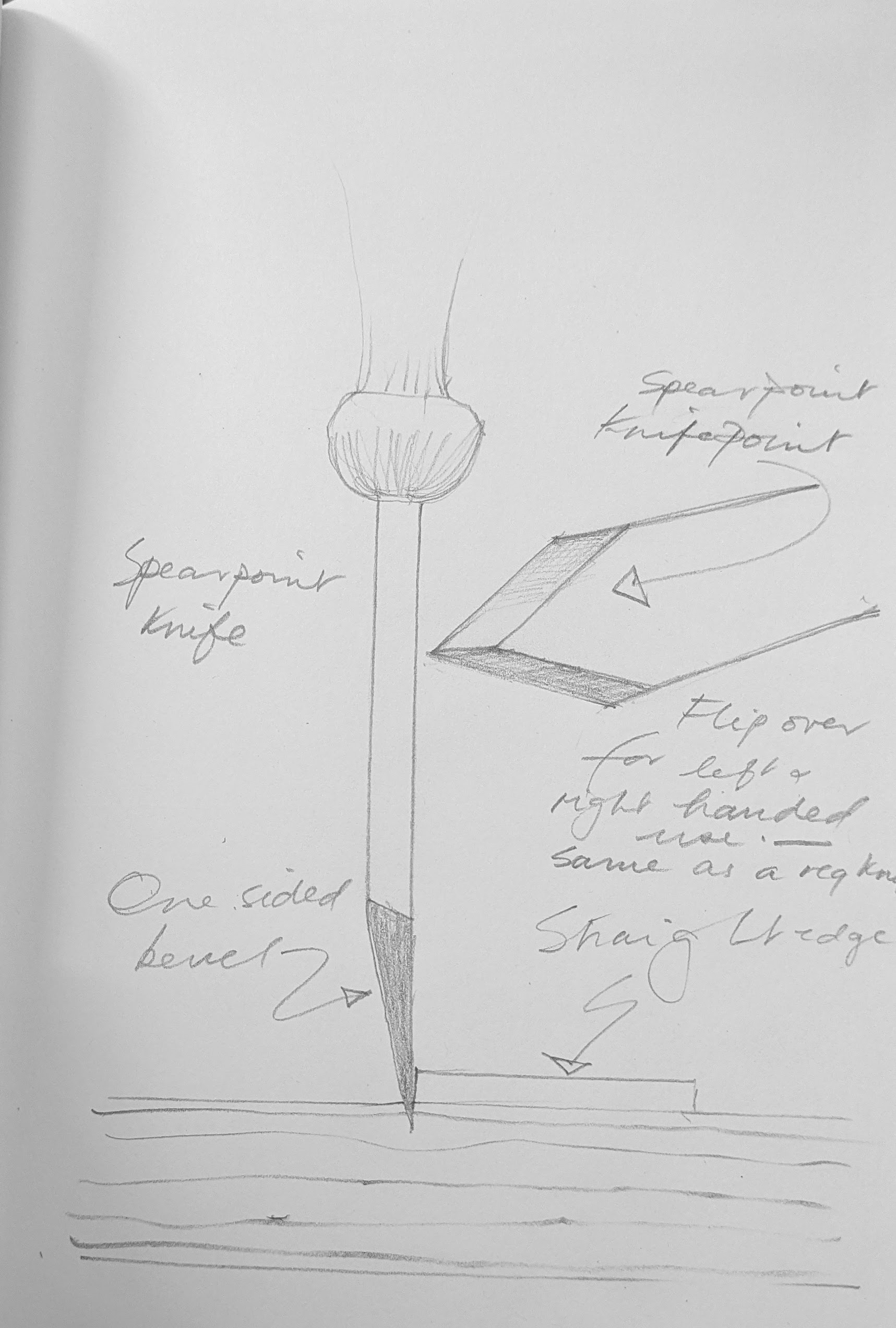
Supposedly too, this saves having to own two separate knives with two opposite bevels for left and right-handed use by the owner. Of course, as I pointed out, buy a knife with a bevel on both sides and you only need one knife. It's no more easy to use a spear-pointed knife than to use two knives. Most people will find it awkward to use any knife in their non-dominant hand no matter what until they have trained themselves over a number of years. Only in the rarest of cases do you find either an ambidextrous user or a two-handed user. In my own life, after 55 years using the knife daily minute by minute, I still find less control with my left hand than my right. The reality is that the dominant hand will feel perfectly natural and the other utterly awkward. Also, the idea that flipping the knife for a left-sided presentation (as in the spearpoint versions), using the non-dominant hand as a matter of improved dexterity, is far from practical and achievability too. Frankly, well, it's truly quite awkward. Of course, this is just my point of view and someone will no doubt offer another perspective from their preference. But we should realise that it is indeed a preference and not a better option for the vast majority. On the other hand (no pun intended), a bevel-both-sides knife compensates perfectly well for the triangular presentation of which I speak.
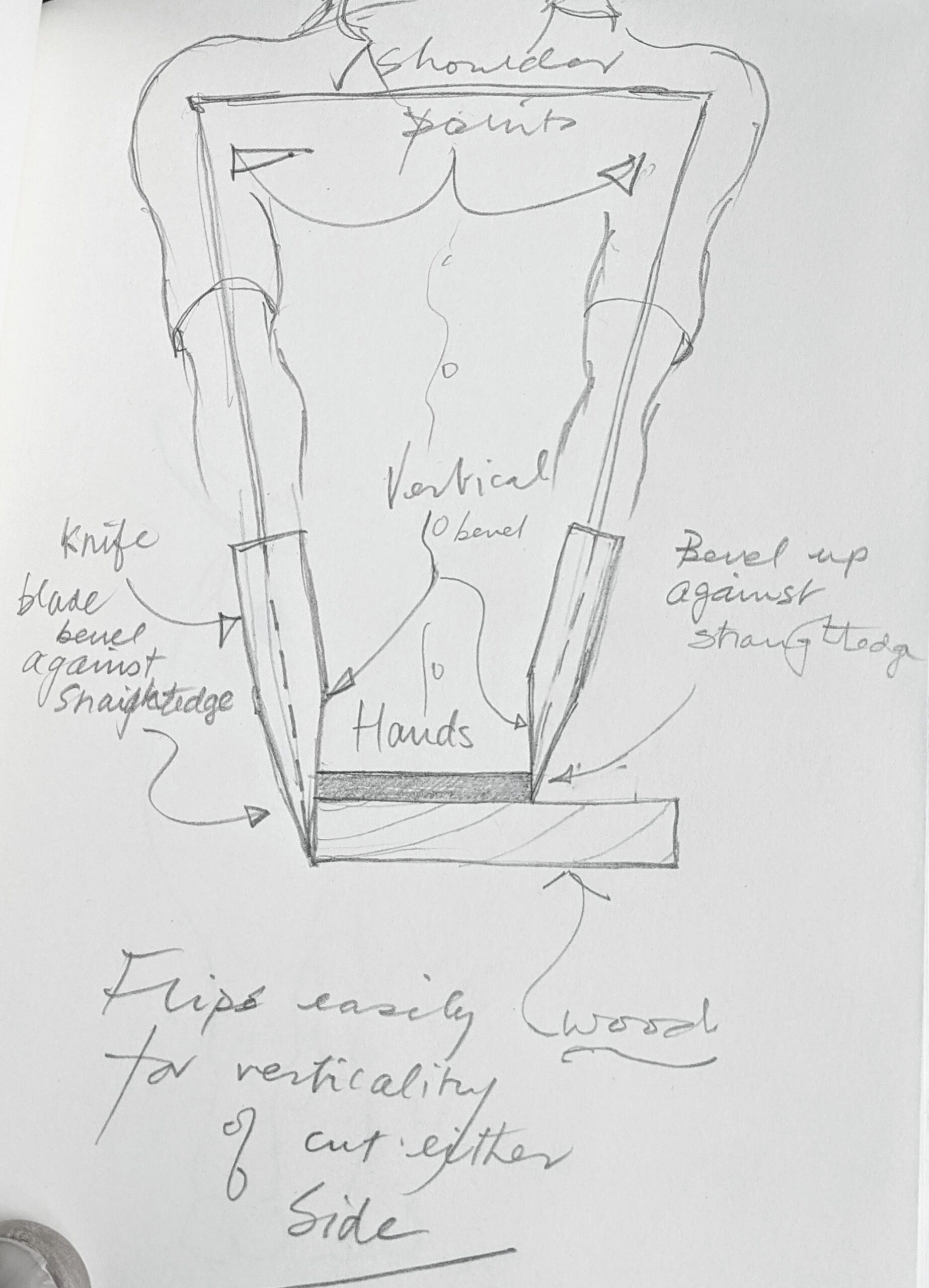
The knife, so held, presents the one side of the bevel with relative verticality against the straight edge of the square or straightedge perfectly well, if you think about it, and flipping from one hand to opposite hand means the same opposite bevel side is presented with the same verticality. Adopting either presentation in left or right hand, the shoulders being wider, will cause the hand and arm to adopt a perfectly natural angle that compensates for the actual bevel of the knife perfectly. I think adopting the double-sided bevel on a knife is quite apt to address the work of any woodworker. With the single-sided bevel knife, there will be a 15-degree difference pushing the limits on the human form further, one way or the other. The user must bring the hand in to a more central position, forcing the hand itself to verticality in the central position.
Of course, you can buy some quite fancy spearpoint knives for good money and if you like them then there is no reason not to buy them. My favourite knifewall knife now is the Stanley Folding Pocket Knife shown at the top of the page, but not because the blades are throwaway but because they are easily resharpened in seconds and then too, very important, they seem to keep their sharpness for as long as any other knife blade anyway. I wanted something that was readily available and relatively low cost for everyone. It's a nice knife and I have had one of mine for about 17 years with no sign of wearing out or any malfunction. I have found that spearpoint knives are not so easy to sharpen as regular knives because of the awkward geometry and the points themselves don't seem to retain the pristine edge I get with bevel-both-sides knives. If I were to sharpen my knife in front of you you would indeed see what I mean. It is literally a few strokes each side in under five seconds. Use any knife type you prefer. It makes no difference as you will usually adapt to the one you adopt to use anyway.
Comments ()