
Discovering and Woodworking
I'm not altogether sure what makes for a purist. Some have cast me as a man that hates machines, someone that refuses to accept progress, eschews the use of machine methods for working wood. These are the assumptions of those who know little about me or indeed prefer to cast doubt on the efficacy of hand tools as a viable means for working wood. The dividing line for me is much simpler. The dividing line for me is my choice to teach only skill-building methods to others to work wood with. Over the past century, we can do nothing but admit that skills, even the most basic skills, have been severely diminished and continue to diminish to the point of disappearing. But it's skill that sustained me through what is nearing six decades as a full-time woodworker and furniture maker. By sustain, don't get me wrong, putting food on the table and making an income is but a percentage of what life has been about for me as a maker, the other half of this, the important half, the part that mattered the most, was my having the freedom and the ability to live a life as a maker and then to help others to do the same with their one life. The skills I speak of defy the quest for ease, the quest for much money, the desire for recognition and power. I didn't want speed, progressive ways of working my wood, an unskilled life, such like that. I wanted the life of enterprise, free choice in designing, simplicity and skillfulness. In my search for such, I discovered that many if not all that I came across seemed to shun working the body in union with the wood in every way. I didn't want power feeders and dust extractors, T-slot systems and hold downs for safe handling and guaranteed alignment. I hated the thought of making jigs to hold, steer and guide and biscuits, dowels and dominoes have to be the most boring things in woodworking hands down. The dividing line for me was skill and skilless woodworking.
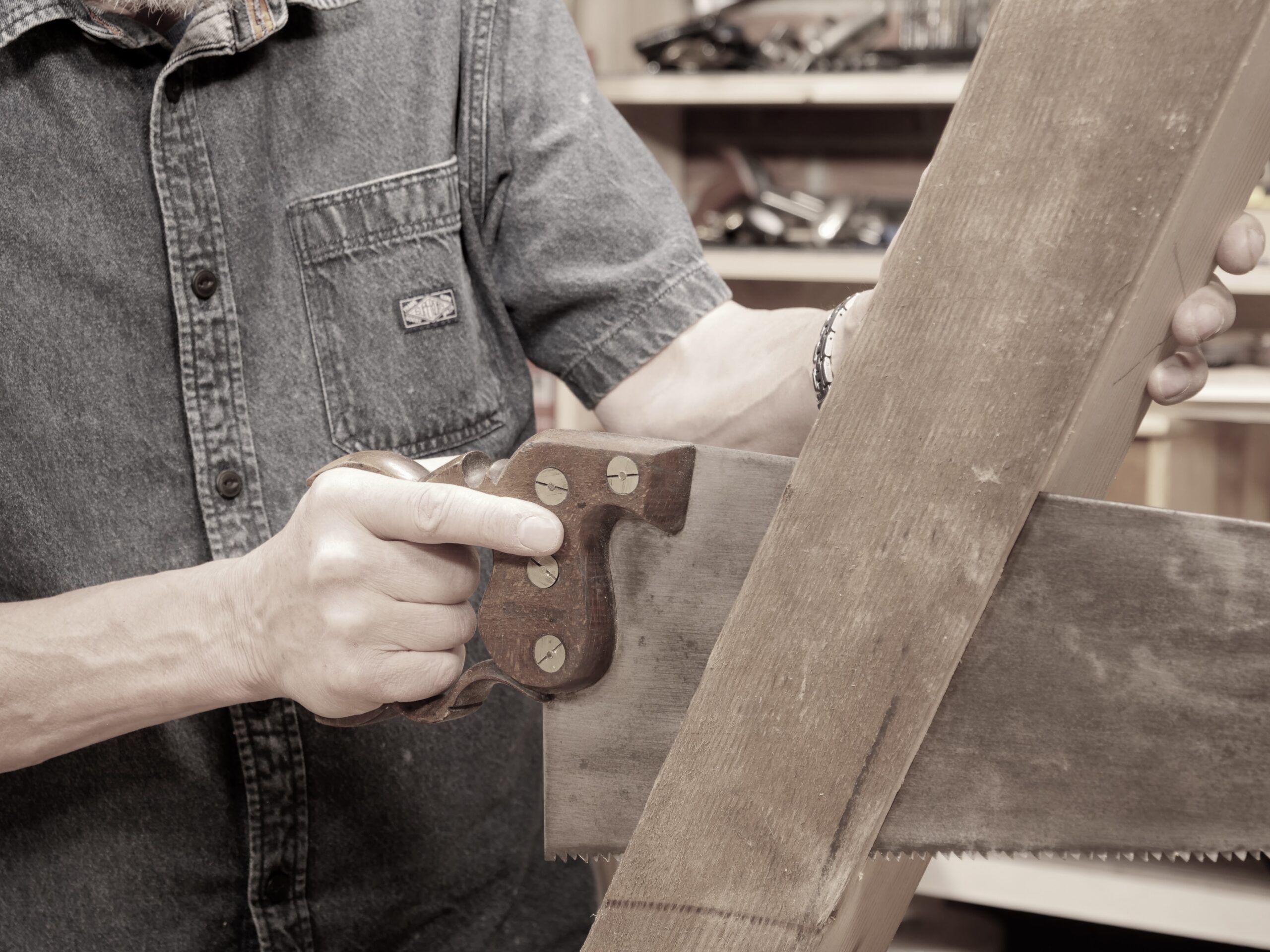
By basic skill, I wonder how many will take this the wrong way. You see, I do not mean fine inlaying or carving ornate and ornamental designs in three-dimensional art but the using of different handsaws and all that that entails. You might think my enemy to be Japanese pull-stroke saws made in China and Japan as well as other Asian realms. Not at all, my enemy is the destruction of skill by creating tools that cannot be sharpened and the whole culture that surrounds that which is rendering others unskilled by creating tools that must at best be discarded. My enemy is the belief that the whole world of woodworkers must always own machines to do the work that in general people now believe defies the accurate milling and machining of wood in every area of processing. I no longer met woodworkers working with hand tools in almost 30 years except those that I had trained. How could this be? And for about 30 or more years I never met a woodworker that could sharpen his or her saws. Buying throwaways is fine if that is what you choose to buy into, but if it's that you don't have the skill, well that's another thing. I wanted to make sure that too was a choice. We should all remember that tool makers don't make woodwork. Anyone that makes any tools is solely in the business of selling tools. Nothing more and nothing wrong with that.
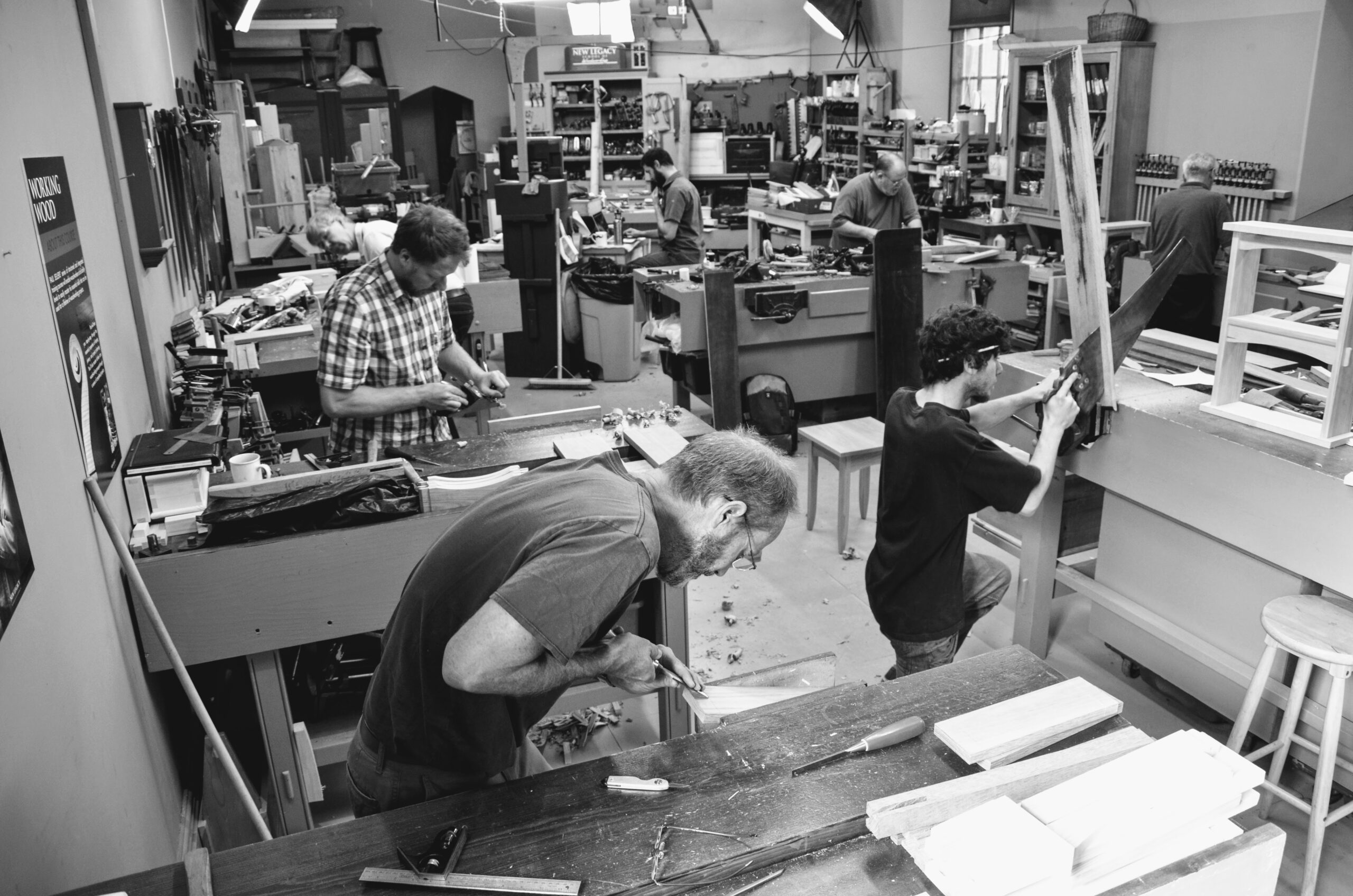
Over two decades living in Texas, and then traveling to another dozen or so US states, I discovered new woodworkers. I choose the two words, 'discovered' and 'woodworkers' for sound reason. One by one, hundreds of men and occasionally one or two women, watched me working with my hands at woodworking shows. They were passively watching over the first two minutes but then passivity left and intensity took over as they moved to the edges of their seats, "Did I just watch him cut a dovetail in two minutes?" This demolished the belief that dovetails could only come from a machine loaded with a router bit and wood held in a jig guide. I would plane up the outside faces of the wood with a # 4 Stanley plane and again they were amazed. Busting the myths and mysteries of handwork took me just a few minutes. My demonstrations were always packed and not one person left even though the demonstrations were the longest and largest of any in the auditorium, at least one hour. So, my chosen two words? Discovered was the realisation that somehow I was unearthing a massive population of people, almost exclusively men, who had unconsciously taken up woodworking without really realising that they were mostly machining wood using high-ticket machinery that took a massive footprint in their garages. My 'discovery' was that they were truly interested in methods many had mostly ignored as archaic and outdated or indeed had never seen in real life. Suddenly they were believers. I had hundreds of converts from each show I demoed at over a 25 year period. This is what led to me becoming famed only as a hand tool purist when in reality that restrictive title belongs to others, reenactors and the like, living-history museums, not me.
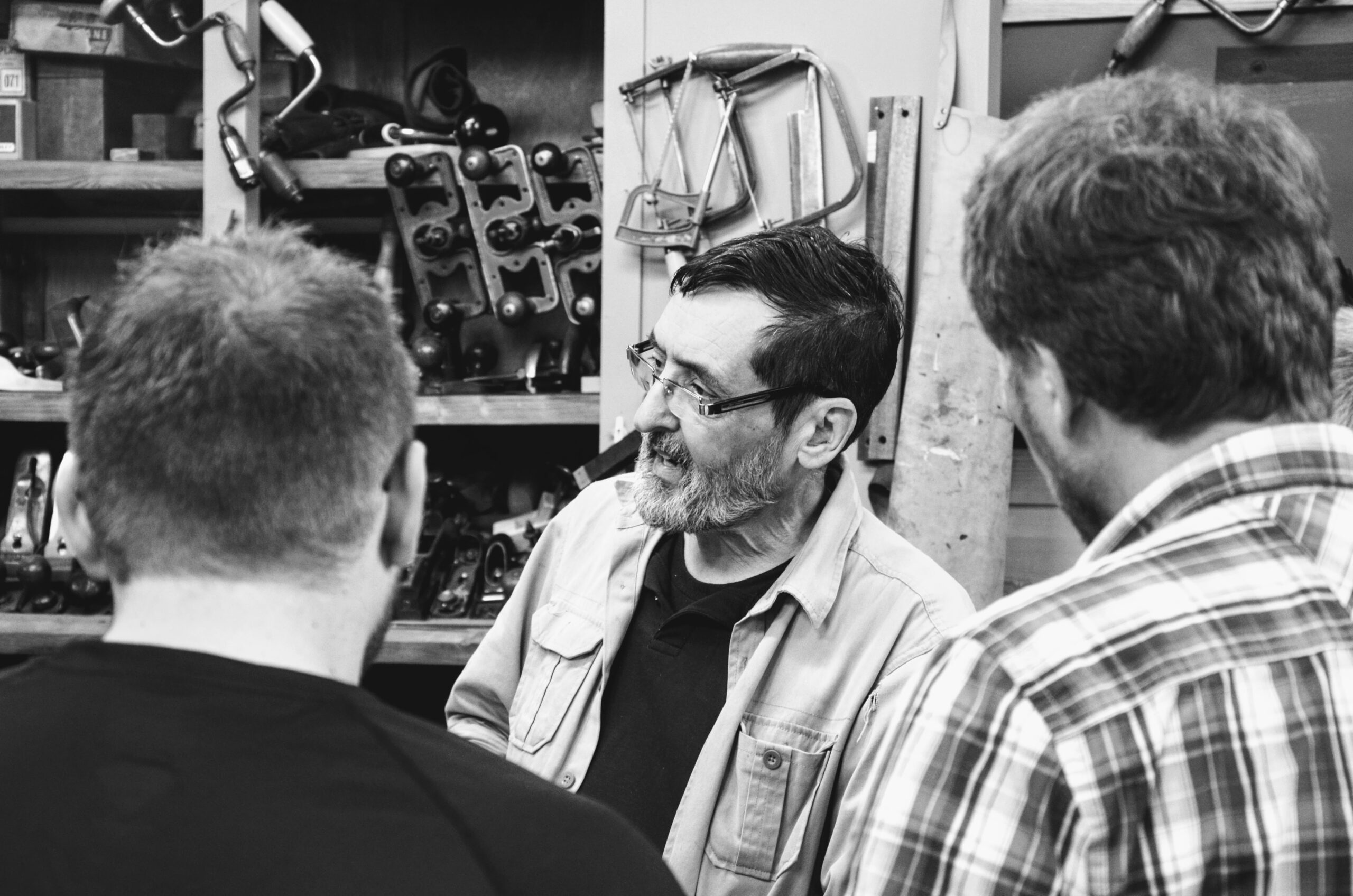
The 'discovered' is that there is a sort of underground mass of woodworkers who quietly and unobtrusively practice woodworking in their shed or garage at weekends and in the evenings on their own. I discovered that their love and passion for woodworking and their knowledge and skill levels far surpassed that of the so-called professional, certificated carpenter. I discovered that they were just like me but that most of them could only find machine-only methods and that this for the main part was due to woodworking magazines showing half of their pages with adverts for machines only. The word 'woodworker' is the other carefully chosen word. A carpenter never refers to himself as a woodworker, at least not the ones I have ever met. Woodworker and woodworking are reserved for the amateur, whereas carpenter means that you make your living from, well, doing carpentry. Woodworking is much more expansive and then too inclusive and woodworking can mean everything from carpentry, joinery, intarsia, woodturnery and much more.
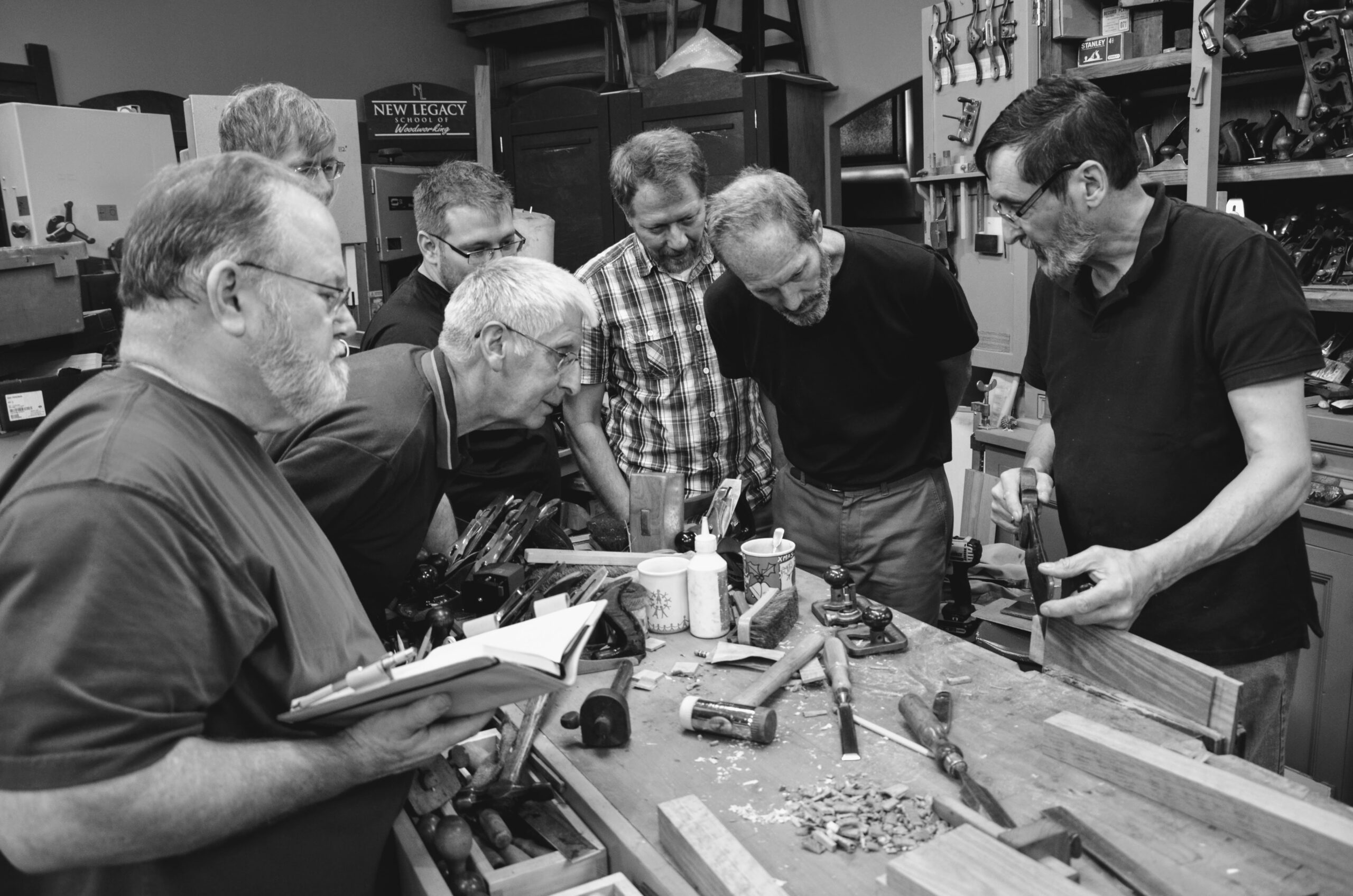
One by one the people were converted by my simply and quickly cutting a perfect two-minute dovetail in the middle of a machine show with a handful of hand tools. You see, the basic skills I am speaking of is not how to saw to a straight line, though that is important too, no, it was and is much more; the skills I speak of are how to sharpen the saw itself, all saws, how to change the pitch of the teeth or indeed change the ripcut saw to a crosscut saw in a matter of five minutes. What of saw setting and so on. Could it be that I could develop a teaching plan that would equip that generation of newly emerging woodworkers now seeking hand tool methods to work their wood with? Could I work with groups of people with whom my life now seemed to unite with; people who actually wanted skilled work rather than machine work only? And what of those who could never own the types of machines of which I speak? People living in a high-rise, a tiny home, social housing? What of those in a bombed-out middle-east and an isolated village in Asia?
Over the years I find myself intentionally evolved with my craft by a path I call the de-industrial revolution. When I discovered that I was on a mini-conveyor belt system 30 or more years ago I cried out in my head, "Stop the world! I want to get off!" No one ever again was going to push my buttons because what evolved for me was the better way of working. I went right back to the very root of where and when I first discovered real woodworking. I wanted the hand tools and I wanted the rough wood. I did not want the conveyor belt and the diversions of new gimmicks. I wanted the freedom hand tools gave me to think for myself and I especially wanted others to rethink what they were doing with their lives.
Comments ()