
Where is the Point?
I am never sure if it's a unique phenomenon to woodworkers alone or whether it is an element that only affects them, but for some reason upcycling a plastic-handled throwaway saw costing £7 to become card scrapers somehow gives credibility to an otherwise limited tool, a tool that's lost the point.
I suppose salvaging the tool to live a second life beyond its built-in obsolescence might just justify its low-cost purchase in the first place, except it is not really such a low cost if it only lasts for a few months of daily use. But lets face it, if you have some periodic home carpentry to do a few times a year, saws like this can be the obvious answer and they do work well anyway. The issue here is what do we real woodworkers do for the best in our bench shop? At least upcycling a saw plate might be a way we are saving the earth from choking up on steel and plastic, or is it? Also, just how many card scrapers does any woodworker need. I've had one of mine for over 45 years and it seems as big as when I first acquired it. Of course, we all know that the tool will not be landfill fodder and neither will it clog up the arteries of our rivers before starting on the seas. Both steel and plastic can be melted into another amalgam type to come to full resurrection as a pair of kitchen scissors, knife and a few lightbulb connectors, according to global demand.
Much of our consideration as hand toolists is to be advantaged by this free thin plate beyond life as saw. I am regularly asked if the blued teeth can be snapped off or softened to recut or sharpen then and rehardened with a blow torch. Well, I'm a busy maker teaching others, and guess what! It's a full-time job for two people done by one. I think sometimes some things are what is just an interesting thing to do in what might otherwise be a dull and dulling day. I don't have such days because I disallow them. But in some ways I liken this interest to the man who took off after a rattlesnake, caught it, killed it and cooked it and an hour or two later said, "Mmm, tastes great! Just like chicken." So why not just go along to Kentucky Fried Chicken? My question back might be why buy so ugly a saw that's designed only for crosscutting and engineered boards like pressed fibreboard, Oriented Strand Board (OSB) and plywood and not one that you can sharpen straight out of the box for the next hundred years?
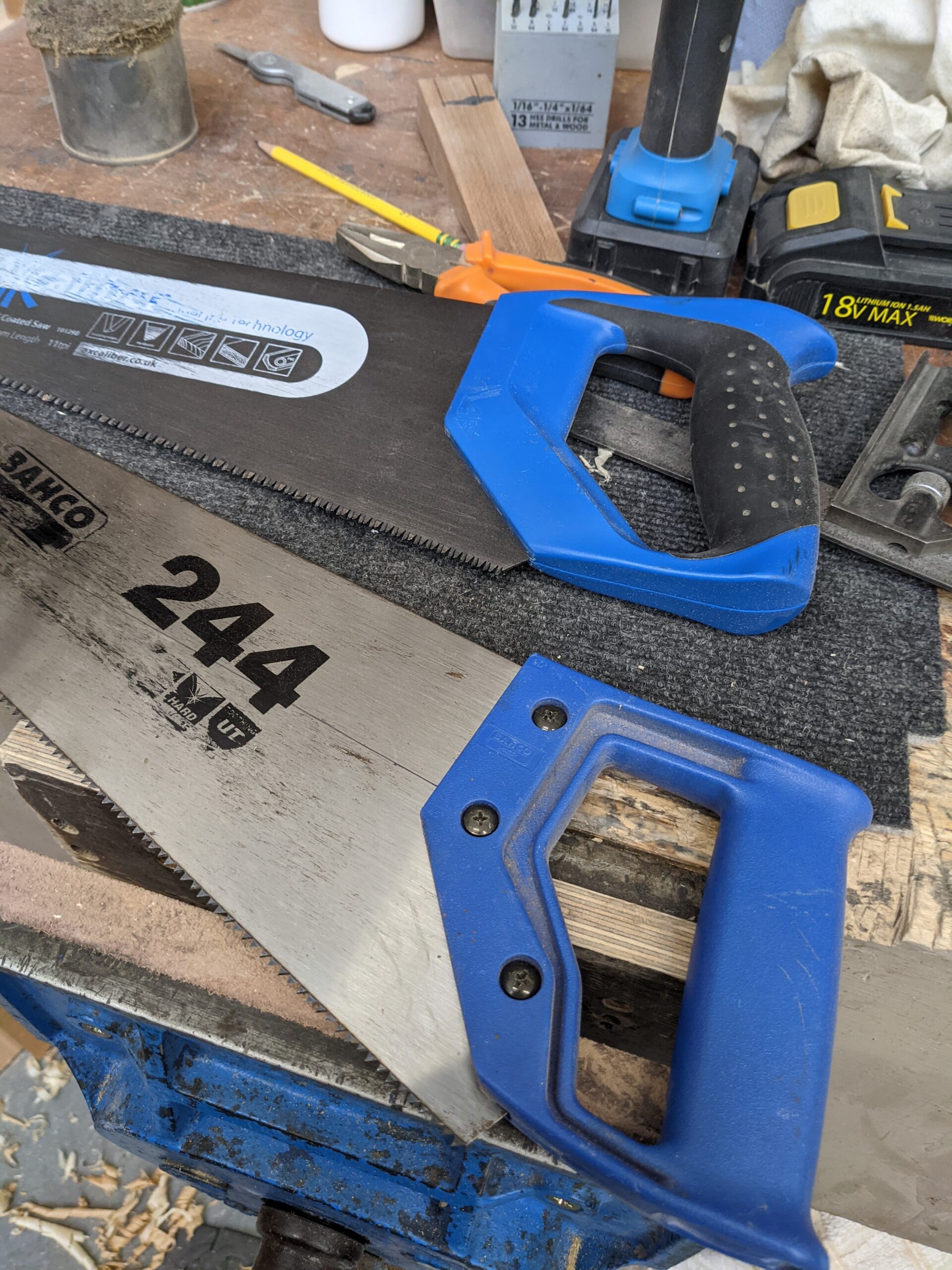
Of course, the thing that justifies the purchase of a disposable saw is that it has teeth designed to cut only across the grain and not along or with the grain. These pinnacle points sever the fibres perfectly well and it makes no difference if it cuts on a pull or push stroke. The hardened teeth do keep their sharpness up to about five times longer than a saw with a conventionally hardened plate and that is that it can be readily sharpened in about four minutes, thus allowing the sharpener/user to sharpen it throughout a lifetime of use. I have been resharpening my saws for 56 years and by that I mean the same saws. Responses I get from 'professional' carpenters are, "Time is money!" or "I can't afford the hours it takes to sharpen a saw." Nearer the truth is that they don't have a clue how a saw is even sharpened never mind the skill. Not altogether their fault if they never believed that they could. This is of course a matter of personal choice though. Everyone can learn to sharpen any saw in a matter of an hour or two spread over say a year. Even a badly sharpened saw will cut well enough and certainly as well as a disposable saw that's gone dull. It will prove economically viable if you take time to learn saw sharpening as a skill. It is worth the time to at least think about it and the benefit is that you can change the saw pitch of tooth and even tooth type to match the work you are about to do. Of course, the needs of a construction site carpenter on a busy site is not the same as a furniture maker or a more general woodworker. It's competitive work and then there is of course peer pressure too. Here at the workbench we mostly do not cut sheets of OSB and pressed fibreboard - not part of our remit.
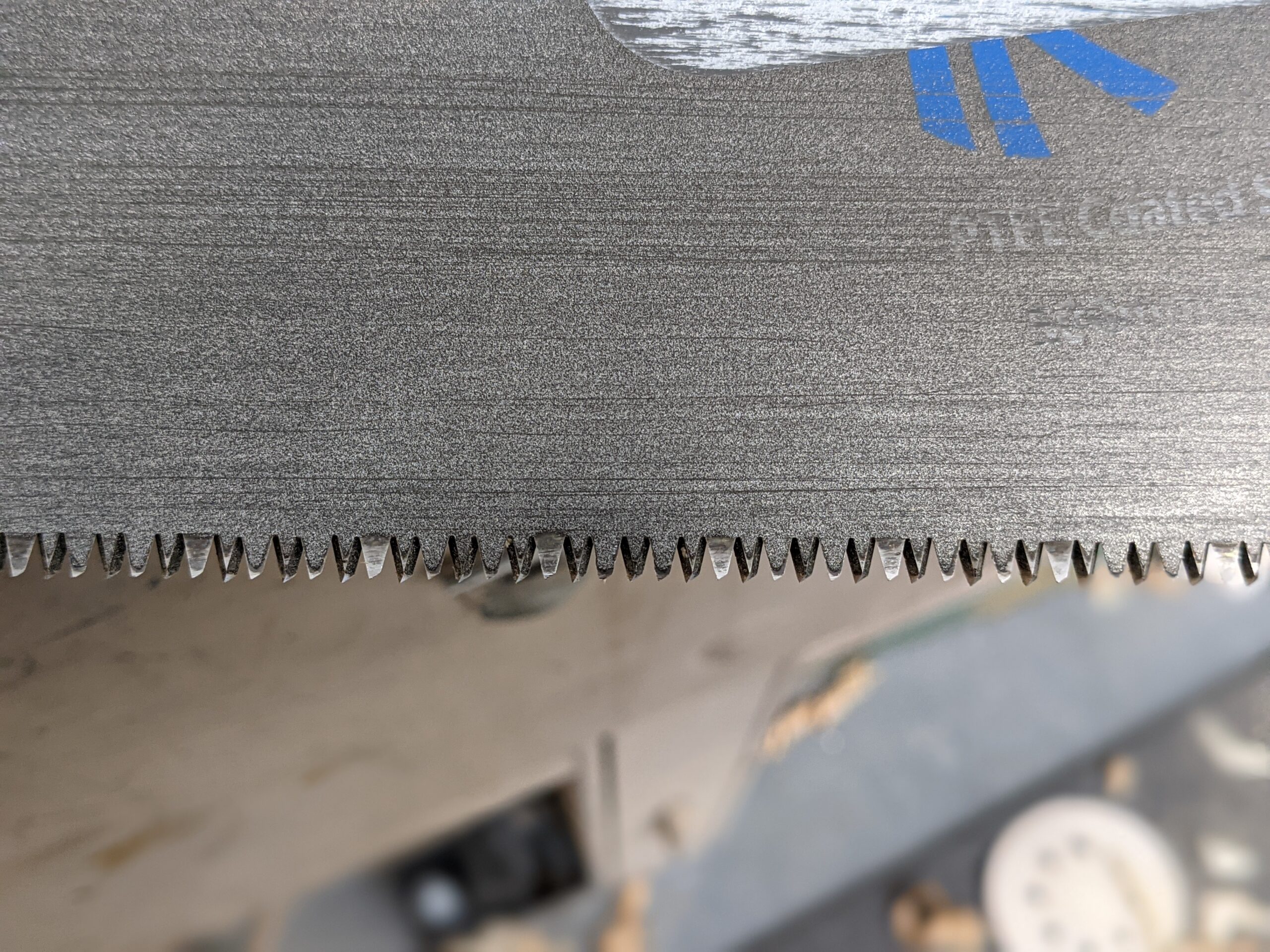
I own two disposable hardpoint saws and both suit my needs well but on a limited basis. These are my preferred outdoor saws for garden carpentry of the type I have been doing at my house in the building of fences, bed curtilages, sheds, decks and greenhouses. Most of the wood I used there was pallet wood, treated 9and very wet decking and siding and old wood salvaged from skips. If I hit a nail or staple I still get miffed, but less so than I would with my workshop saws. In other words, these saws have their place. The term 'universal cut' emblazoned on the package and plate means I cut well across the grain but I am useless along the grain. All compromise means less effectiveness in one way or another. In woodworking that means with or against the grain, along it, or across it. In the construction trades, 95% of woodworking comes from a machine while the remaining 5% is in awkward corners and hard-to-reach places where a machine just will not boldly go - think circular saw and jigsaw up against a wall or post. Another ninety-five-percenter is that 95% of cuts are in fact across the grain on construction-type, two-by stock. Stud walls, floor joists rarely get rip-cut on site. Again, in a bind, a hand saw will usually get you out of a fix - in this case, think birds-mouth and foot-cut two stories up on a roof to fit a hip rafter. OSB, a common construction sheet product, is always a cross-grain cut really and that is because the grain striations or omnidirectional except that the strands are laid somehwere near parallel to the outside faces of the board. It relies mainly on its constituent strand elements which greatly vary in size and aspect ratio, making the strands wider and more apt to span greater distances because of its larger and wider strands. Combining this with fillers and a range of different resins means that the material is particularly hard on saw teeth. A hardpoint saw is ideal for such rugged materials and will therefore work longer on solid woods whether softwoods or hardwoods.
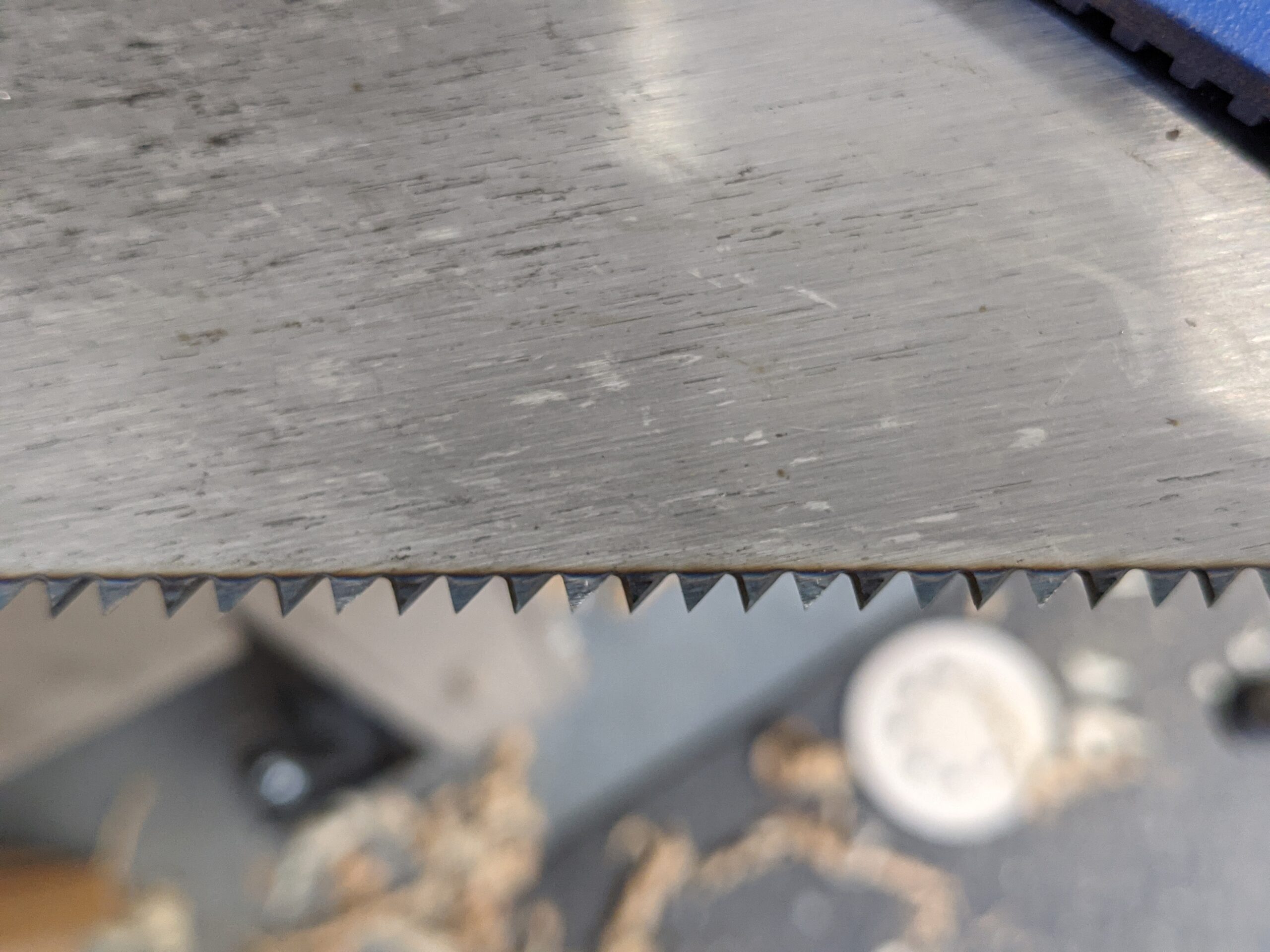
So, for all of my general opposition to throwaway saws, I do keep a hardpoint saw in the garage workshop for crosscutting rough boards to length before further dimensioning with my 'good' handsaws and the bandsaw. Hard, gritty particles like sand lodge into the rough bark and even bandsawn surfaces will house dirt and grit when kept around in warehouses for a while. It seems to me that one of these saws will last me for a year or two but when they are done and past their best, I usually put them out for recycling.
Comments ()