
George Bridged the Gap...
...55 years later.
I told you the story about the man who ended up with gappy mitres to his architraves. How George helped me to see the true picture. Here is the story if you missed it. Well, I recalled this when I saw this gap in a hinge on the underside of an 1800s drop-leaf table. How easy it is to consider another man's shoddiness 150 years beyond his death. The deep, impreciseness of his knife marks in the wood, the shim at the end of the recess. I have heard men woodworking for a hobby say that their dovetails were better than ancient craftsmen because there were gaps, imprecise angles and the saw cuts ran past the depth line. To their unswerving arrogance of comparisons, I would ask how long they'd taken to cut their dovetails. To that, they might say, "Oh, I'm a perfectionist so I took my time. Half a day!" Then I would say that the work of past artisans would disallow such luxury because for this work they would be allowed only one day to complete six drawers four to five inches wide with four tails to each corner -- 64 single dovetails. There were a dozen or more joiners ready to fill this man's shoes.
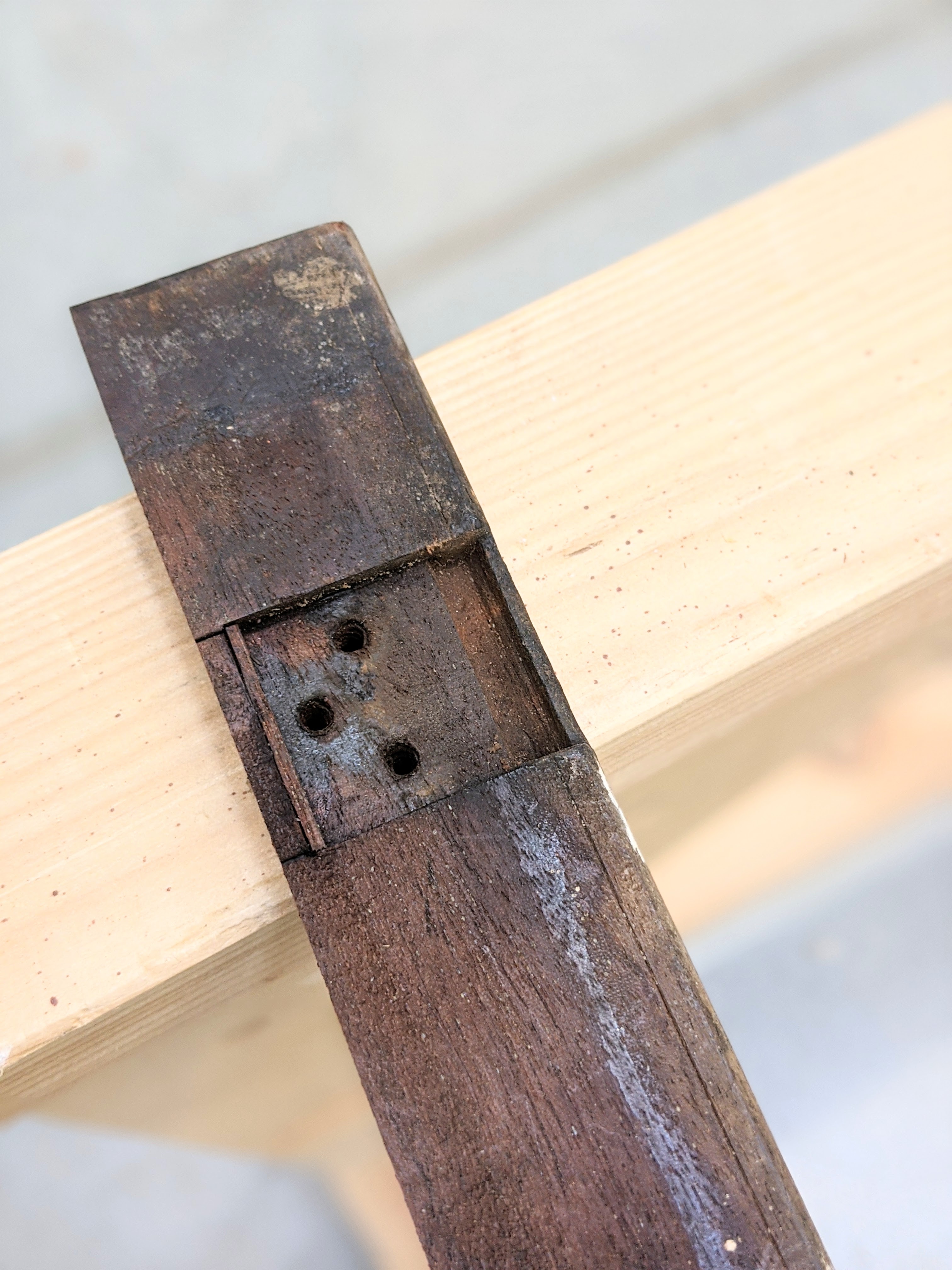
So here we are. Was this a mistake or a necessary addition for a good reason? The marks in the wood being so thick and overshot first: well, this would be the day when knives were used in place of very expensive pencils. Thus they were called marking knives. They were not to create knife walls. He took the decision for deep cuts because the light was disappearing and he needed candlelight. The knife marks were on the underside of a table. The start and stop points were immaterial as no one would lie on their backs under a table to examine his work. It didn't matter and he was under pressure to complete the work for his unmerciful boss.
As to the shim at the end of the hinge recess. The likelihood is that he had the three hinges ready. These were hand-wrought by a blacksmith who hammered the tabs around the pintels on an anvil with a 1lb hammer and by eye alone. Variations in flap lengths varied and were sometimes longer on one flap than the other. He may have mistakenly laid out to the wrong flap. Filling the gap was not so much to hide his shoddy recessing skills but to align the hinge when the screws were applied. Secondly, this would maintain the position of the hinge in the years to come.
Comments ()