
Sharp Talking
As I have grown older I have grown less tolerant. I think this to be symptomatic. Sharpening seems to me to have become an abrasive subject discussed by expert sellers and those seeking ever more knowledge. As an apprentice, the men had whetstones in boxes without grade-knowledge per se, but they often had two, one coarser and one very fine. Mostly they used the coarser one and then got back to work; they just on with it. Experts these days, teachers and salesmen and often a combination of the two somewhere along the line, will tell you of this method or that. Usually, it's the one or ones they can sell for the higher profit. Mostly they confuse what is simple. The reality is that it is mostly about abrasive and so that is where we should start this discussion.
By its very harshness and unwillingness to yield under pressure, abrasives of every kind then crumble under pressure. Crushed particulate changes things on the surface of the abrasive panel no matter the type. Applying steel to abrasive causes the abrasive to inevitably self destruct. Though particles are categorised by any particulate sizing developed to make the sheet, 250-grit, 500-grit, whatever, as soon as you apply pressure to the surface with a cutting edge tool this grit will be changed. it cannot not be. This is mostly of little concern to us, but it needs saying all the same. Sometimes we forget that that's what's happening beneath every stroke and that is why with sheet abrasives we must change the sheet regularly according to the amount of use. Ultimately this leads to poor economy.
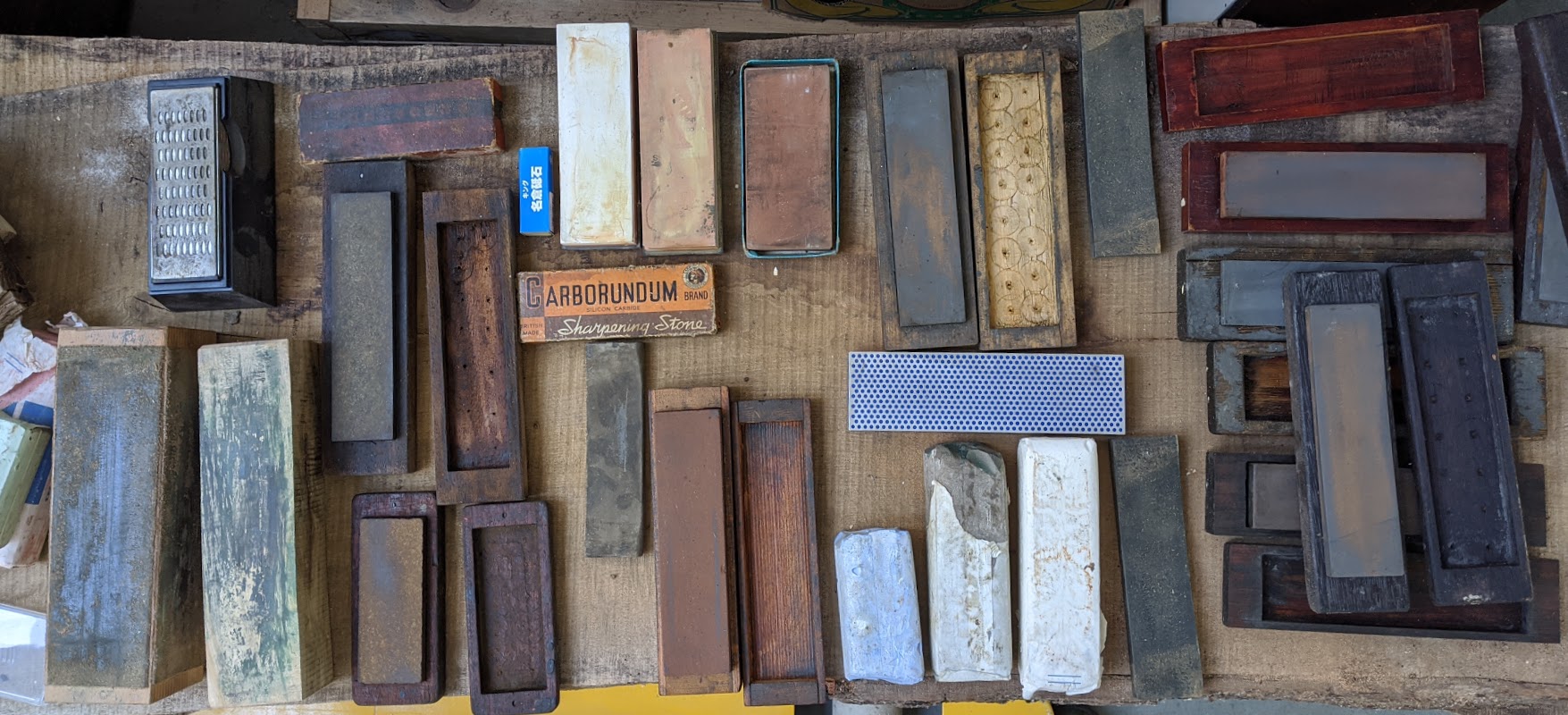
Oilstones, water stones in general last a thousand times longer than abrasive papers and film. Diamond plates rely on the reality that they re the hardest known abrasive material and they last well enough. These are the ones I rely on most. I do use a coarse abrasive, cloth-backed, to reestablish a damaged bevel and so on, or if I have gone out of square. It's the fastest way without resorting to a mechanical grinder of some kind. Why not just use a belt sander then? Well, not everyone has one, not everyone can handle one, not everyone can afford one and no one needs one. This alone is explanation enough, aside from the safety issues surrounding them for grinding steel, like the festering heat source inside a cloth bag that becomes a fireball and sets the shop alight four hours later, or the spark that hits the eyeball. I doubt that anyone can sharpen faster than I do without a machine or even with one when I am in the zone sharpening. It takes me around 5-7 minutes max, to sharpen 7-10 hand tools surgically sharp, no more, usually.
So, what else is wrong with mechanical grinding?
I think that mostly, people do it because it is what they were told starting out in woodworking. Of course, grinding on wheels dates back through the centuries, to a point I suppose where no one recalls nit using some kind of wheel grinder. Sandstone wheels 24" in diameter and 4" wide, hand-cranked or treadled, water-driven and geared, gave us fairly silent grinding for decades and years. These mechanisms rarely moved fast enough to cause sparks and didn't burn the steel either. Many rotated through a bath of water to keep the steel cool of course. You would often see them around farms and workshops as relics of the past, but worked they did! The electric motor made them redundant. Progress! Then on the back of the Industrial Revolution came the electric motor in small and powerful form and it was the power source that changed everything. In woodworking and for woodworkers the hollow grind has been with us for at least three hundred years, be the arc on the bevel barely detectable from the 24" wheels or the 6" Black & Decker ones that became so ubiquitous after the 1950s. Problems with them? Not for just grinding off mild steel, tempered or not, but for edge tools, there was always the high risk of burning the steel and of course, they take off fifty times more steel than is usually needed.
Comments ()