
Ed's Question
Question:
I like turning and have wanted to make spindle chairs, but I’ve come upon so many that are falling apart that I’ve held back out of concern that the form is intrinsically weak, at least if not built right. People say they are strong, but then there’s my pile of degenerate chairs. I can see the handplane marks under the seats of some, so those at least weren’t mass made.
Here is my question which I’ve asked many people and none have been willing to answer: Is green wood mandatory? Those who seem to give the most details about construction rive green wood, then do various drying incantations, and orient radial and tangential grain just so. Can reliable chairs be made by sawing billets instead of riving and made from seasoned wood rather than green? And, when all that is said, can someone make a lifetime chair by teaching oneself, or are there critical tricks, like the drying you mentioned, that one just won’t know to do?
I’m sure I can make a spindle chair that will stand for a few years. I have no confidence that I can make a spindle chair to put my name on, sell, and back with my reputation. I’d do that with mortise and tenon, but there’s the stack of failed spindle chairs I’ve seen….
I’m not trying to argue or contradict you, but I’ve tried to find this info for several years now. Is there a reliable resource that describes spindle chair building, preferably a book older than 50 years so that it’s more likely to be solid?
Answer
Para 1:
Actually the plane marks you see in the surface may well have been mass-made even or especially from the pre-machine era. The early planing machines developed by different entities, and that includes the Shakers in the USA, worked on a rotary cut, and even, in the case of the Shaker's, a horizontal slicing cut and horizontal rotary cut depending on the inventor. Though such contraptions simplified surfacing wood to a great degree, the results still needed refinement and that's because of the use of wooden or early Babbitt bearings that were unlike anything we might use today as they were composed of tin, antimony and copper and not the hardened alloys available over the counter today. Remember we do not have abrasive belt sanding in our sights yet, and even today many if not most surface planers except the most sophisticated and well maintained types still need their efforts refining to give a suitable surface for finishing.
Para 4:
I would be surprised if early books are of much use because the authors were indeed more authors than say chairmakers. I would say that 80% of real and relational knowledge by chairmakers died with the last ones relying on handed down knowledge. The chairs I have been shown from so-called green woodworkers are often as you say failed examples in that the course they went on had not used wood that was sufficiently dried down and often the makers will tell you that the posts are used green so that they shrink onto the rails and so remain tight. Whereas there is some truth to that, often the tolerance levels are too high and also many woods just too soft. Now I had better get my flack jacket and tin hat on for the fallout. There generally was an era when artisans simply passed their knowledge on by mouth and living action and in some measure the www has become the new era surpassing the blank years between the 1950s and the 1980s when the knowledge was indeed all but dying with the men that held the information in the doing of it. Magazines too carried some of that load but now of course there are those of us who have indeed lived the 'trade' and we are using it to replace the former days of old; those days of man and boy, craftsman and apprentice.
Para 3:
No, you don't need green wood and nor does the wood have to be riven either. Most modern manufacturers make perfectly good and strong chairs relying on well seasoned wood and nothing green at all, by the millions.
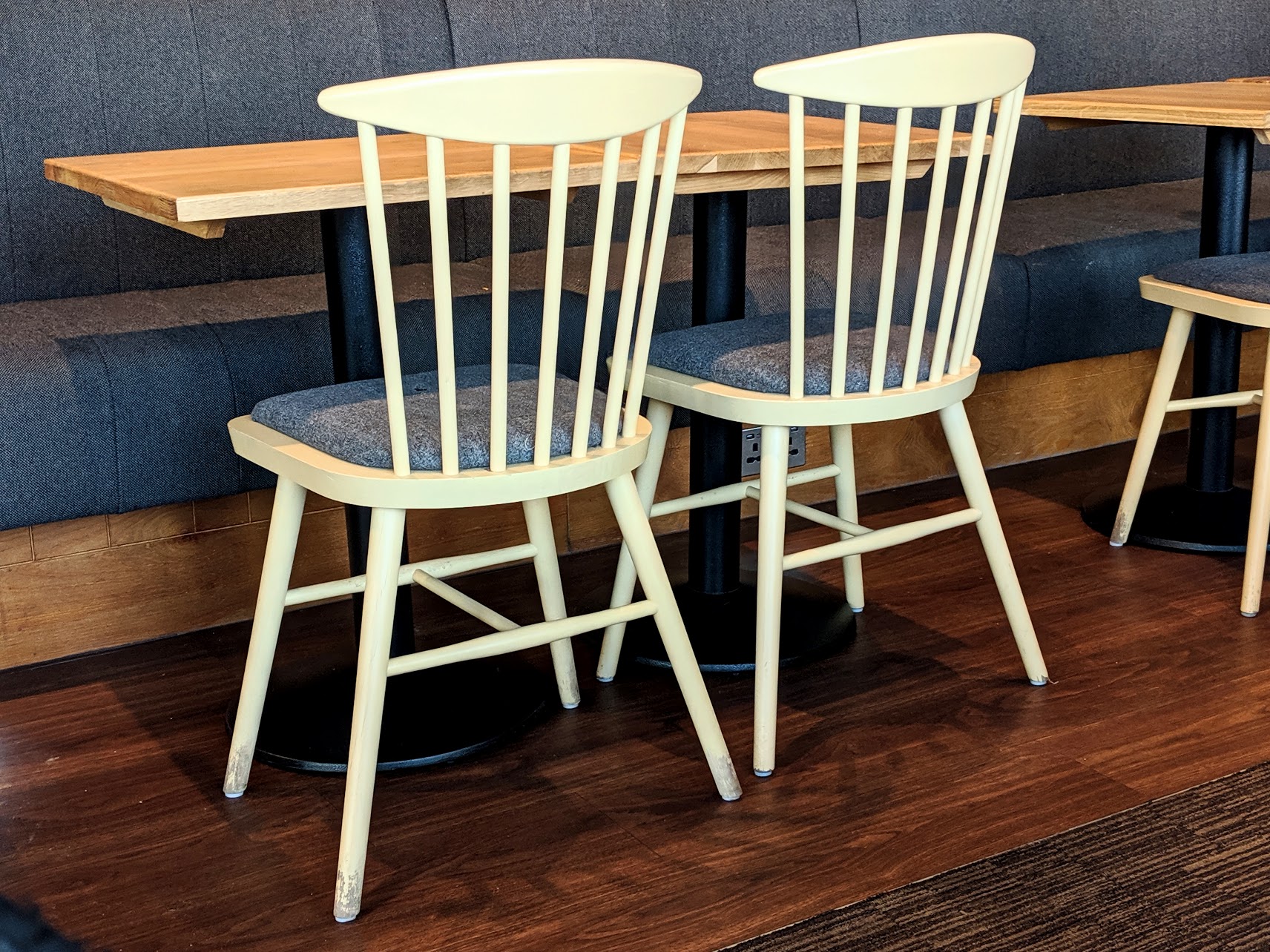
Mostly the issues surround our modern lifestyle of central heating or air conditioning where the MC (moisture content) tends to be fairly constant. The average moisture in the atmosphere of very home will be different because each home might by occupied differently to its neighbours. A family with 4 adults and home cooking will give out more humidity than say an elderly couple might. Customising your wood becomes imperative. Ideally you want the posts to be reduced either wholly or partially. By that I mean if the posts are entering bored holes into a seat then they should be reduced in MC as low as possible but the lower area of the posts receiving cross rails and such should be kept a few percent higher. When the post goes into the seat the seat will shrink onto the post and the posts should shrink onto the rails as the rails also have had their moisture content reduced as much as possible too.
To reduce the MC can be done in a variety of ways but one way is to use heated sand over a burner or stove and left over night with the ends needing shrinking or drying left in the surface area of the sand. You can also use electric heaters, heat lamps but you must always take caution with extremes of heat of course. The final turning on the lathe comes after this overnight drying. Rechuck and turn to final diameter, insert and leave alone, allowing expansion or shrinkage to take place. Yes, it is a challenge but as with many things the more you do it the more you understand that area of your woodworking.
Comments ()