
He Rolls Up His Sleeves
He reaches across the workbench for a plane and says, 'Let's get crackin' then." His plane's a Woden. Well used, well worn, well 'broken in'. Mine's new, narrow, a #4 Stanley. He'd loaned me his when I first started under him but then I saved up and bought my own. Mum told me, "Don't pay any keep until you've got enough for buying your own tools." She'd apprenticed as a dressmaker when she was 13 years old: she understood the importance of tools and ownership. I earned £3. 10 shillings a week at the time; for a 42 hour week. Knowing what I know now I realise the sacrifice she and my dad had made for me. It was no small thing with a family of six kids. I also started to understand the difference between broken in and the awkwardness of newness. Just as I was new to woodworking, and my plane was still feeling awkward to me, so too I felt awkward at the bench doing the things that seemed always tripping. But George understood this. He wasn't a boss, who grunted and groaned at everything awkward to me. He was a mentor, though he would never have referred to himself as that. It's core to the wellbeing of any apprentice to have a mentorship with the artisan supervising the work. You don't need a teacher, a lecturer, a boss, a professor. You need those people to own the additional qualities of mentorship. Without that there's no sense of companionship.
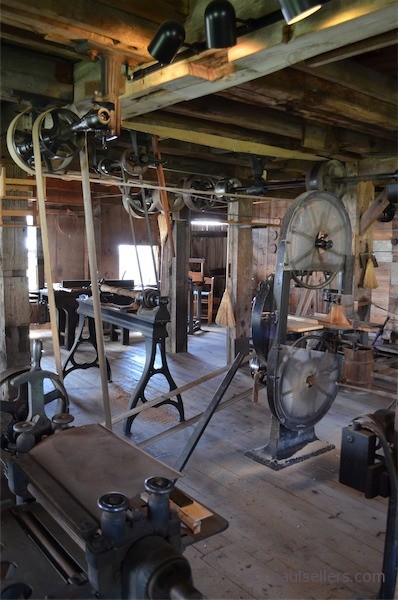
We had grown fond of each other, George and I. Rarely did he greet me with anything more than smile, but he didn't suffer fools. He treated our relationship seriously and seasoned it with grace.
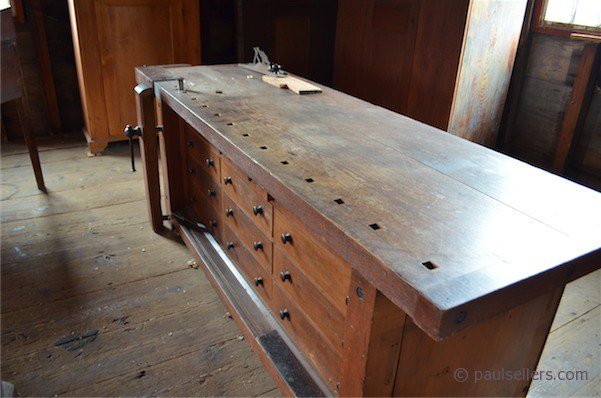
I think we live in an age of instancy; patience is two seconds too long waiting for something to load on the screen when our attention span is only 1.5 seconds. Go on a website that takes two seconds to load and the click of your index finger automatically takes you off on another tangent because it took too long and you couldn't wait. Woodworking with hand tools is an instant antidote to high speed working with machines, the antithesis we need to heal us from false and over expectations. There is no bolt-on, the app's not there. You can watch a video a million times but it will not stimulate skilfulness. Skilfulness must be earned by the doing of skilled things even when they have not reached any level of skilfulness and that is why so many people forfeit skilfulness by relying on what has indeed become artificial intelligence. To develop skilled workmanship means you must take time out from the fast pace of our present age to take up the tools and learn them, if, or should I say when, you earn them they become your possession. No one can take them from you you see. The neat thing is that they are omnidirectional. You see using a belt sander does nothing to equip you to use a bench plane, but using a bench plane does equip you to work with a belt sander. Using any machine, a router to cut dovetails with a dovetail jig, such like that, takes a certain level of dextrous movement in the using of it or them. Skill in guiding the router in and out of the prongs efficiently minimises the risk of bit-burn by lingering longer than a split second. But making sure there is no rock as you manoeuvre it through the slalom course of alluminium prongs takes practice and confidence. That hesitation leading to bit burn or digs and divots, dives and such, happens in a heart beat, which is why you see these pockets of putty filling gaps on the mass made dovetails and shoulderlines.

Pursuing the art of hand craft is a patient occupation. We initially learn by observation. Adding into the equation is the reality that, for me, there really was no time set aside for practice. My first planing took place on a real window frame on the bench. George said, "Watch!" and I watched. It looked so easy. I knew I could do it. 'Easy peasy!' Or so I thought. Actually, it was. My plane landed perfectly and a shaving whooshed up through the plane throat and curled in a spiral to the floor. George seemed impressed. I was impressed. Then came the intersection. My legs seemed to go somewhere else, while my arms went opposite. How did that happen? The frame had knots. Each knot seemed to argue with me and George saw every stammer. "You're hitting too hard, too deep and without anticipation you will never develop the right surface. Knots need gentleness and careful consideration. Planning if you like. Knots can be your friend if you treat them right. Pine knots often 'oil' the sole of your plane, but you must 'read the grain' beforehand in a split second, flip the plane end for end, that kind of thing. Anyway, the thing is patience rewards you and your work.
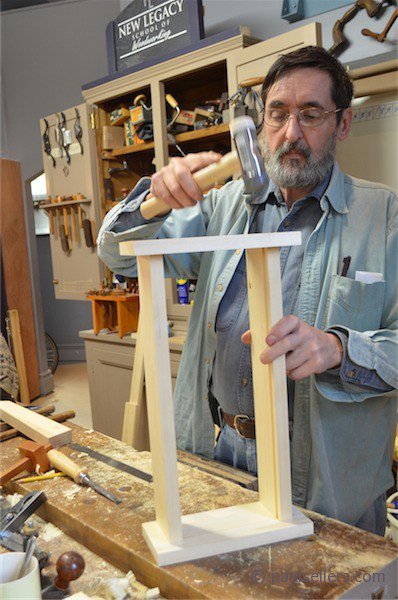
You don't see rolled up sleeves in a workman any more. Times have changed. At least I don't. Same way you don't really her men whistle and sing at work. I sing and whistle every day because it became part of my work culture when I was a young person. If my jeans get holes across the knees it's because I worked in them and they wore or caught on something. The cotton gets thin you see. It's a uniquely different cultural shift to live in a culture where people wear jeans intentionally shredded as part of the manufacturing process to make them look like something they're not. If I arrived home with holes in my knees my dressmaking momma unpicked an unused back pocket and stitched a patch on it. It was unpretentious.
Comments ()