
Don't Gang Up On Me
From time to time, whether in a class or online, someone asks the age old question, "Can't you put several dovetail pieces together and cut several dovetails all at once?" I usually ask them why they would and the answer's are always the same. "Speed! Saves on repeat layouts. Gets the job done!" That sort of thing. Another more recent one was stacking up pieces for the workbench, drilling through three or four pieces at the same time. Whereas I understand these considerations, and of course anyone can do it how they want to, I try to help others to more 'feel' what they are doing. You know, get inside the process. Deindustrialise the processes a little. In industry it is practical to gang up pieces to load them into the carrier and feed 20 pieces into a cutter-head. I've been there too, sadly. Using a tenoner that cuts 20 sash bar tenons is expedient, cope and all. But I want the real woodworkers I work with to fully understand the drills and drivers, the drill bits themselves and then too the wood's response to a more gentle and less aggressive approach to working their wood. This is how we learn without bypassing the significant essentials that inform us, and by 'inform' us I mean 'form in' us. I like people to build their ability and skill, gain confidence through what they master and achieve quality levels of workmanship. That way they feel benefit from personal research, the gentleness in embracing and being embraced by their work. There's enough cut and thrust in the daily grind they work in day in day out so evenings and weekends is a way of disengaging one realm to restore themselves in another.
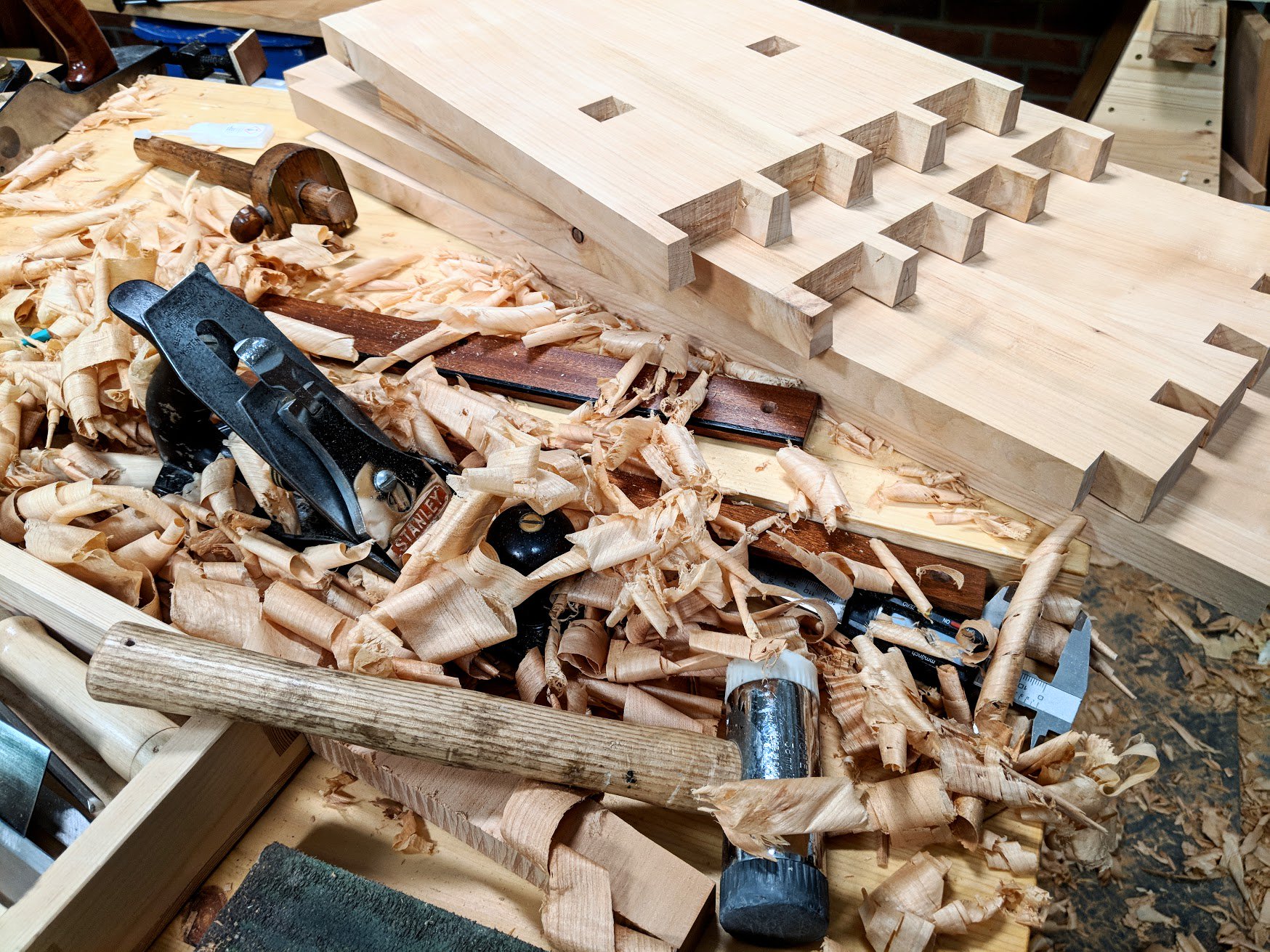
In my view it's much more about perception. For some, cutting dovetails is tedious and so too even drilling holes. Trying to save time or a few screws by screwing three pieces all at once with longer screws often fails because it becomes like juggling to a new woodworker. Managing several pieces for a perfect alignment increases the likelihood of shifting components leading to failure. We're often driven by the concept that greater efficiency takes less time and therefore the outcome is more acceptable but with the same end result. By that I mean you still end up with a dovetailed box and a workbench. But the truth I've discovered follows the old adage, "More haste less speed." I say it often enough and it's what I know now to be true so I penned the statement for others to consider: 'It's not so much what you make that determines the outcome but how you make it.' This directly relates to the working, the deployment of your mind and the union between the mind and the hand. How you make then affects the overall wellbeing because you appreciate the processing of your work and your body at a pace you can truly assimilate and absorb everything of the work you're involved in. Having worked in mass-making ways for just long enough in my life I saw, see, chose and continue to choose a different way based on my life experiences. You see it's discovering the process of hand work as an alternative possibility that dismantles the industrialising of the industrial. Whereas we can see benefits of the Industrial Revolution, we must also see and admit that the long term effects have damaged all areas of life itself. We see that just as industrial processes have improved many areas of life, greed by the few have led to the demoralising condition the majority find ourselves in to today, unless of course we are a part of the elite minority that dangle the carrots.
Whereas the Industrial Revolution was the beginning of a continuing period hailed as one of the greatest advancements in the history of a developing and progressive industrialised world, it also polluted the same world with what we must now export to other continents and spend centuries trying to clean up the result of our failure to recognise boundaries of limitation and habitation. Industrialism and economy only thrive through out and out consumerism. There are indeed hundreds of thousands of miles of conveyor belts that come to us in different forms but all in the name of progress (good or bad or starting out as considered good but culminating in bad) and all of them make us dependent on their systems. From schools to airports and health care to motorways we face conveyor belts and the pushing of buttons all day long. My computer right now causes me to push buttons a few thousand times in a given day, though not anywhere so many as most are forced to. For us, dismantling the nuts and bolts begins with a simple step of building a workbench and buying 10-20 hand tools. It's the very start we need that releases the build up of unused chemistry in the brain--brain cell stimuli that have been log jammed in most of us for years and decades. Did you know that the very act of sharpening a chisel, sawing a dovetail and fitting the tales alone immediately releases dopamine to activate the processes you are doing. This alone increases wellbeing even when the results don't match the expectations. Countering depression and anxiety begins, but the acts must be practised to get the results long term. In some ways it's not ethereal so much as taking a step towards discovering a process that's been missing in our lives. Though I say it is not etherial, it is enjoyable and yet it does become something of an etherial experience once you begin to bring order into everything it takes to cut that perfect dovetail or even just learn how to plane a piece of wood.
Working alongside a man who brought stacks of wood into my workshop to use my machines regularly resulted in him losing stack alignment and him dropping a dozen pieces all over the floor. I reasoned with him that carrying half the sticks would give better control. He didn't listen and continued in his disruptive methods over a couple of weeks. The irritation gained predictability and became too much for us all. I took him aside again and said I'd rather he didn't come again because his calamities affected me and my staff. A week later he came and asked if he could use my shop and equipment again if he did as I had asked him. I said we could try it. The result was order and efficiency. I suppose the methods I use bring order and efficiency that results in the levels of pleasure I feel are unsurpassable. When I sharpen my plane in readiness for planing oak the result is effective planing. A sharp plane pulls itself to the wood and takes less effort to effect the cut. As it dulls, stroke by stroke, I have become well disciplined to know it's dulled and I take care of it by sharpening rather than procrastinating. The process I have developed and taught is the most efficient of any I have used or seen. In under two minutes I take a dull edge back to surgical sharpness. I'm back to task. It didn't start out like that but what matters is I looked for the answers and came up with a result. When others tell me I should do this or that, use this or that, I can say how I got here was through that process of trial and error. Through the decades I have changed and so have thousands upon thousands of others. People evaluate and then copy what works best for them.
I suggest we all ask ourselves why we want to gang up on the work to force it through the passage of conveyor belt production when we might just examine what the real purpose is in our woodworking at home.
Comments ()