
No Question! George Knew
There are quick ways to check accuracy in measurements in dovetailing. You can measure them, of course, you can gauge them by eye, very quick and equally accurate if you don't need measurements, and then there is George. I'd laid out my dovetails for the drawer I was making ready to cut. Three of equal size at 1" per tail and 1/4" equally sized pins, none of that half-pins stuff. No pirouetting dividers to strut off steps. And then of course there were no YouTube discourses on how to nor Googling for methods either. Actually, the pocket calculator in its most basic form was still five years away from the high street shops. All calculations came from formula of one form or another.
Try to imagine a world without personal computers and computers at that time were the size of a bathroom yet only had the smallest fraction of what a cell phone can give you today. Imaginer a hundred punch card operators pumping in information to feed one computer. It's hard to imagine the only availability for contacting home was by a telephone box. Now you can hardly find a telephone box and kids of five have a more sophisticated system that most people my age and older! So there you have it. Progress! It's no longer the case that people have more knowledge today than say in the 50s and 60s, it it's that they can easily access it. Whether it's my imagination or not I am not sure, but I question whether younger people can remember things as well as the men I worked under. They pulled out algebra in moments of uncertainty and worked out such things as parabolic curves on the back of some well worn sandpaper. Imagine these men, workmen, working in overalls, World War II veterans, cloth caps, men, pencils pulled from behind their ears, getting excited as they talked between themselves using words and terms like directrix, vertex, reflection to focus. They no longer exist. They weren't academics, never went to college, just working men's union classes in the evenings, to better themselves voluntarily.
I'd set the two drawer sides on my side of the bench well and felt pretty good about it. George looked them over from his side, picked them up, held them side by side. "Uh oh!" he went. "Bit off, eh!" he chuckled. Grinned. "Don't let anyone else see them!" He said at the top of his voice. "No!" I replied. "Yup!" He said, without measuring a thing. He placed them end for end and said, "Look!" It was then that I learned about something called the, 'Rack o' th' eye (pronounced 'rack ot th-eye') (Rack or rake of the eye) an' slant o' t' chops. (pronounced slantotchops')(Slant or slope of the chin). By closing one eye and skewing the mouth jaw he was sighting in his crosshairs and thereby evaluated the size and accuracy of all things.
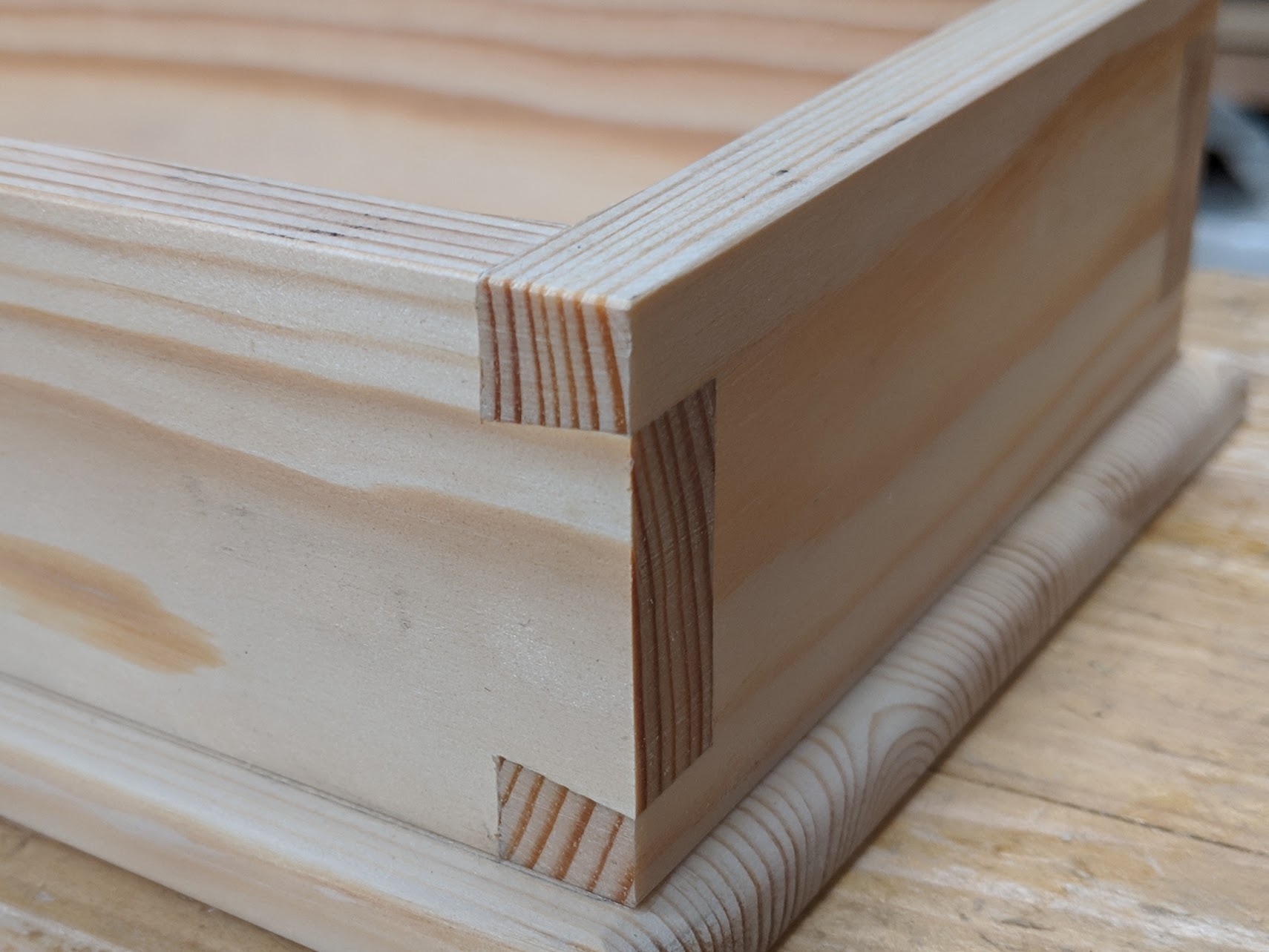
It was then obvious something was out. In reality the difference was not so great because placing them together showed twice the inaccuracy really. it was here that I developed a method I now use all the time for cross referencing my accuracy levels. For the four corners of any box I lay out the dovetails on one piece only. For a two sided box, a drawer, I still layout one set of tails. With the tails laid out and squared across the end I transfer the squared across lines onto a second piece. That done I flip the second piece around and offer it to the first. If the lines align with the second aligning the dovetails are accurate. If they are indeed accurate I flip them end for end and use the lines to mark the third and forth end pieces. This means that I measured the dovetails only once. It is fast and saves much repetitive measuring.
Remember, if the lines are a millimeter difference the sizing will only be half a millimeter out. That's about 1/32" in real money. Not worth changing in the grand scheme of woodworking and dovetails. Sweat the big stuff!
Comments ()