
Two Strokes Beat One
In saw sharpening, generally anyway, two file strokes per gullet will deliver a better cutting tip if you understand what you are doing and the reason behind why your are doing it. Until I began teaching others about my daily working, subtle nuances I generally took for granted remained hidden away. Most of them were things I'd thought through for myself by questioning myself as to why I did this or that. So it's been with sharpening tools like saws. Anyone can shove a triangular file through a saw gullet but that is not what intentionally defines and redefines the saw teeth.By that I mean we can make subtle changes that profile the teeth three dimensionally to make them cut slightly differently for different needs, different woods, different densities and so on. To get teeth to cut a certain way with a certain reaction is to stop, look, feel and listen as the saw file strokes the teeth and then to the saw when the saw teeth themselves stroke into the wood. When people say saws from this continent or that work better because of this and that I think to myself of my own history and the history of all the other continents knowing that somewhere in the mix they all delivered some of the highest quality craftsmanship regardless of the dirt they stood on. It's unfortunate that those levels of fine craftsmanship, craftsmanship commonly held amongst the more commonest of people, are so diminished they have indeed all but gone. Culture demanded cheapness and a way to provide ever cheaper goods for the masses. Surprising work will be ever harder to discover as 'progress' shuns loveliness and lovely things.
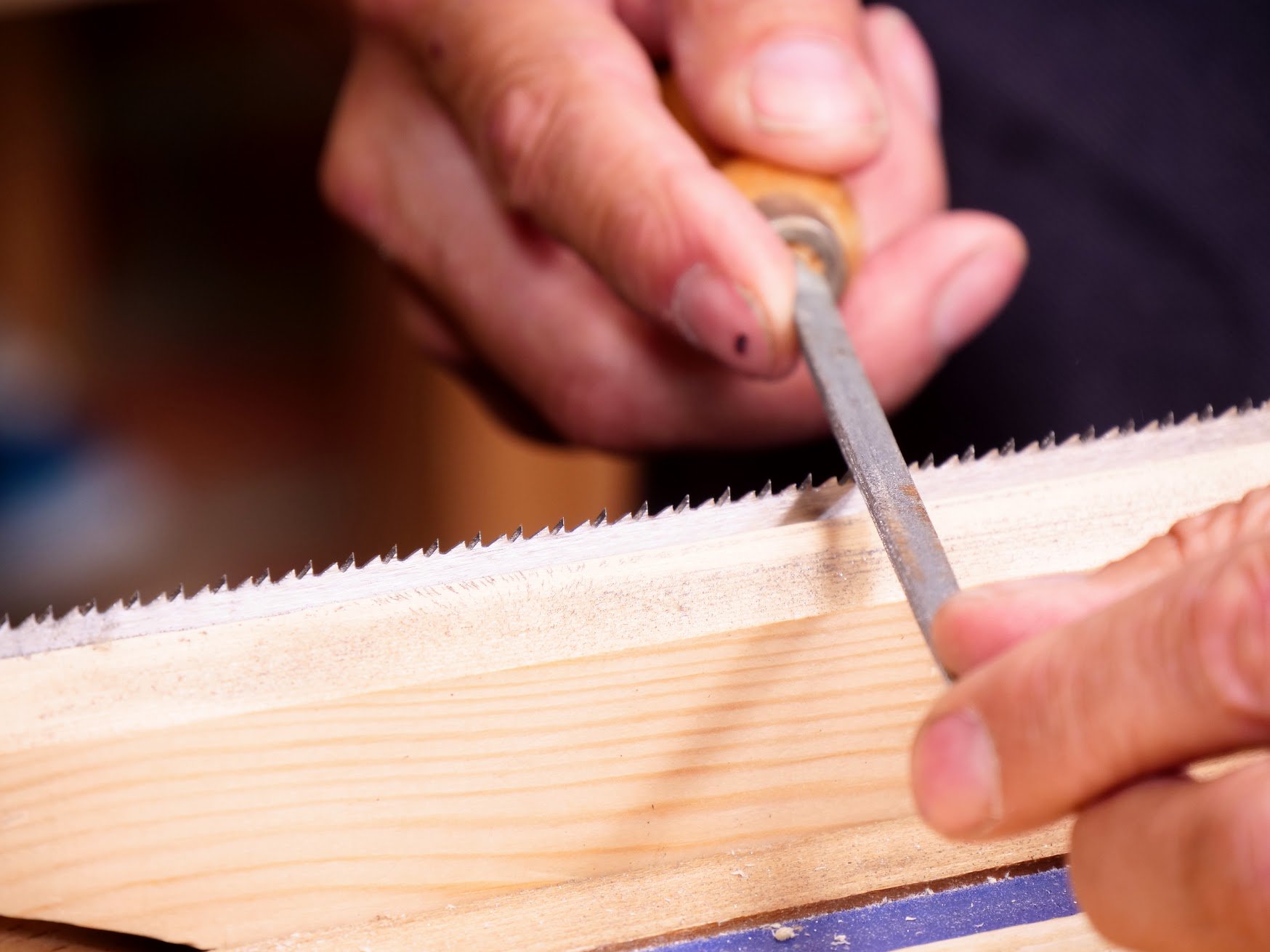
Saw sharpening is a common task to every hand tool enthusiast. Every other day or even most days I should say, I take one of my saws and lightly touch the teeth to optimise its cutting capabilities. This can seem obsessive but my work demands fineness and it means the teeth are never so dulled that they need many passes with the file. Sometimes I will take the added step to change the shape of the teeth of a saw to sharpen it more aggressively or more passively. If, as now, I am working in virgin pine taken from an early piece made from eastern white pine, I need a sharp saw passively set and sharpened. Wood like this came to the UK two centuries ago from ancient forests on the Eastern seaboard of the US, What another woodworker discarded in his burn pile, was a treasure I couldn't let burn. So I redefine the teeth from my general ripcut and add some slope to the pitch and then another slope, not too much, to the bevels. These unwritten thoughts were taught by man to boy. Things I take things for granted were left unknown to most, safely in my head. The internet has a way of changing things as we now know. Knowledge is cheapened, often, I think. `We welcome its free resource yet pay the high price of confusion. Many decades of skill, knowledge and learning has died with most craftsmen I knew but passed on by word of mouth. Today such sources carry no weight as one copies down another's video as though skill can be mastered in minutes and posts it from their half hour experience. A dozen more join and then the core information from the skilful past is somehow swallowed up and the true source of real skill becomes permanently buried under the razzmatazz of fast speaking entertainers.
There is indeed more to saw sharpening than just passing a file into a saw gullet. It must be understood and internalised by practice, experiment and, yes, even risk. Reading of course may well be the good beginning we need in the absence of one to one teaching as in the past, but it's not the experiencing of it. When we begin sharpening saws for ourselves we begin to unwrap the mysteries a a new journey becomes one only we can take. A video is merely the skeleton, we must put flesh on the framework. It is for every crafting artisan to master this art and then to continue learning according the the work he or she encounters along the way. Don't rely on the professional carpenter today. In the past 45 years I have not met one that sharpens his saws though I always ask. Look to the amateur. Don't think it's hard to sharpen saws either, it's not.
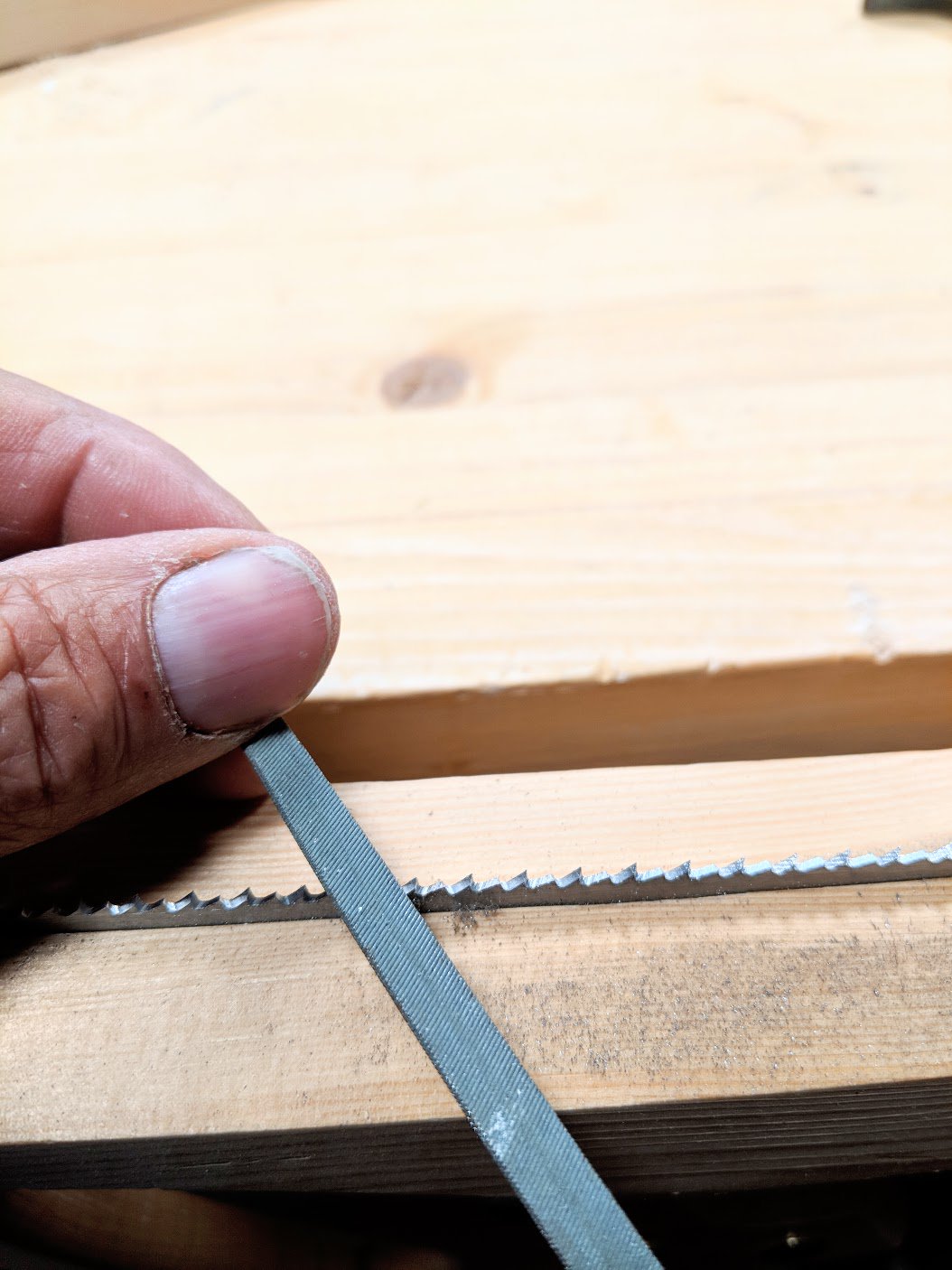
Most often saws slowly develop issues and before we know it we are the owners of a saw that somehow swerves in the cut, jars or causes us to sweat sooner than we ought to. This is especially so if we've neglected sharpening for too long and over used the teeth. This type of procrastination results in a severely round tooth tips no matter the saw or the maker. Often it is intimidation about sharpening through our self doubt and inexperience that holds us back. Other times it's just plain not knowing how to, and then lastly and commonly it's just plain laziness. Not the way of the craftsman at all.
Most people do not realise that saws often rely as much on the shear-cutting sides of the outer faces of the teeth to part the ways of wood into two separate sections as the central cutting edge or tip. By that I mean that a ripcut saw has three forward cutting edges not one alone, nor two as with crosscut saws. Whereas the cutting chisel tip rakes out between two side walls, the side walls are sheer cut with a slight relief caused by the saw's set to both sides of the offset teeth. If we miss this we miss the essentiality of sensitivity in our file strokes. Harsh filing breaks edge of the steel point and edges at the out-cut edges of the teeth. This causes fractured corner rather than a crisp and sharp corner. In sharpening, the best result comes not from a single hard thrust stroke but a gentle and light second one. That's why hand sharpening delivers a better result than a machine sharpener in some ways, not all. The first thrust-cut shapes the gullet and the fore edge of one tooth and the rear edge of the adjacent one. This develops the profile and determines the degree of aggression to the cutting fore edge of the teeth. The second pass finesses the surface. This is the light breath into the gullet. the one that perfects the surface. Here then is where we understand the saying, "As iron sharpens iron so a man sharpens the countenance of his friend." As a boy a man told my my saw was too dull. That it was indeed a shame to let such a thing happen. It may seem hard, but I listened. At first I bristled inside, but then I thought to myself, "It's true. His saws are always sharp. He took down a saw." and he showed me how to sharpen and I became sharp in the process. Listen for the sounds within the strokes and adjust your attitude until your understanding is as refined as the saw you are working.
Comments ()