
Q&A Why Two Routers? Why Two Bench Planes?
From Entry Monday 6th February 2017
Question:
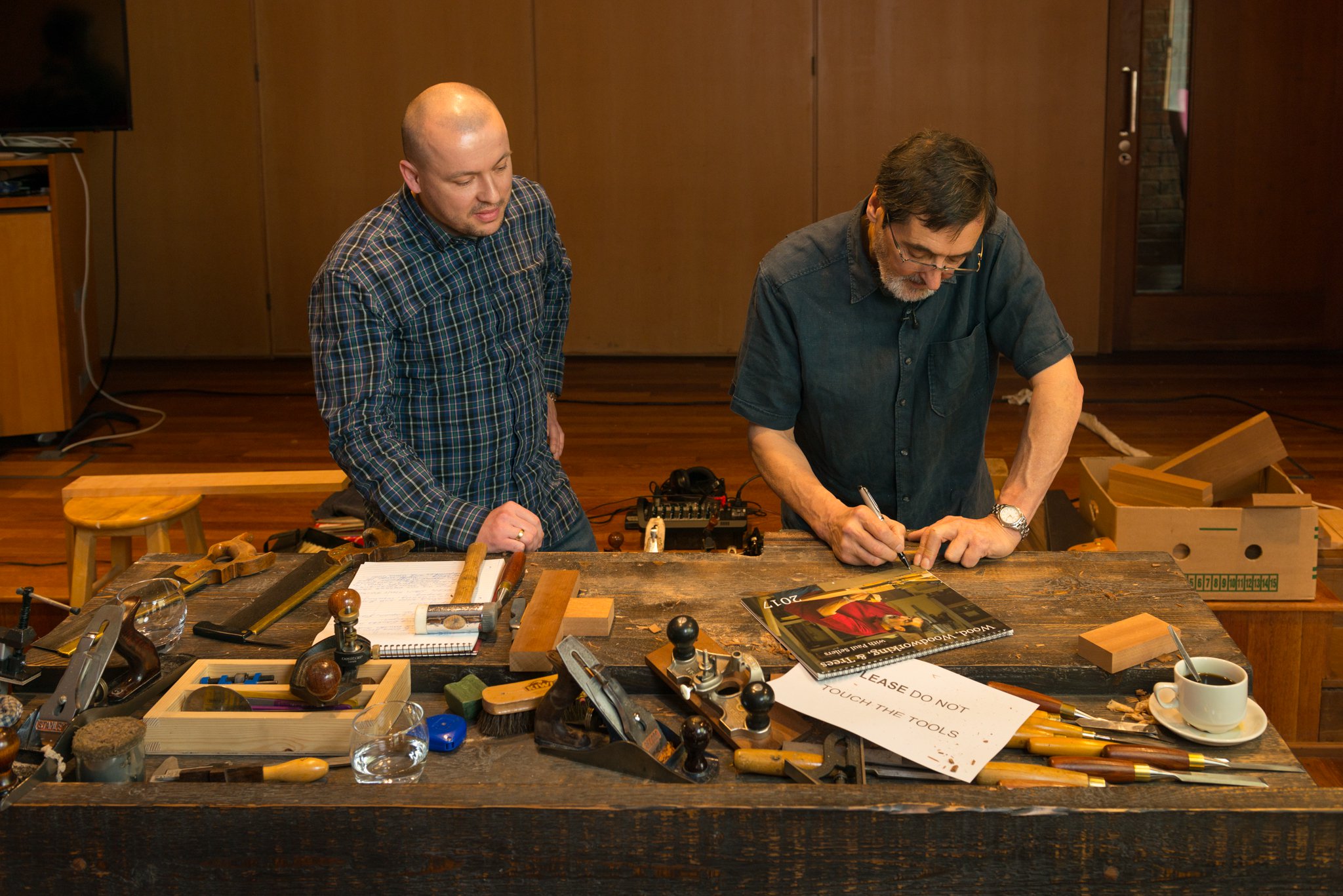
First, THANK YOU! A careful inspection of the pictures reveal the following list of tools.Notebook
pencil
tape measure
brush
oil can
square
hammer
a couple of clamps
a set of chisels
2 bench planes
2 router planes
2 saws
set of sharping stones
I am sure you also had a marking gauge and a knife.
I did not see a scraper, gouge, or rasp.Why 2 bench planes? Were they different?
Answer:
This question resulted from the great images Ryan Cowan took for me at my speaking engagement last week at Oxford's Somerville College. I suppose it was more a minimalist array of tools I use in joinery so the first part of the list comprises the normal individual tools I might use for laying out joints, followed then by tools to cut them with, surface plane and perhaps keep the tools sharp with.
There were indeed two bench planes but not one and the same planes. One was a #4 Stanley, the other a #5. That said, I did have two additional #4’s behind me but not visible in the pictures. I always take extra planes or should I say duplicate tools to demonstrations as backups in case of need. Drop a plane on a concrete floor and it’s gone, hit a hidden nail and a plane used for smoothing might not be restorable in the time you have at such an event.

I chose a longer plane to demonstrate with so that’s why there were two on the bench—I also regularly have two and even three #4 planes on the bench for use in my everyday woodworking life in my workshop. (I know, spoiled brat!) That way I have one for heavy work and even making deep cuts for quicker stock removal while the second one finesses the work. The third will be a #4 converted into a scrub plane. One of the #4s I set for a heavier depth of cut and this one will dull all the sooner whilst the more finely set and tuned plane is maintained for the quality results I strive for. I switch from one to the other throughout the day. The scrub plane is handy for all manner of work but especially getting stock down super fast. I also use it for say bevelling work where I might take a square edge to a 45-degree bevel or a chamfer.
As to the routers, I have a system of joinery that relies on the two routers where I work them in tandem in a special way alternating them to produce the pristine tenons and recesses I rely on in my work. Whether it's need or preference, well, two routers perfectly harmonise my work.
I am currently working on two more books where many unseen and unused concepts will one day (hopefully soon) be my further investment in future woodworkers.
Comments ()