
Questions Answered–Alternating Panel Sections and Using Biscuits/dowels
Question:
Hi Paul,
It was nice to meet you again at Harrogate. I tend to make up my own panels for furniture from something like 6 *1 boards and have not had any problems. I alternate the grain on adjacent boards and find they come out pretty flat even without the use of biscuits or dowels for levelling. What are your thoughts on using ready laminated pine and hardwood panels, the panels are usually 40mm. It seems most commercial furniture is made this way.
Regards Chris
Answer:
Thanks for the question, Chris, I have never dowelled panels together because I never saw the need and the same is true of biscuits and biscuit jointers too. Now I am not saying that they don't have value or add additional security with regards to strength though. Indeed they will help alignment too, especially iof you are on your own gluing up. I did own a biscuit jointer for a brief while when they first came out but in the end it just gathered dust alongside other such equipment.
We all develop techniques and adopt methods for different reasons and then try methods to see what works for us. In my case I use a technique I have developed that's worked perfectly for aligning all but the largest panels for me for decades; it's fast and effective. Old dogs–new tricks? Maybe. I just felt like it was unnecessary for me and also an unnecessary piece of equipment intruding my workspace. Oh, and in all my years of creating panels I have never had a glue line fail, so I suppose that proves glue.
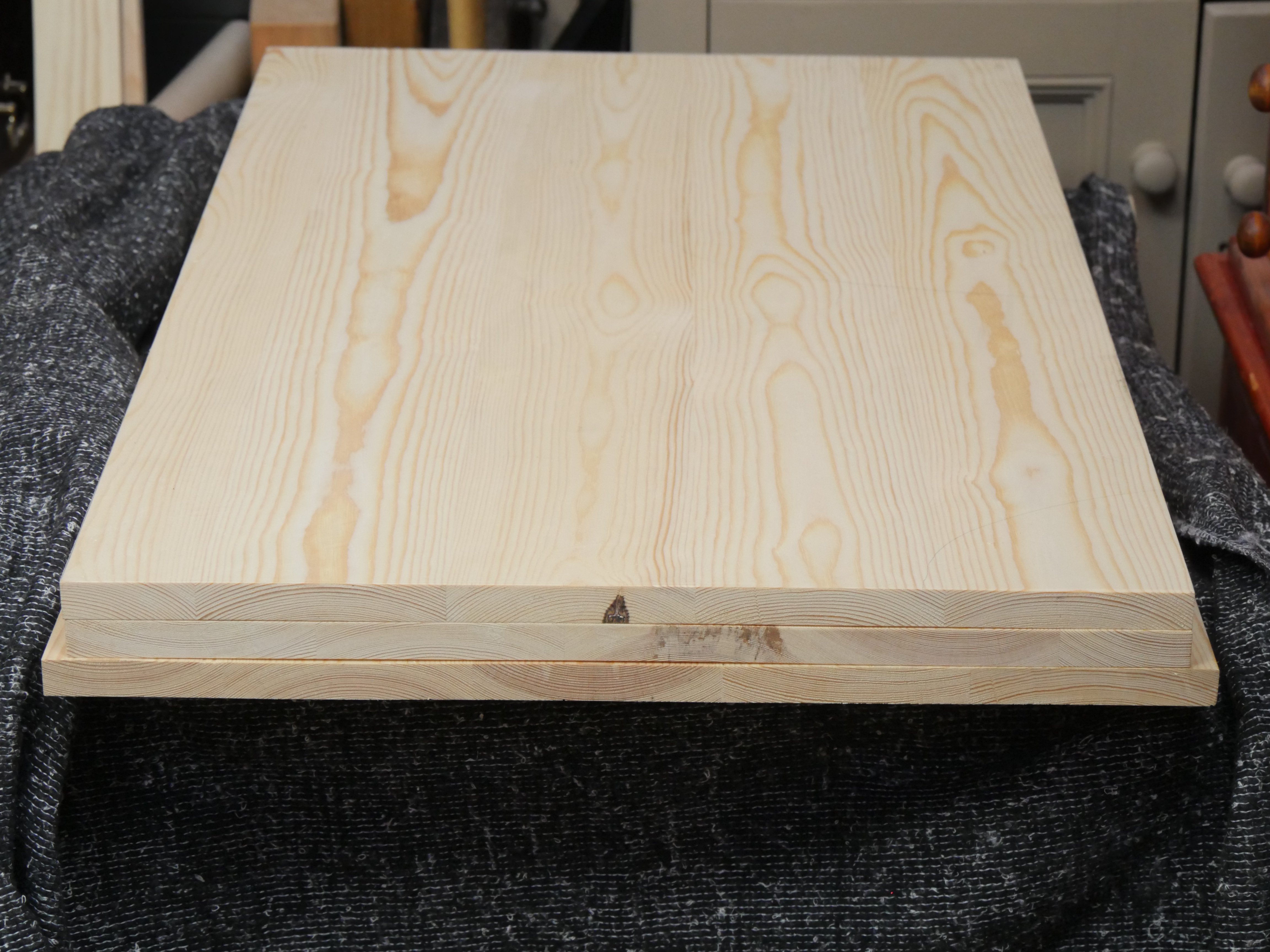
With regards to commercially glued panels. I have bought a couple of panels of ready glued panels once from a flea market for 20p and used them. They were fine once I painted them–stayed flat and everything. I think the sophisticated equipment and adhesives used in the commercial sectors are efficient and strong. I see no problem with using them as long as they are grain and colour matched to suit your criteria.
The question of alternating boards to arrange growth rings so that the counterpoise one another comes up frequently as many commercial operations use this to help boards resist creating a mono-convexing/concaving to surfaces used to make say wider surfaces such as tabletops and panels, cutting boards, countertops and so on. Here I think is the reason. Most commercial producers reduce the widths of wider sections of wood to under 3" and flip them to alternate because it the resultant panel is more stable and more controllable for production and after installation. With very narrow sections this also leads to less decision making in the manufacturing process and of course the narrower the sections used the more uniform the surface patterns and colour. We on the other hand are picking our wood for what we want to create using colour and grain configuration to its optimal advantage and that's what makes our work different to commerce. Unfortunately flipping is standard because people are fearful that omni-directional cupping will occur and ruin our endeavour. In reality this is more rare than the norm in my experience, even in extreme exchanges. Often flipping boards as has become standard even for individual makers like myself leads to a washboard surface because we tend to use wide surfaces rather than the narrow ones used in commerce. Remember they don't have someone doing the flipping and matching but often machines do everything.
I took this picture of three 22mm (7/8") panels I actually glued up around the 5th November and the panels have stayed really close to dead flat (if such a thing were truly possible) even though some I have grain-oriented mainly alternately all the same way and then one that has alternate flipping.
Now of course the thicker the sections you are creating for panels the more problematic panels become and this is where alternating comes into its own. The thicker joined edges push the inner and outer surfaces further apart and of course that means that the surface fibres absorb moisture differently. There are different reasons for this including the wood types, density of one face over the other, end grain absorption versus face grain and then of course surface finishes applied too. It is very common for top faces to receive finish while the underside receives none. Any variation in the amounts of finish applied to the two face, underside and topside, means atmospheric moisture is absorbed at different rates, resulting in possible mass distortion. That being so it is indeed better to use narrow sections as the wider the boards used the greater the influence moisture has and the greater the distortion that takes place.
Comments ()