
Becoming an Artisan
I know from the responses that what I say about becoming a lifestyle woodworker touches a few nerves for whatever reason. I think I most likely understand this more than most. I suppose the word reason is indeed a choice word here because it’s used to somehow justify not becoming a woodworker rather than becoming one. “It stands to reason…”. “Give me one good reason…”. “It’s not a good enough reason…” and so on and so on.


I never plan to step on toes in any of my blogs and I know people who if anyone says “No” to them they immediately respond with opposition even if they have no real reason at all to do so, but that’s not what I do at all. Most often I share from my life experience as a lifetime lifestyle woodworker who has indeed started several businesses that always provided for a largish family on a single-income wage. When someone said thick ironed heavy planes stopped the problem of plane chatter I spoke the truth and said thin ironed planes never chattered. At first it caused conflict but now thousands upon thousands of lightweight #4 Record and Stanley planes have been retrieved, restored and rescued from cellars and attics on five continents.

With the blog on dealing with customers I wanted to introduce the concept that many craftspeople labour under false impressions. It occurs when they fear losing a sale most. This then undervalues their own evaluation of self worth and also the worth of what they make. Mostly of course the real problem is being under the false and misguided impression that for some reason they have to reduce prices to people who are often arrogant in thinking they should indeed reduce the price because the would-be customer can afford to buy more than one piece or that they somehow warrant preferential treatment. In some cultures bargaining and bartering is standard but that’s not mine and it has not been mine working equally on two continents for 25 years in each. I have traded my work for the work of other craftsmen and women because we liked each others work but that’s always been worth for worth and not to manipulate profit. I once traded $7,000 worth of dental work for a mesquite cabinet to the same value. I have found that people expecting a discount can get quite angry when you don’t meet them part way and some get very offended. This can indeed be wearying. In both cases I don’t give in, but, on the other hand I do have a privilege card. When I do reduce my price it’s only ever because I want to. My reason for wanting to is when someone wants what I have made, knows that they could never afford it and I decide at that point that they would love owning this or that for their home. These are people I might want to meet half way. I think too that there something uniquely special about giving my work away for nothing on the occasions when I can afford to to a good cause, or to a friend, a family member, an auction for charity or someone I want to bless for any good reason or for none.
I understand the reasons people give not to go into business and start on their own, but you know, there comes a point when you do feel competent and you know what you made is good. I was 17 when that happened. I had made six bench stools for a man who drove a Lamborghini and then a Jensen as his second car. He owned a pre-digital age cash register business and needed the stools for his staff to work at their repair benches. I know he could have bought the stools for peanuts elsewhere but he wanted to give me work. I worked on my hands and knees on a concrete floor over three weekends with my knees as the vise to chop sixteen mortise and tenon joints for each of the six stools. He paid me on the day I delivered and we were both happy with the results. It led to more work later.
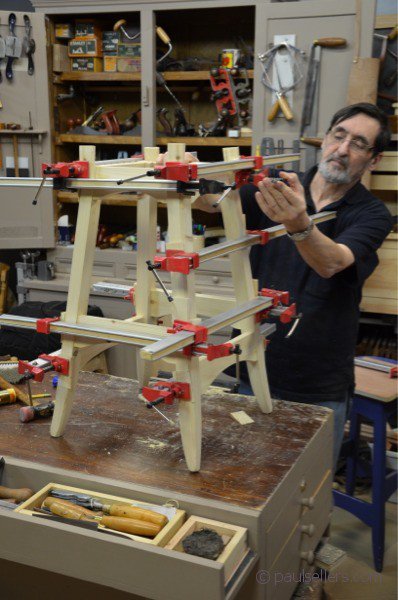
This was my first ever customer under my own steam. If you use dry and well seasoned wood, the right sizing for the joints and also traditional joints, there is usually little to go wrong. That’s the stool we made on woodworking masterclasses two years ago above. Admittedly I didn’t have a family to support at that time, but there were other obstacles facing me—no vises, no clamps to clamp the joints, the risk of not getting paid, buying my materials, no real oilstone but a broken chunk of one. It taught me that a craftsman doesn’t wait for ideal circumstances to start their business. I’ve learned something else too.I have made many things I didn’t know I could make and so I did it. I recall when someone asked me why I had made a cello as my first bowed instrument. I told the violinmaker this; “I didn’t know we couldn’t do it so we did it.” Joseph still plays the cello today, nine years later.
If you want to become a lifestyle woodworker there is nothing to stop you. It might happen overnight and it might take a few years, but there is one thing you don’t want is to live an unfulfilled life. Dreams do cost you, but once you climb over your fears and doubts it’s a wonderful thing to enter the fray and become something you only ever dreamed of becoming.
Comments ()