
A Thought in Design Concepts
Someone asked me to write about my past works and I am reluctant because I have no decent images of what I made nor pictures of me making what I made. I am a dinosaur from the pre-digital era. If I go back too far, say the 1970’s and 80’s , I have almost no photographs, and the ones I have are now stored in Texas in the USA. In the next lines I will describe making a chest of drawers I made and eventually to a man in Houston. I will describe my doubts and my emotions and try to express something you and others might or might not understand. It's a series. Too long for one post given my always ever-diminishing time.
This piece is a piece I made and sold to a Houston lawyer; for his boardroom centrepiece. It's not a large piece, quite diminutive for a Texas lawyer, but it had punch and spoke much about Texas wood so few can ever understand because it's unlikely they will ever see it or know it as I have. I lived in south Texas when I met two men who were cutting mesquite trees and milling it into boards to sell as rough sawn lumber. These two men built my first USA home for me and were both carpenters cum timber saw millers at weekends. I regularly bought mesquite wood from the two men over the first months when I arrived and one day they came to me bright-eyed with a truckload of “something special.”
It would be hard to describe the wood without you thinking I was exaggerating. I don’t know if I could ever find such quality again. As we stood and examined the woodcut it was as if I invaded their excitement, got caught up in it and found myself twirling with them. I think that it was the first time I had seen two adult men, basically cowboys in the true sense of the word, who for the first time in their lives felt the extreme heights of discovery that was no different than those discovering the redwoods of California or the mahoganies of South America. My hands slipped quietly over the poser covered boards and the intense cat-claw figuring popped and popped and popped in 3D reality as I uncovered the grain beneath. Back then I [paid $2 a board foot for mesquite if it was nice and of course ot was always nice. The rough sawn boards were cut to 1 1/8”, 30” wide and sequence cut through and through. The stack was burl or cat-claw for about 40” long and I could see would yield about half of what I saw in useable wood. They invaded my space and sense of discovery with a swift interjection of, “We want $6 a board foot and there’s 120 board feet here.” $720 was hard to come by for me but we cut a deal of half down and half when I sold whatever I made from it or pay up in full if nothing was sold in six months. It worked. I made 10 meat boards and sold them for a $100 each from the non-usable sections because they “Shure looked purdy” to everyone that came by the studio over the next few weeks.
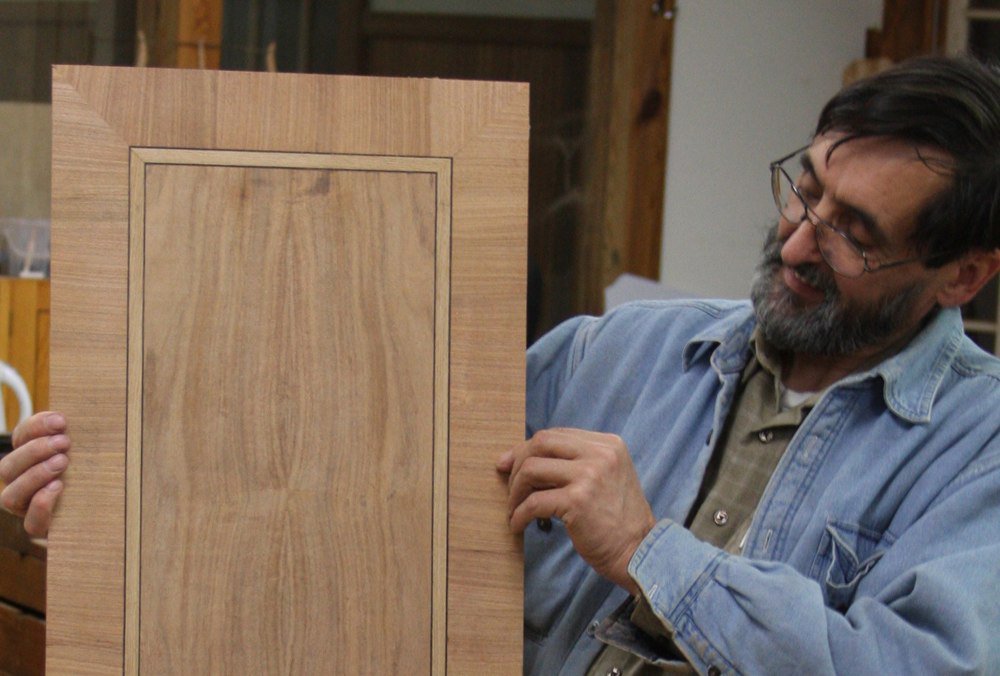
The wood had been dried in a solar kiln Bobby had and then acclimated in the Texas summer sun under tin. Mesquite is the most forgiving wood for drying there is. No other wood comes close. Distinctive features about mesquite is its canary yellow sapwood against the deep reddish purple brown heartwood. Even the sapwood was very highly figured and I was able to work some stunning centre book-matchings using the sap wood as the jewel in the centre. I have done this many times with this and other woods and it looks quite unique and lovely. Here below are some similar panels I used for the White House cabinets to show what I liked in the formation of panels but the woods shown in no way parallel the quality of what I had down in Uvalde and reagan Wells in Texas.
Mesquite panels made with book-matched centre field and skirted with an oak and ebony frieze and an outer band of mesquite crossbanding.
I continued the acclimation process for about a year under my carport where I stored other woods. it’s a mistake to use such wood too soon after purchase. Seasoning is something we have lost and most people call kiln drying seasoning but that’s really not what it is at all.
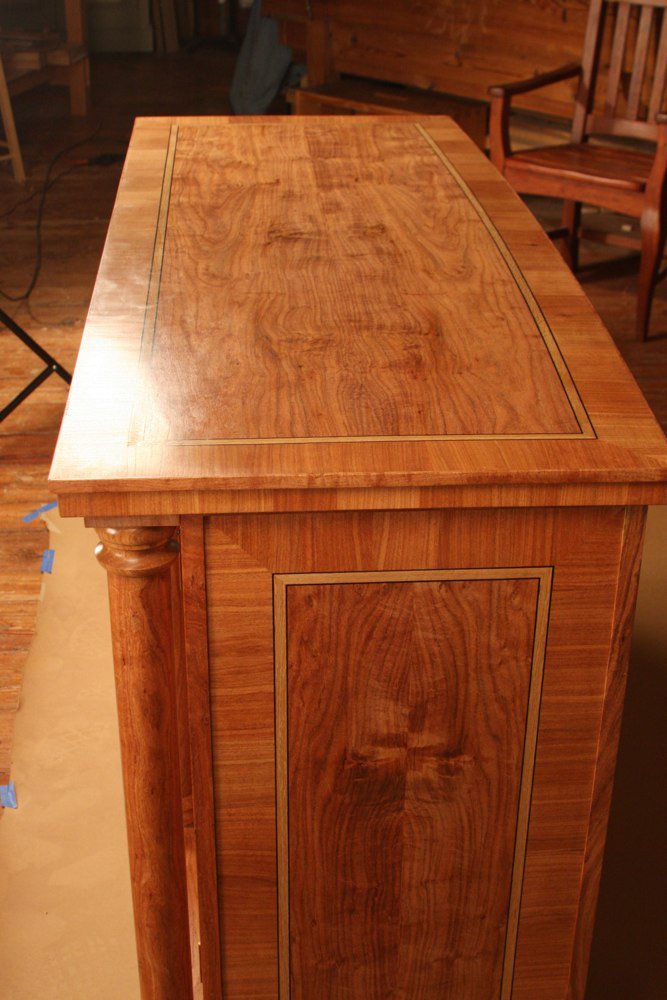
The White House pieces I designed and then made for the Permanent Collection in 2009
Often I would sit out in the car port and stare at my boards, pull them apart and stare at them. I didn’t want a commission piece to be made from them, I wanted to design a piece for them. I think the process often goes this way for me. processing the thoughts rather than the wood. making the thoughts fit the wood rather than the other way around. it’s something of a luxury to do this but it allows me to step outside of business and consider wood more than perhaps commission work does. All too often commissions have price limits and deadlines. making some pieces without a sale using wood no one else has ever seen allows a privilege to happen that can never be explained. I don’t say all pieces should be that way. Such things are the laughter and the joy that come periodically in life to separate joy from hardship so that contrast separates us from the monotony and the mundane to create spheres of happiness and to explore those unchartered realms of the unknown. Wood like this, and of course other precious woods are jewels where our mind explores passages over weeks and months until we plumb the depths as best this finite mind can and fathom hitherto unreached and untapped depths before we begin to consider how parts begin to fit together in dimensions of unity you felt but never knew existed. This was what happened when Joseph and I made a voice come from wooden parts in a cello we made. Your mind races as never before and your muscles and sinews flex and twist your arms and legs according to each beat your heart takes and makes and trembles for. The chisel, the plane and saw explore as no machine can ever explore. The rhythm starts like a fast pulse starts to pump and you embrace the straining conditions you might never otherwise embrace. And all the time this happens the wood is still; it just lies motionless, stickered in unconsciousness not knowing the plans you developing and forming shapes by every impulse in your sensing mind.
Comments ()