
Conical Sockets, Chisels and More
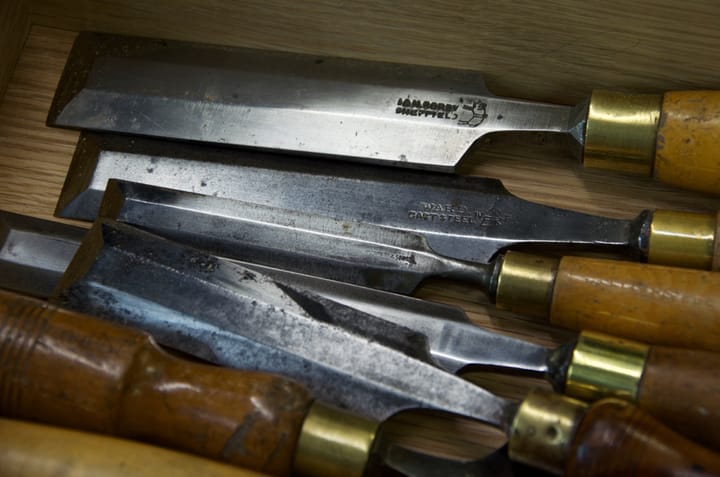
Something seems evident to me and that is that when I see all the old chisels made by people like Marples, the handles are always bonded by rust to the sockets and they take real effort to separate them. Something else seems evident to me too. The cone on this Marples is turned to fit straight from the lathe and stops short of bottoming out by 5mm. Notice too that the wooden cone fit so tight before bottoming at the entrance to the cone that it pared back the wood toward the shoulder of the handle. My suggestion here is that this handle was dried right down to the lowest percentage. When it was first driven on to the steel it could only tighten and swell into its permanent hole. The surface was rough-turned not slick and hard-polished, that’s evident. The gap as I said is the safety margin allowing perfected tightness. Neat, clean, effective.


I hear of Japanese chisels, that they use laminating blacksmithing techniques to fuse two metal hardnesses for strength and durability to the tool. It’s a tradition sustained in a culture passed down and preserved in its doing. Here is a chisel I own that’s laminated, laminated by a Sheffield blacksmith in the steely heart of England’s industrious revolution. Sockets were forged in two ways I know of. Some were formed by opening the red hot steel from a mass using drawing out methods and some were flattened and wrapped and then forge-welded where the two flanges came back together in the wrap. Laminating the hard to the softer but stronger gave the same durable qualities of a top-quality chisel. Isaac Greaves made this chisel sometime in the early 1800’s. You can see the line of lamination at about 1/8” at the points. A file glances of the steel on the flat face but grips the topside. The wood is immoveable from the socket. The hoop too is inseparable. Rust plays its part in both.
Hammer forged blacksmithed chisels rarely came out to the exact size and so, like most of those I have owned, this one measures 1/32” oversize. Engineers boast in thousandths, few of them can forge a chisel like this one.
I own sets of chisels that are at the upper end of expensive. I wanted to test them out over a longer period than magazines do for reviews. Magazine reviews are paid for, all be it indirectly, by advertisers advertising in the same magazines. Anyway, some sets are dangerous and have safety issues, others have buckled-edge problems and others fracture along the edge when you chop pine with them. Most old chisels have none of these problems and so too, I have found, chisels at the mid to lower end of the market. Imports too have changed from once producing unreliable chisels to more reliable ones. The steel striking buttons on chisels that enable people to strike steel on steel with heavy claw hammers – I’m not sure who these were made for really.
Comments ()