
Working Wood at Weekends
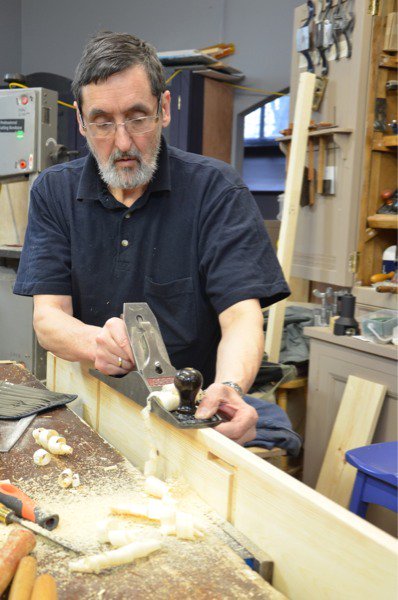
I think about people escaping their place of work on Friday evenings traveling home and thinking of the weekend when they can wear different clothes, pick times to work, what to work on do what I do during the week. It’s as much in the planning as in the doing. Thinking through the stages, weighing up the materials available, a trip to the lumberyard.
Saturdays somehow grab meaninglessness from the midweek workdays and translates us into depths of meaning we often can’t describe with words. The saw rips along thin lines with strong, intense strokes and the waste falls away. For me, I look at the kerf as I cut and see 1/2” travel with each stroke 26” stroke. The wood is 72” and so I make around 150 full length passes of the saw into the board. Then, a few minutes pass from one exercise period to my next. I lift the plane, the jack, and brace my back leg as I push the plane to start straightening the edge and soon the wood feels clean and straight and, well, lovely. I can’t imagine it’s easy to cram family life and woodworking into a couple of days but most people do it that way.
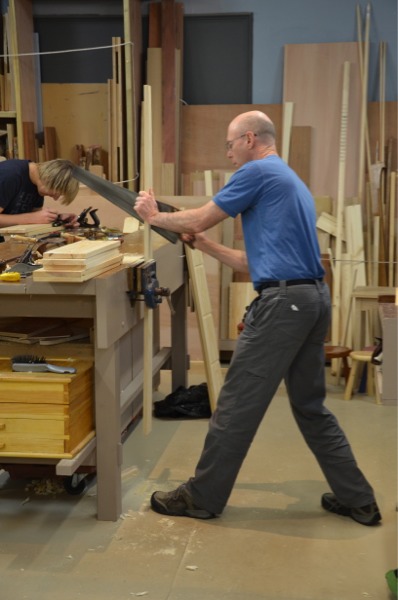
Woodworking with machines is really nothing like woodworking by hand. For the main part they are quite unrelated spheres unless you do what some are now calling hybrid woodworking. Bit silly some might say, but, really, I think that that might be nearer to reality than some might think. I see more and more woodworkers reaching for hand tools than ever before in the last five or six decades. The machines seem to have lost a little of their early 80s “power” and woodworkers started searching for a bit more depth, more skill and more fulfillment. There is a marked difference between UK amateurs and our US counterparts. If I ask ten students in the UK whether they have a machine set up, you know, planer, jointer, tablesaw, chopsaw, bandsaw. almost always, no hands go up and there are no nods. In the US it’s tended to be nearer the opposite. Many reasons account for this. The UK didn’t have its Norm Abram equivalent nor a New Yankee Workshop back in 1989. Machines never took off like in the US and, frankly, the UK magazines fell far short when it came to inspiring the new-genre woodworker. Space is more of a premium than in the US and of course there was no Woodcraft or Rockler chain of woodworking stores. I think US enthusiasm did influence the UK woodworking scene, especially some of the magazines, but other spheres too. It’s funny really, US woodworkers tended to look to the UK for aspects of woodworking while the UK looked to the US. On the British front we had John Makepiece and Alan Peters and in the US we had Sam Maloof and Jim Krenov. There were others, of course, but somehow these men breathed life into woodworking. They were able to impart something more substantive and had a staying power that gave others resolve to become more, question more and even achieve more. They seemed to see the importance of passing on what they had. I do think that people were supposed to go beyond copying their designs, but it did get people going in a new direction and that was important.
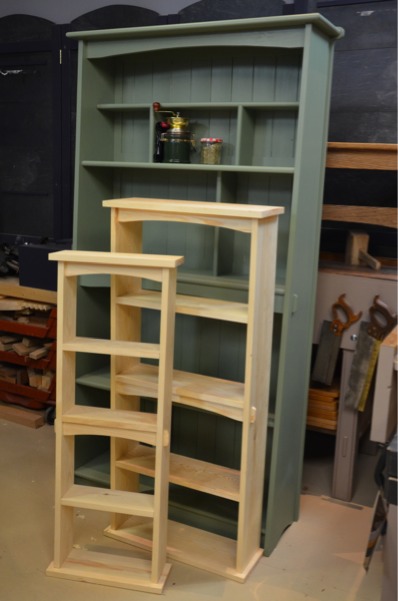
Today was a full day. The saws and planes scarcely stopped. I am on my final bookshelf unit. Tomorrow I return to the sapele tool chest I’ve been building and hopefully those in the nine-day class will begin making their oak tables. Confidence levels increase by the hour and even though there are some setbacks, the work keeps progressing so I feel content in what we are achieving.
Comments ()