
Saw Questions Answered
Question 1)
Hi Paul.
Recently bought two vintage saws on Ebay and after following your video on saw sharpening, work great. But seeing this post, I think there is a detail that escaped me. The cut of one of the saws is curved as I saw in one of your photos. Can you explain me how to solve this problem?
Answer 1)
The most common causes for this is either one side of the teeth caught something like a nail or screw, the vise or some other hard surface, and dulled the teeth to that side so much that that one side of the saw no longer cuts efficiently when the other does. Children often catch the vise, damage the teeth and keep on cutting. Another issue causing this curve in the cut is that the saw teeth are unequally set. This means that the set is unequal so the efficient and inefficient sides create an unequal cutting strategy and curves the cut. In the first case the teeth must be refiled until equal. In the second case you must remove the set using one hammer in the vise as an anvil and a second hammer to carefully tap the teeth between the two hammerheads. I recommend that you do both sides of the teeth quite gently and try the saw. Sometimes this still leaves enough set in the teeth for the saw to be used. Often this will take care of the inequality. If not, reset the teeth using a sawset.
Questioner 2)
Hi Paul,
I recently bought a PAX Panel & Tenon saw from ebay, they’re as new, not vintage other than the design and manufacturing process’s. I am looking to build a basic collection of tools to allow me to undertake and educate myself in wood working projects based on your DVD series.
Do you have any experience with these Thomas Flinn / PAX saws. They feel well balanced, and using the knife wall method, I have achieved clean accurate cuts.
Thank you for a wonderful website, video’s and blog, I have learned so much already.
Adam
Answer 2)
Thomas Flinn make fairly good saws using acceptable materials. Visiting their website is a little problematic as for the many saws and tools you don't see prices straight off the bat, which can be a British thing. By the time you get to the checkout you still do not know quite what you are paying so totalling up your purchases is not so easy. All the saws accross the range of makers are made the same way and are made the way the present day company makes them, which is more modern-day generic and indifferent to the original makers. The present people/owners bought the Thomas Flinn name and company and all of the other trade names they market their saws under as those original companies went under or out of business. So they have established their own saw making processes and call them by the names they bought. The steel and brass and wood are all good materials. The saws are a little clunky and undefined and definitely lack the quality and feel US makers have in their saws with regard beautiful shaping and finishing. This is because their end product pretty much comes straight from the CNC router with minimal manual work to refine the details and the shape. What they lack in terms of refinement, however, can always be done by you. Shaping the handles is an hours work even if you cut some Disston leaf patterns in, so you can end up with a good saw custom shaped to suit you if you don't mind a little sweat equity.
Questioner 3)
Hello Paul
I have 2 old saws that I think were probably left here when we bought the house (a long time ago) but can't be sure. I was thinking of trying to sharpen these and both of them have a concave curve on the cutting edge. my question is how to get rid of this curve and secondly is it worth it apart from practice at sharpening perhaps. One is a "Bishop" and the other medallion just says "Warranted Superior" or something similar. The "WS" one looks like it has been cut down in length and maybe the "Bishop"
as well as they are both just under 19 inches in length. I don't have a rip saw so was thinking of sharpening the "Bishop" saw to that pattern, not sure about the other one. Both the saws have really nice comfortable handles. I have attached a few photos so you can see what they look like.
Thanks again,
Richard.
Answer 3)
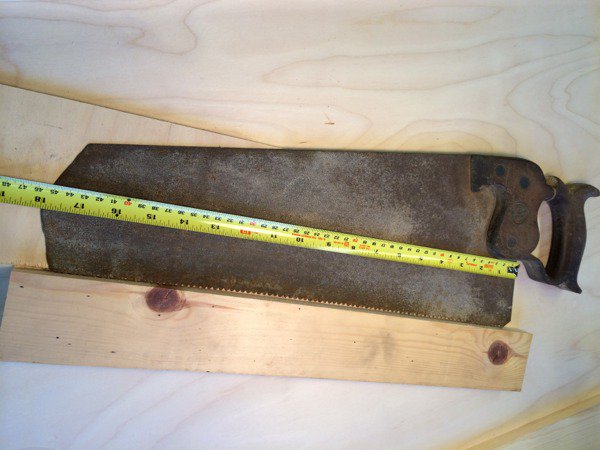
These saws would be good for practice and you will likely have usable saws but not pretty ones. Both look as though they have indeed been cut down which is OK. Sometimes woodworkers cut plates down if they want to fit them in a tool box or they were kinked through improper use or stood on.
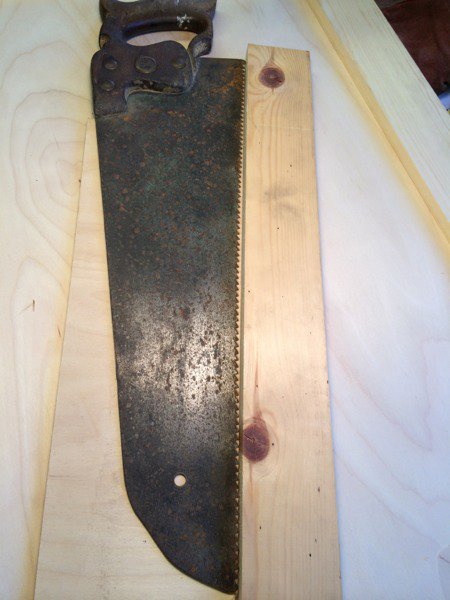
You can cut the plate down to neaten them up. I have saws 16” long that I like. The wide one with the double angled end here would best be cut down in width by at least an inch, the toe end squared up and skew back cut to the top edge from toe to handle. You must decide if this is worth it as you will need to recut teeth and sharpen. If you do make the saw smaller as suggested I would shoot for 10TPI as a tooth size. The other saw too will need reshaping if it is to work at all well. A metal cutting bandsaw will do this effectively as the plate will not cut well with shears.
Comments ()