
My Creative Workspace Works
I Coined the Phrase 'My Creative Workspace' for a reason. I felt that because of machine industry giants and the machine-only culture invading our lives over several decades, we lost the significance of an inner eco-climate environmentally dedicated to hand work and hand tool methods. We indeed lost a culture. This advocacy almost destroyed those elements I considered critical to the wellbeing of craft and the art of handwork. Today I see light at the end of the tunnel. It's amazing to me today to see so many embracing much of what almost became a lost art. No, it is not merely some notion of nostalgic preference. My work in my blogs will show that. I am interested in progress as long as it considers the well being of people in their workspace whether that be at home or where they earn their living from. Culture has indeed shifted and it's culture that defines who we are, what we say, how we dress and what and how we make. The future is critically important to all of us and to the near generations born to replace us as crafting artisans and not machine parts pushing buttons. Therefore, no, I am not looking at many professionals working in woodworking as the standard to attain to to, emulate or indeed use as role models. I am looking at you; gifted and caring amateurs who pursue their passion to master skill and become creative woodworkers in your own right. Today I think we have a sustainable alternative to what was developing and we should continue our research to develop growth and pass it on.
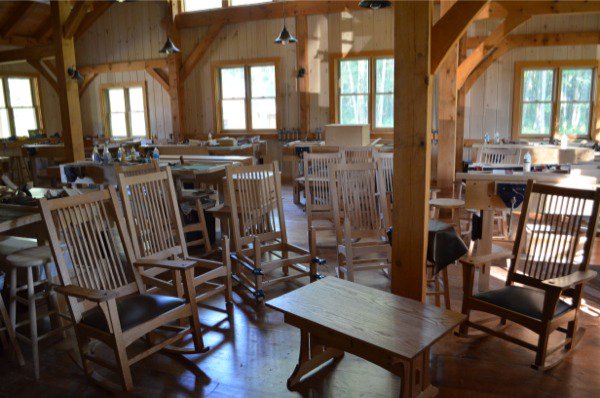
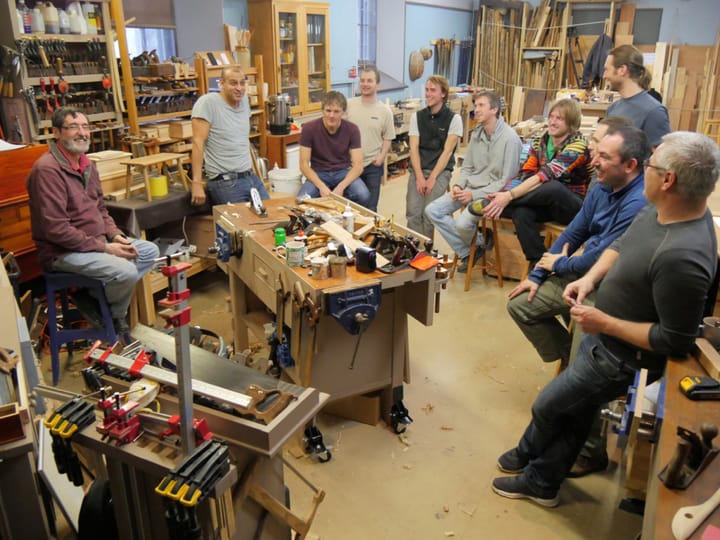
The picture above shows the results of a month-long workshop and what happens when you share your creative workspace with others for a season.
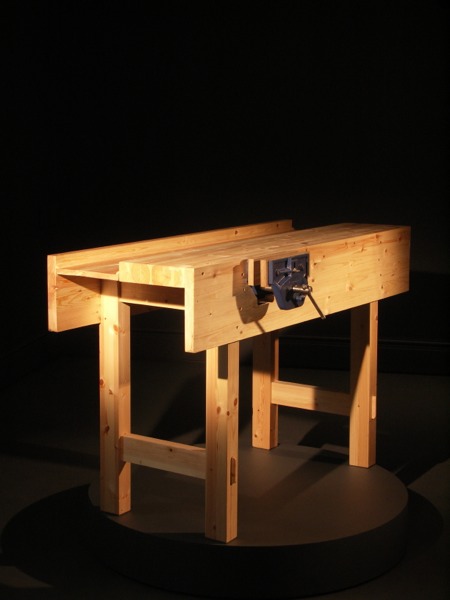
Through the years I have developed many workspaces from scratch, constrained in almost every case by four walls but mostly by the sphere of my own limited form. For hand and machine woodworkers using hand tools they anchor is always the workbench and I have blogged extensively on this here. Using the workbench ad relying on it for multi-tasks soon becomes automatic. In almost all cases the bench gets shifted incrementally to a position in the shop where it relates to everything around it yet never denies its supremacy to all in its centrality. The inch-by-inch shunt and shove sets the position to several key elements, predominantly the tools you work with and the support materials that we use in the making of our projects; glue, sandpaper, nails and screws, pens, pencils, paper and patterns. Depending on the space we have. These elements are best positioned near to but not crowding the place we work in. Many are surprised to find that in my home shop my creative workspace is a mere 8’ x 12’ space with a ceiling only 7’ from the concrete floor. My wood is stored between the ceiling joists and my machines are on home made dollies that move easily in and out of play as needed. In so confined a space I use these very minimally because of the dust they create. If I could I would separate these machines from the space I work in, but I still perform most of my home work to hand power even though the machines sit there inactive.
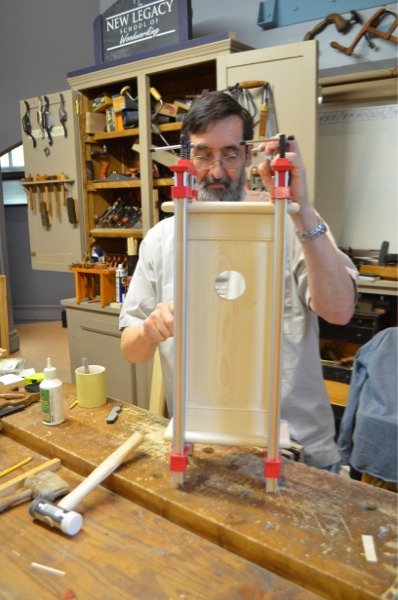
In the Penrhyn Castle workshop where I do most of my daily woodworking I am restricted by my personal sphere of limitation. I have created elements that work for me and improved them as I developed them. Shelves, tables, tables on wheels and cupboards all house my work, my equipment and of course my tools. In New York I have the same elements and wherever I have lived I have had something so similar to what I have now, most would scarcely see any difference.
Many have criticised me for having a drawer on the work-side of my bench. Claiming the inconvenience of clamped stock in the vise sufficient reason for not having it there but somewhere else. But for me, the occasional irritation is like swatting a mosquito in relation to the created universe around me. The nuisance factor is so minimal I put up with it and get on with it.
Some criticise my aprons on the bench being so wide you can’;t clamp stuff to it. Of course you can and you can do this very simply, quickly and effectively. When you do. the work is rock solid. Some criticise my not having dog holes in the apron and legs. If I found need for them I would do it. frankly, I never saw dogs used in aprons and legs until more recent years and no one I ever worked with anywhere ever used them. So I find little need for such things. My vise will hold everything. I don’t mind a little slippage that needs vise adjustment some times throughout the day. Usually that’s my fault for not tightening sufficiently at the get-go and not any flaw with the vises I use. I like the freedom a bench unfettered gives me in my work. I do like some other workbenches too, but I have found what I like and what works best for me. I hope others will discover the simplicity of the bench.

When it comes to bench dogs I do understand that people like pulling out useful dogs and holdfasts. The best holdfast in the world was developed by Joel at Tools for Working Wood. Its a pristine piece of equipment and had I one here in the UK I would find a spot for not simply because it is so nice to use but its simplicity as a single piece tool has a beauty all of its own. If you live in the USA or Canada, get one. You won’t regret it. I used to own a Record holdfast with the screw-down mechanism but I didn’t like it too well at all. Someone gave it to me and I kept it around. As anyone knows who knows me, I rely solely on a clamp secured in the bench vise for my working. The blogs I have written show different situations for all around woodworking using this type of mechanism. Now here is a thing. If someone were to develop a clamp-in-the-vise system with simple apps they could really have something.
I think this thing is important for us all. I will be adding more soon.
Comments ()