
Perfect Benches Revisited
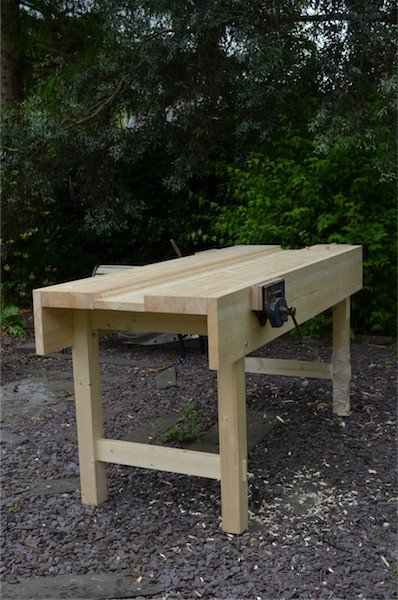
Perfect benches do exist and usually they are made by, designed for and married to their maker. I think many longer term woodworkers have made more than one bench before finally arriving at what suits them best. I know I have. In designing and making my workbench I arrived at several junctures every decade or so along the way that made me rethink how I worked and how I wanted to work. My age, strength and work needs shifted bit by bit. I became more direct, stronger, more demanding and more precise in my work. My conclusion today leaves me with the reality that owning three benches works well for me and I enjoy the luxury of having three whenever this is possible. One thing I have also concluded is that I do not need a bench lower than 36-38". Owning New Legacy School of Woodworking has many plusses not the least of which is that I can move around the shop as needed, pick up and use tools at each bench and take advantage of light, bench height, position and so on, but therein is another reality, which is that most of us don't have time or space to build and accommodate more than one bench. So, in all of this mulling we most of us find a one-size-fits-all bench and suffer minor discomfort at different times during the day. My personal benches are all 38" high and I didn't establish it by bending my wrists or finding wrist creases, I have never found that that works at all well for most woodworkers using conventional methods and tools and equipment. Perhaps it does so for those very few who advocate one particular way of working wood with planes. Experience and teaching has taught me differently.
Vises give adjust-a-height delivery
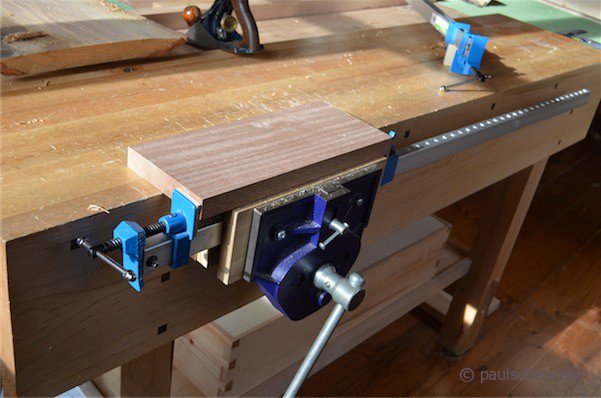
Another influencing factor is whether we use vises to their maximum efficiency. The bench vise is seldom seen or should I say described as an adjust-a-height feature in the bench consideration and so this piece of equipment is seldom included in the equation. The bench height is of course the lowest point that can be used and so adding height is a question of rising above that height and this is why we use vises so much. The vise is as much for adjusting height and presentation to task as it is for secure fastening stock with speed and efficiency. I believe people are working more on benchtops now than ever before because this is mainly what they are told is the norm for planing yet throughout my life with older mentoring craftsmen that trained me, almost all work was definitely held in quick release all-metal vises. These vises replaced old fashioned vises because they were so efficient and strong. They will hold just about everything, which is contrary to the message sent out a few weeks ago in a Popular Woodworking article.
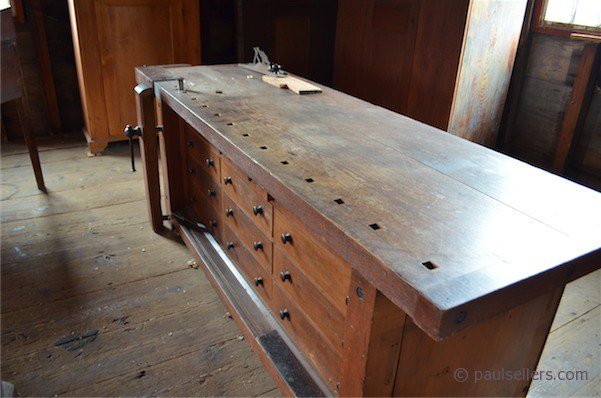
Using the benchtop only means you must generally work at a fixed height. In this I see a dividing line even though I use both the bench top and the vise. The bench top of course supports what will not fit into the vise and therein is the dividing line for me. Ninety percent of what I make is made up from small components as can be seen from my online broadcasts, films and photographs. It's so infinitely practical. Thin and wide stock doesn't work well in the vise and so it must be supported on the bench top using dogs, clamps or holdfasts. These are my alternatives when all else fails.
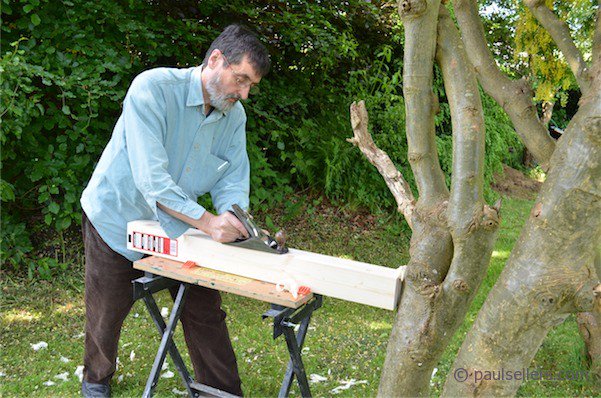
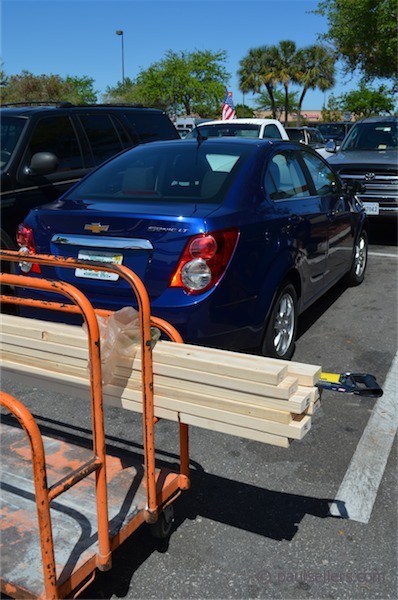
I have used the term 'Perfect bench-build' not because the bench itself is so perfect, even though I think for me and my personal needs it is, but because it can be build by just about anyone at almost any skill level using only about ten hand tools, a saw horse or workmate and two clamps. Most of the other benches I know of or have built have complexities to them that make them prohibitive to make and indeed quite intimidating. If there are any benefits to them I have yet to see it, but if there are, the difference would be so marginal it is not worth the massive extra to build them. What made my bench nearer to perfect for me was that you could walk out of Home Depot or Lowes with a carload of wood for under $80 and have a bench made in 30-40 hours. The next day you could install a vise and be working wood for fifty years with no need to change it. On the other hand you could make a more fancy bench suited to your ambitions using the joiner's bench to do so.
Comments ()