
Questions answered - Vise mounted proud of bench
The questioner has a question that comes up all the time:
Q:
Hello Paul,
I really enjoyed your bench build project and I recently bought your book which I can highly recommend. Anyone who is interested in woodworking who did not have the advantage of an apprenticeship with a cabinet maker should get a copy. Even woodworkers who have years of self taught experience can learn something here. You do not waste time on things discussed elsewhere you get to the real deal fast and clearly.
I have a question about the positioning of the vice in the bench build. No doubt there is a very good reason for this but since I am slightly puzzled perhaps I am not the only one.
I noticed you mount the vice so that the rear jaw stands proud of the bench apron. Other benches I have seen mount the rear jaws flush. I can see that mounting the rear jaw flush allows for the use of an extra clamp at the other end of the bench for holding long boards. If the vice is mounted proud you will need to use a spacer block to clamp against the face won't you? However it may be that there are other far more important reasons for doing what you did. I am keen to learn about them.
Regards,
Gerard
A:
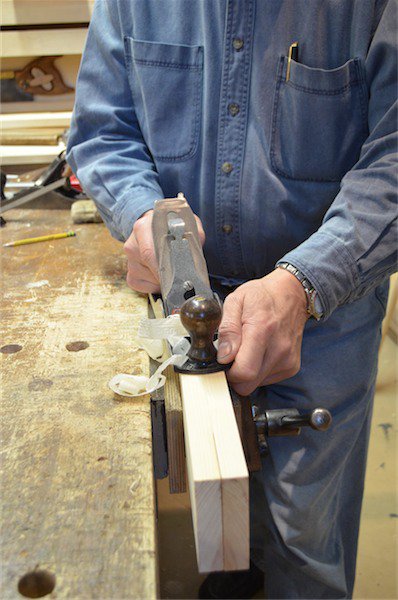
Well. it was not common to have the vise flush on traditional joiner's workbenches because more stock is sectionally square and short. Leaving the vise proud the thickness of the jaw and then adding the jaw lining means that you have room for the hand to grip the wood and place it in the vise with a comfortable overhand grip and clamp the wood with the right (dominant in my case) hand.
Someone at the wood show last week questioned me on this and then went on to tell me how he can clamp full length to the bench top when it's flush. I told him I had used this method all my life and never had a problem. Bit like the time someone asked why I had made a cello as my first ever instrument because it is one of the hardest instruments to make. I told him I didn't know I couldn't do it so I did.
Left, you can better understand that here I have two pieces of wood i want to plane the edges of at the same time. iIf the vise face was flush it would be more difficult to hold the two pieces flush at the edges and hold them in the vise with a side grip. I can set this up in a heartbeat and keep both pieces fully aligned with one another and parallel to the benchtop surface. This is the common work and comes up a hundred times a day. Planing the dge of a panel needs no support with the Woden or record type quick release vises I use every day. I made two doors for the Castle in North Wales and clamped 8' stiles of 2 1/2" 8" stiles in the vise with no problems. I think it is funny that people think this to be a wrong method when it was the most commonly used and most practical application of all. Try a retrofit for a week. Screw a wooden jaw to the existing flat face the same size as the opposite vise jaw lining. Make it 1 1/4" thick, enough to receive the palm or fingers of the hand. Just try it. Then if you want both you can always unscrew the one and have the other.
On the road to Indianapolis for the next Woodworking Shows' show . Traveling along Lake Eerie.
Comments ()