
Bench making question
NOTE:Just so you know, Paul has a newer Workbench series. If you are interested in the updated version of Paul’s workbench please click the button down below. This page links to a cutting list, tools list, FAQS and much more.
Click here to go to the workbench page
My bench-making videos and blogs have stirred many, many questions worldwide and are indeed challenging the woodworking world of mis information to simplify what has always been simple until the interconnecting worldwide web of fractured information. This has fascinated me in that we have managed to resurrect what was probably the most well used woodworking bench in Europe. A bench that was almost lost in this ever fracturing and disintegrating world of global economics. Locally, this bench was used in every joiner's shop in Britain. Cabinet makers (UK furniture makers), boat builders, joiners and carpenters relied on this bench and made ninety-nine point nine of them from softwoods such as spruce, pine, fir and so on. Was that because we didn't have hardwoods? Of course not. Pine was the premier wood. We had all kinds of softwoods from the USA sent over as ballast and stock rather than empty ships....
Q:
Hi Paul
For the bench with two tops and well in the middle, how do you get the two tops to be flat and at the same level as each other, or doesn't it matter? Do you get one side flat and free of wind and then use winding sticks to transfer it over to the other side? Do you somehow figure out which side is the "low side" and do it first? I'm definitely going to do the one-side bench so I can learn to walk before I try to run, but am curious and maybe it will help people more advanced than I am.
A:
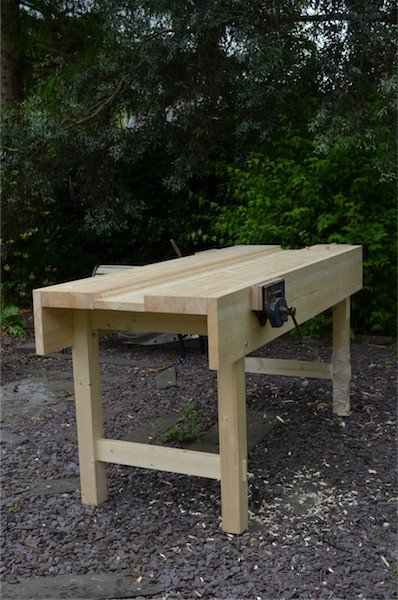
I wanted to at first say this may seem to complicate what's simple, but that's not true and would seem dismissive of a genuine regard for discovering the truth. Firstly, we do plane the underside of the bench top to make it dead flat and out of wind and so we used the winding sticks in the video to make sure they were flat and without twist. Surprisingly, doing the same to the opposite face will indeed most likely create a parallel face too, but there is no guarantee without measuring the thickness because of course it could be out of twist but out of parallel too. This then means measuring or gauging the thickness with a marking gauge to establish exact thickness. Alternatively, you can secure the two bench tops and use winding sticks over the whole. This works well too and you will be surprised how quickly the two sides can be levelled even with a #4 Stanley smoothing plane. I have found that levelling and truing takes les than 20 minutes even in a bad case scenario, so I say do not worry. The most important surfaces are indeed the undersides of the bench top sections because if these are twisted, so too your bench will stand twisted on the legs and you will need to shim one leg. It is important not to make a twisted bench because what you make on it needs to stand or lay flat.
Comments ()