
Questions on diamond sharpening methods, stones and plates
Question:
Hi Paul,
I bought your book recently, having never done woodworking before, and have very quickly gotten very confused about the act of sharpening.
First of all, I figured that diamond stones would surely be pricier than oil or wet stones, but unless I'm looking in all the wrong places, they appear to be of a similar price! I had hoped I could find a cheaper set of equipment to start out with, since my budget is limited - are there ways I can get started with sharpening for cheaper than these diamond and wet/oil stones?
Second question: the wet stones I saw seemed to list 8000 grit stones as extra fine, whereas diamond stones list 1200 as extra fine - what's with the differences?
Third question: you wrote in your book about stropping with a 15,000 grit compound, and how critical it is to keep the bevel at the appropriate angle while stropping, which makes it seem a little fragile to me. Now, obviously I'm not the expert, but when working with stuff that fine I would have thought that the first few cuts you make with the chisel or whatever would bring the edge back down to a level that would make the 15,000 grit stuff a little over the top, wouldn't it?
Last but not least, would I be able to get by with only using two different grit sizes instead of the three you use in your book, and if so, which sizes should I use?
Thanks,
LM
Answer:
Hello Luke,
Different sharpening stones and plates
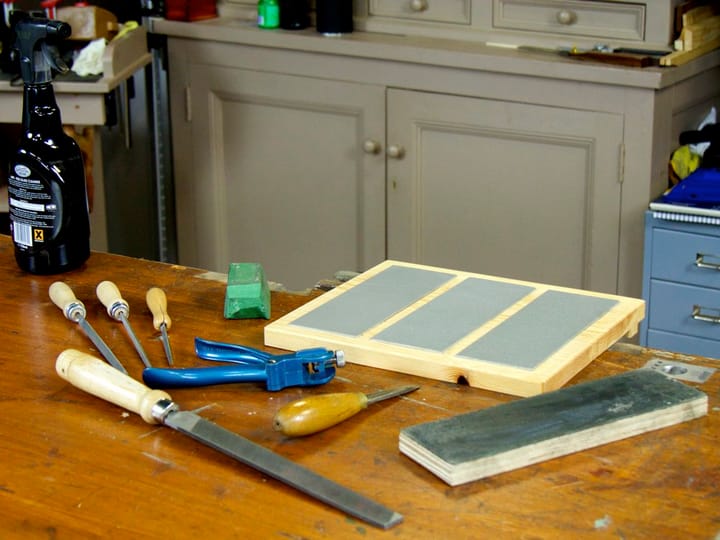
I and many others abandoned different natural and man-made stones to adopt diamond plates for three main reasons; they last long, cut fast and stay dead flat. Over and above that they are cleaner, less messy, more convenient.
Two sharpening plates or three?
With regards to two stones instead of three. I started with three stones and then went to two only myself. A cost factor at that time. I felt then that I spent too much time on the fine stone and of course that stone wore down more quickly. I went back to three around ten years ago and never switched from what I had.
Are cheaper stones any good ?
Now as to cheaper stones. I have found that 1) Cheap stones scuff off the diamonds. 2) The particle size is greatly varied on most cheap stones. The deep scratch marks are hard to remove and translate into a blemished cutting edge. There are only two makes of diamond sharpening plates that I can recommend for long term usage. EZE Lap and DMT.
Is the 15,000-grit edge more fragile?
No, the edge is strong and long lasting because of the convex bevel that 'backs up' the cutting edge. We are not talking micro bevels here because I never use micro bevels because I found I returned to the stones much more frequently. Micro bevels are very different t secondary bevels. I would recommend a 30-degree, singe bevel over this but a wider macro-secondary bevel would work great too. It's more a convenience thing for me. I can sharpen a chisel in a few seconds if I do not use a honing guide even though I appreciate honing guides guarantee exact grinding and sharpening angles. I also advocate mastering the convex camber method because we use the round so much for other aspects of work such as creating coves, creating hand cut arches and much more. This enables the bevel of the chisel to ride the concave being worked much more smoothly and very efficiently. So, no, the cutting edge is not fragile at all. Typically I can chop 30-40 mortise holes 4" long x 1 1/2" deep by 3/8" to 3/4" wide in oak without sharpening. Using my method to resharpen takes no more than one minute and then I am off again. It works and has worked for almost 50 years. I have trained myself to do this and it is very much a system that works. Also, the reason I mention keeping the same bevel for stropping as grinding and honing is that students and those new to sharpening tend to feel they should hone at a much higher angle and even roll the chisel edge into the strop. This does nothing more than dull the edge and cannot sharpen it.
Stone fineness
Re fineness indexing on sharpening stones and plates. It takes me thirty stropping strokes on the plane iron to go from 1,200 diamond grit to a 15,000-grit polish. I want to keep expense down to a minimum for everyone and of course manufacturers would like you to buy ten stones in between 250 and 8,000. I suppose I am saying I find the finer 8,000-grit sharpening plates unnecessary.
Hope this clarifies things for you and others. I will post the answer and your question on my Q&A blog.
Best regards,
Paul S

Comments ()