
Why not mallets - myths busted again!
Why did I revert to metal worker's panel-beater hammers instead of traditional mallets?
It's dead simple. My goal is not the preservation of the traditions but the craft. That my goal just happens to do both is a great coincidental for me, generally speaking, anyway. So the traditionalists cling to their traditions and exclude modern developments that are as equally inspired to us today as those were to men two and three hundred years ago when their ideas were innovative and new and rejected even as heresy.
I have used and still use wooden mallets in my immediate work. I like them for some work and find them unsuited to others. Modern day manufactured wooden mallets in general are wimpy and ill-designed apologies for what once was. My own hand-makes are not. I have yet to find a commercial mallet made in the last fifty years that wasn't underweight and thereby none productive. Those touted and sold as beech mallets made in Europe are generally this type of mallet. That being so, making your own becomes the only option. A good mallet needs a 3" x 4 1/2" x 7" head. Hard maple works well, Bois d arc (osage orange) and many others too. Where do you as a new woodworker find these sizes in suited woods. Not so easy. Now my goal, and not all people feel this way, is to get people to the bench working the wood and not encouraging them to buy my tools or anyone else's I am in the pay of or to get them to become tool junkies and procrastinators spending too much time talking and admiring the new generation of guru followers. So, at the risk of criticism, I find things, alternatives, when necessary, that really work and then give out my unbiased results. This is not meant to be cute or clever or in any way controversial, but inevitably things can become controversial. There are excellent products out there made for every level of demand and price. That's positive, I think. On the other hand people getting into woodworking need some guidance and if you open a tool catalog and see fifteen mallets to choose from, questions like, "Arghhh! Which one do I choose?" need some kind of definitive answer. That's where I come in. I have used them all. Name a saw, a plane, a hammer, a chisel, a mallet, a gauge, a knife and I have used them at some time recent or past. So, in my quest to counter the culture group analytics, I present a simple alternative as an immediate solution to get stuff in the vise and made into projects. It works, and it has for the whole of my life. People don't always like this offering but I do always listen and care about what people say and think if they are open and honest rather than snide. If they can persuade me differently I will shift and represent something better after I have considered the elements by which we at New Legacy evaluate tools and their worth for our audience. Back to hammers. Where possible I want something anyone anywhere can walk into a store to buy. In the case of chisel hammers, well, they have gotten somewhat fanciful through the years. Cutish too. It's inevitable that makers and users want to create something with a distinctive, set-apart style to be admired. Go and try to buy a simple claw hammer and there are three zillion of them in Lowes and Home Depot. Gone are the old 16oz Stanley claws and so too many others. Ergonomics gone wild so we can beat a sixpenny nail in in one blow.
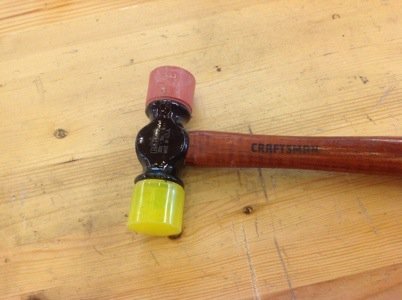
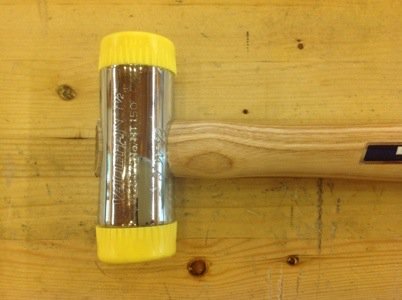
The hammers I have used over the months and years deliver the goods. Weight ratios and balance are more critical and so too the centre of percussion (COP) that provides economy of movement and power. I find that with large face mallets, new woodworkers seldom find the COP, which is often an outer corner and not dead centred in the mallet head. Getting it wrong tilts the mallet, glances the blow and frequently twists the chisel from its course, especially in say mortise holes for instance. On the other hand, the smaller heads hit squarely and more accurately for a reason I cannot give. Most of my students have no difficulty using what I now call chisel hammers to chop and chisel with. Most of my recommendations are available from any store and they cost mostly around $15 for a lifetime tool. I want what's best for my readers and students. They know that I think.
In concluding.
I think everyone should make their own mallets. Make two or three for their own use as I have. Two of my sons have owned businesses making mallets that were highly prized. They find it well worth the effort. Someone could make a good living making hard maple mallets and a none fanciful model I received as a boy back in 65 when I made my first mallet
Comments ()