
A response that might help
Hello Brendan,
Firstly let me apologise for the length of my response. Thank you for taking the time to write. I want to respond to your comments because I think others might find this subject interesting too.
I feel I should make no apologies for my working with hand tools; it’s who I am and what I do. I no longer try to justify myself to others for choices I consciously made in becoming more a lifestyle woodworker than a businessman woodworker.
Being able to readily switch between hand and machine equipment use because I have mastered lifelong skills in hand work is important to me and I want to help others have the same options with equal dexterity. I in no way I have ever shunned the use of machines. Using machines, as I said, needs only minimal skill, but more a working knowledge mostly revolving around personal safety, the safety of others and the probability that if something does go wrong, and periodically, on a somewhat regular basis it does and will, I will ruin my wood. Understanding this takes only but a few minutes. It's an unfortunate reality that many often learn mostly by near misses and hits no one wants to really talk about. As I say, machines merely displace skill, but they are good for grunt work and also substituting for developing skill and accuracy that anyone can develop if they want to. For dimensioning stock to size accurately and fast, machines have no equal.
As I said, I want to respond to your comments because I think it’s important for people to understand how and why we think the way we do. You are not the only one that wants to take issue with me and you won’t be the last. As a fulltime lifelong woodworker I don’t occasionally use machines, I use them most days, but not all day as is the case for most of today’s woodworking machinists whether professional or amateur. In the past I have spent many long days, weeks, months and even wasted years using machines all day long. Many years ago I chose to climb down off the conveyor belt and discover a more balanced approach. My time now is to help others to do the same.
My blog is never some kind of embarrassing confession but more what practically works for me as a result of having established skill early on in my woodworking life. I am simply letting my fellow woodworkers know from time to time that if they think I don’t use machines they are misinformed by assumptions and not by me. I have no issues with people using machines, simply that if they don’t master hand tools and the skills and knowledge it takes to use them they are robbing themselves of something very practical and many things they will not be able to do without living behind dust masks, eye protection and so on every time they do work wood. They must live in a sphere of self-protectionism and even isolation all the time and they will never find the levels of fulfilment others have in their mastering hand skills. That, for me, is not a small thing. Healthcare is a major concern throughout machine woodworking and especially to amateurs with minimal time to find recreational fulfilment. This is I think partly your point about the risk of, as you say, “maiming oneself” if they are not “acquiring sufficient prowess with a router or a tablesaw.” I am afraid I take issue when anyone says that “tools ARE machines….machines are tools.” I realise that this is opinion-based, but renaming machines as tools was masterminded in the US 40 years ago. You can never persuade me that they are coequal in value or purpose. If a machine cuts a dovetail with jigs and specially devised bits, then the machine did it not the man pushing it through the slots to take away the risk and guarantee the right angles, slots and spaces fit. The truly creative person in all of this is the engineer who devised the whole machine and jig system.
There is of course much more to both worlds than meets the eye. Most people today, as I said, live in a sort of nether world, avoiding the development of true skill because they are told, “You’ll never master skill; it takes years to learn hand tool woodworking.” For me there is no competition, but I can make choices most others cannot make. I see people very experienced with routers use them to cut dovetails knowing they have never been able to truly master dovetailing by hand for whatever reason, but usually not having been taught proper methods. The process of setting up a router for so simple a task sidesteps the simplicity anyone can have and seems quite retrograde. That is not in any way condemning at all. It’s a shortfall within this present culture promoted by protagonists of the machine-working world.
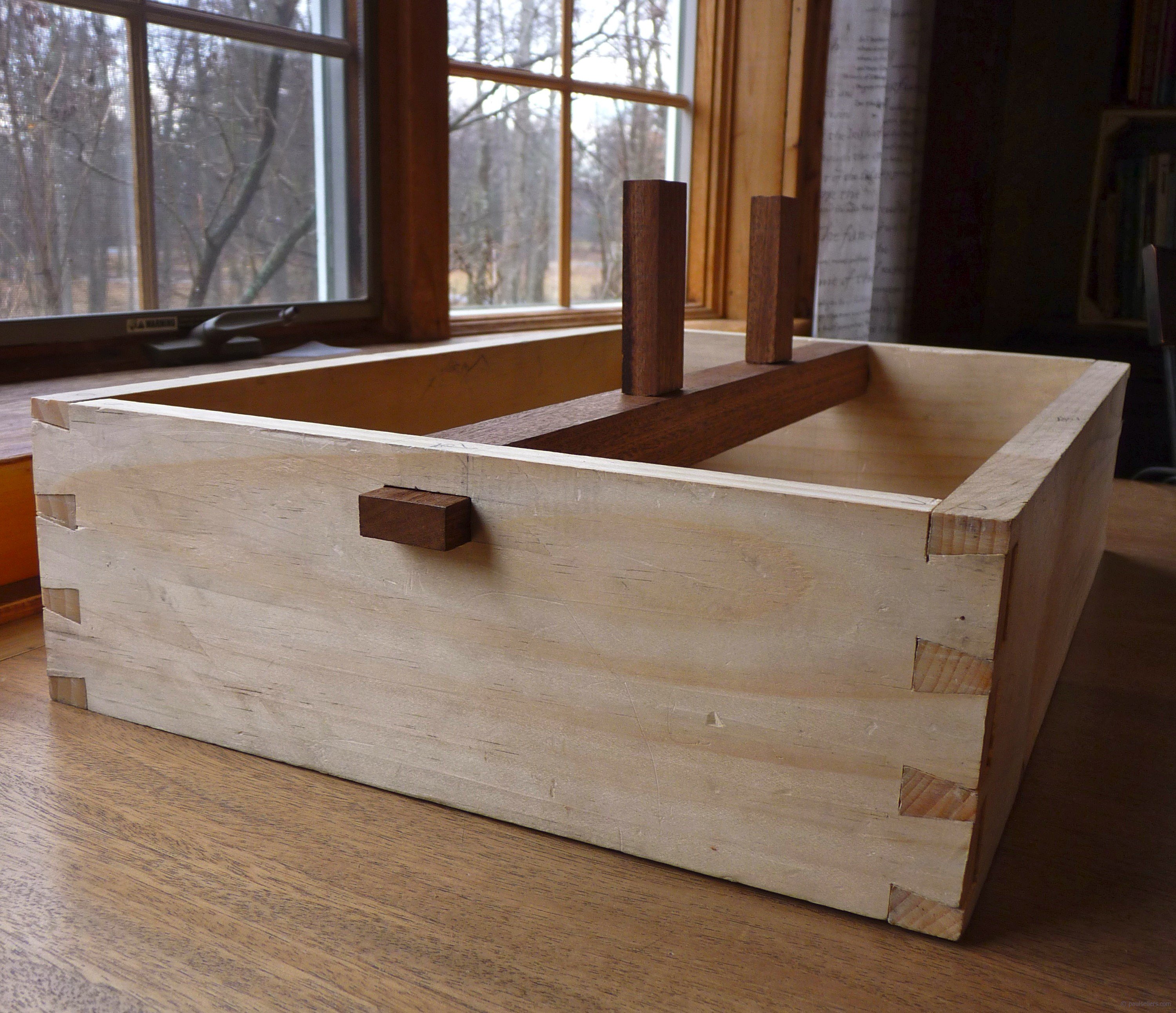
I ask anyone this. Had I been a machine-only woodworker, would I be able to responsibly put a ten-year-old on a power router and have them make a dovetail joint like these shown here? This is the work of a young boy barely ten years old. On his tenth birthday he was making this dovetailed project following my program. Indeed, these are his first dovetails in a project after some very basic practice to understand the concepts of dovetailing and creating mortise and tenon joints. Had no one the skill to pass this on to him he would have had to wait until he became of age, about 18 years, to begin his woodworking interest. How did this happen? Ten ears ago his grandfather came to a series of hand tool workshops and perfected dovetailing by making the Shaker candle box in my course. He made other projects not the least of which was a Craftsman-style rocking chair. After the course he went back to his hometown and shared his newfound knowledge and skill with his son-in-law and some friends who than adopted hand methods of woodworking too. His son-in-law then taught his own son when he was of an age to receive it. This would now be ten or so years later, and this is the boy that made the tool carrier above. Needless to say none of this would or could have happened had I not taught one man to work wood by hand.
Machine versus hand tool is not merely reduced to choice. It’s now become more a question of damage reversal. Trying to find balanced cohesion, integrity and more in the present world of woodworking can be very difficult, and this is especially so for new woodworkers getting started. Walk into Woodcraft or Rockler and you will always be steered toward a line-up of machines and so-called power tools; screw guns (drill-drivers), routers and such. It’s a question of re-evaluating the value of programs (dare I say it) to reconsider just what the true impact of new Yankee woodworking did with its free reign for so many decades.
I do respect your view and the views of others who feel the coequality of machines and hand tools, but it’s not an apples for apples evaluation. It’s unhelpful for me to be in any way condemning or disparaging, but I do simply stand by what I say and will never be swayed to accept that you need anywhere near the same levels of skill to work wood using machines. Neither would I ever accept that machines are tools. That’s far from true. Without repeating previously posted long-term posts on this issue, I will always maintain that a tool is the extension of a man’s hand, his mind, his energy, guidance and self-controlling power. He alone can master skill.
Comments ()